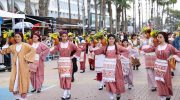
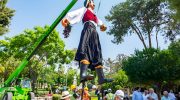
For a few days each year, the coastal town of Ayia Napa seems to loosen its grip on the present. Streets soften under banners and colour, music carries through stone courtyards, and spaces normally passed without notice begin to feel deliberate and ceremonial. The Medieval Festival of Famagusta is not designed as a reconstruction frozen in time, nor does it resemble a museum exhibition staged outdoors. Instead, it functions as a living cultural moment, one that uses costume, performance, craft, and architecture to reawaken the Lusignan era and allow Cyprus’s medieval identity to surface in ways that feel social, shared, and immediately accessible.
What makes the festival distinctive is how quickly it communicates its intent. Even visitors with little knowledge of Cypriot history sense the shift almost at once. There is no requirement to understand dates or dynasties. The atmosphere takes on the work of explanation, and immersion replaces instruction.
A Festival That Transforms History into Public Space
At its core, the Medieval Festival is a large-scale heritage event inspired by the centuries when Cyprus stood at the centre of crusader politics, Mediterranean trade routes, and cultural exchange. Performers dressed as knights, nobles, clergy, merchants, and artisans move fluidly through public spaces, while music, theatre, and craft demonstrations turn streets and squares into interconnected stages rather than isolated venues.
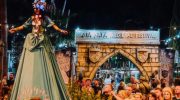
Although the festival draws its narrative inspiration from the medieval history of Famagusta itself, much of its contemporary programming takes place in Ayia Napa, particularly around the Ayia Napa Monastery and surrounding streets. Rather than weakening the historical connection, this geographic expansion strengthens it. The festival does not attempt to confine medieval identity to a single city or monument. Instead, it carries the story outward, allowing the legacy of Famagusta to circulate through modern Cypriot life and remain visible beyond its original walls.
Why the Lusignan Period Anchors the Festival
The focus on the Lusignan era reflects a deliberate historical choice. Between 1192 and 1474, Cyprus was ruled by the Lusignan dynasty, a period that reshaped the island’s political and economic role in the Eastern Mediterranean. During these centuries, Cyprus became both a strategic stronghold and a commercial hub, connecting Europe, the Levant, and North Africa through trade, pilgrimage, and diplomacy.
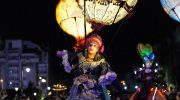
No city felt this transformation more intensely than Famagusta. Following the fall of Acre in 1291, merchants, pilgrims, and displaced communities redirected their routes toward Cyprus, and Famagusta’s port quickly became one of the wealthiest in the region. Trade accelerated, cultural exchange deepened, and ambitious construction projects followed. Churches, fortifications, and civic buildings rose rapidly, many of which still define the city’s skyline centuries later.
The Cathedral of Saint Nicholas, later converted into the Lala Mustafa Pasha Mosque, remains the most striking architectural reminder of this period. Frequently cited as one of the finest examples of Gothic architecture in the Eastern Mediterranean, it encapsulates the blend of power, faith, and ambition that characterised Lusignan Cyprus. Its presence helps explain why this era translates so naturally into festival form and why it continues to capture the public imagination.
Costumes That Tell the Story Without Words
For many visitors, the first impression comes through costume, and this is no accident. The festival’s visual language is carefully constructed. Outfits are layered, detailed, and socially legible, allowing status and role to be read instantly without narration.
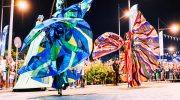
Armour, banners, noble dress, artisan clothing, and performance attire work together to establish hierarchy and movement within the medieval world being portrayed. Simply by observing who walks where and how they are dressed, visitors begin to understand the social structure of the period. This immediacy is one of the festival’s greatest strengths. It allows atmosphere to carry meaning and removes the need for constant explanation.
A Festival in Motion Rather Than on a Stage
Unlike heritage events that remain fixed to a single performance area, the Medieval Festival refuses to stay still. Street theatre, roaming musicians, jesters, and stilt walkers keep the event in constant motion, turning walking itself into part of the experience.
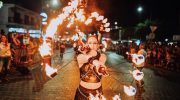
As evening approaches, programming often grows more theatrical. Fire performances, dramatic lighting, and music reshape familiar surroundings, allowing stone walls and open courtyards to take on new character. This movement keeps the festival playful and approachable, particularly for families, while preventing it from feeling formal or static. History here is not observed from a distance. It moves past you, around you, and occasionally invites you to follow.
Craft as Living Heritage
The artisan market is not a decorative addition to the festival. It is one of its most important cultural elements. Craft demonstrations and stalls highlight skills with deep roots in Cypriot history, including lace traditions associated with Lefkara, silverwork, pottery, weaving, and basketry.
These crafts belong naturally within a medieval framework because they rely on visible process and manual skill. Watching hands shape clay, thread lace, or work metal requires no explanatory panels. The value of the craft is understood through observation alone. This emphasis reinforces one of the festival’s central ideas: heritage is not something preserved behind glass. It is something practiced, repeated, and passed on.
When Architecture Joins the Performance
Setting plays a quiet but powerful role in shaping the festival’s atmosphere. The Ayia Napa Monastery, dating to around the fifteenth century, is not treated as a neutral backdrop. Performances staged beside its stone walls gain immediate depth because the architecture already carries historical weight.
This grounding matters more than spectacle. It anchors the festival in place and prevents it from feeling artificial. Medieval theatre presented beside medieval stone does not require suspension of disbelief. The setting itself becomes part of the story being told.
What the Festival Is Truly Recreating
Beneath the costumes and performances lies a specific interpretation of medieval Cyprus, one that shapes how history is presented.

Rather than celebrating a closed kingdom or a single ruler, the festival highlights Cyprus as a crossroads. The “Streets of the Crusaders” parade theme captures this perspective clearly. Medieval Cyprus was defined by movement, arrival, and exchange. Ships came and went, cultures overlapped, and identities were negotiated daily. The festival reflects this openness by allowing multiple narratives to coexist within the same space.
Equally important is the shift from observation to participation. Workshops, interactive performances, and open parades invite visitors to take part rather than stand aside. This participatory approach explains the festival’s broad appeal. History becomes something experienced collectively, not explained academically, allowing memory to form through involvement rather than instruction.
Why the Festival Matters in Contemporary Cyprus
The Medieval Festival is not an exercise in nostalgia. It serves a practical and cultural purpose in modern Cyprus. By taking place in early autumn, it supports tourism beyond peak summer months and helps diversify the island’s image beyond beaches and nightlife.
It also creates meaningful opportunities for local participation. Community groups from the Free Famagusta District appear as performers and organisers rather than background support, ensuring that regional identity remains visible and active. In this way, the festival contributes to a wider cultural strategy that presents Cyprus as a place where history remains part of public life rather than confined to museums.
What Visiting the Festival Feels Like
Arrival brings an immediate change in atmosphere. Costumes appear first, followed by sound. Music and movement fill the streets, and it quickly becomes clear that the event is unfolding everywhere at once rather than in a single designated area.
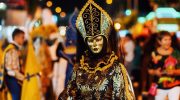
Late afternoon and early evening often offer the most balanced experience. Heat softens, performances intensify, and lighting begins to shape the mood. Comfortable footwear is essential, as historic streets and courtyards can be uneven, and crowds naturally slow movement.
Accessibility remains one of the festival’s most welcoming features. Major parades and performances are typically free, encouraging casual attendance and family participation. This openness helps maintain a sense of community rather than curation.
A Concentrated Way to Understand Cyprus
The Ayia Napa Medieval Festival succeeds because it compresses history into a lived experience. In a single evening, visitors can sense how Cyprus functioned as a meeting point of cultures, faiths, and ambitions without relying on timelines or diagrams.
It demonstrates that heritage survives not only through buildings and texts, but through shared space, performance, and collective memory. When music fades, and banners are taken down, what remains is more than entertainment. It is a clearer understanding of how Cyprus’s medieval past continues to inform its present, not as a distant chapter, but as a lived and visible influence.