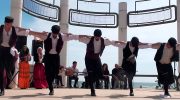
Traditional games in Cyprus represent a valuable cultural heritage passed from generation to generation, teaching social skills, building community bonds, and providing entertainment before electronic devices dominated leisure time. The games of the people of Cyprus are a valuable cultural heritage, as are other similar heritages like fairytales, songs, and proverbs.
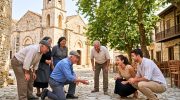
Some games come from Greece, but they play them extensively in Cyprus, while other games are originally Cypriot. Traditional games are played in villages and especially by the older generations, though certain games like tavli and pilotta remain popular across all ages and regions.
Tavli, The Strategic Board Game
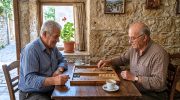
Tavli is especially played in Cyprus and Greece and is enjoyed by people of all ages, particularly in coffee shops where the sounds of rolling dice and clattering pieces resonate throughout the day and most evenings. The term tavli itself derives from the Greek word meaning “board.” The game is thought to have been introduced to Cyprus during the Byzantine era when dice games enjoyed immense popularity.
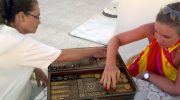
Tavli is a compendium game for two players which comprises three different variants played in succession: Portes, Plakoto, and Fevga. These are played in a cycle until one player reaches the target score, usually five or seven points. The backgammon board is divided into four areas with six points included in each area, totaling 24 points. Each player has a starting area and the player’s area is the picking area. The player’s checkers are cycled from the starting area to the picking area, and when a player has all of his checkers in his picking area he is allowed to start collecting.
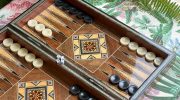
Tsilito represents the most difficult version of tavli, allowing players to capture opponent pieces by landing on them and creating an additional layer of strategy. The game today is a competitive form of entertainment that creates general camaraderie between players. The game’s relevance and importance is often highlighted during national holidays, festivals, and even simple gatherings where it becomes a central activity encouraging dialogue, laughter, and fierce competition.
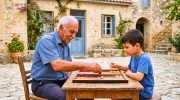
The game plays an essential role in fostering social connections that bridge across generations. It is not uncommon to see a grandfather teaching his grandchildren the strategies he learned as a boy, continuing a tradition that stretches back through Byzantine times.
Pilotta, The Card Game Obsession

Pilotta is a trick-taking 32-card game derived from Belote, played primarily in Cyprus and very popular among the Cypriot population, especially youngsters who usually arrange “pilotta meetings” in places such as cafes and cafeterias. Its counterpart played in Greece is named Vida.
The game uses a 32-card Piquet pack. First the deck is shuffled by the dealer and then cut by the player to the left. The cutter is assigned hearts and moving on anticlockwise the players are assigned a suit in order. The cards are dealt anticlockwise, with three cards given to each player starting with eldest hand and ending with the dealer.
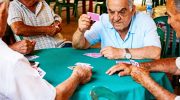
The rank of trumps from highest to lowest is given by Jack, 9, Ace, 10, King, Queen, 8, 7, while the rank of non-trumps is given by Ace, 10, King, Queen, Jack, 9, 8, 7. Usually the score ends when the first team reaches 351 points, though the limit can go up to 400 points for lengthy games or lowered to 251 and even 151 points for quick matches.
In pilotta there are specific rules when it comes to scoring bonuses called “declarations.” These include three in a row worth 20 points, belote for holding the King and Queen of the trump suit worth 20 points, and various sequences. There is a more recent variation known as Pilotta Palaristi which reintroduces a point-based bidding system.
Tavli and pilotta competitions appear regularly at village festivals. During Christmas celebrations in mountain villages like Kalopanayiotis, these games feature as organized tournaments for the older generation while children participate in other traditional activities.
Dijimin, The Test of Strength
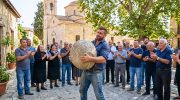
Dijimin is a game that was played by strong men in the days of big festivals, aiming to promote and honor the village’s pallikarin, meaning a brave young man. Dijimin as a subject is a heavy stone up to 100 or even 120 kilos in size that can be held in the arms of a human, usually coming from a river or a fragment of old millstone. The stone typically rested in the courtyard of the church or in the village square.
Unlimited men took part in the game to put their strength in competition. Each player, with the turn drawn by lot, was called to pick up the stone and make as many steps as he could while holding it in his arms. The winner became anyone who moved farthest away from the starting point while carrying the dijimin.
A variation existed when dijimin was too heavy for horizontal movement. In this case, the player was not required to move it horizontally but only to lift it, with the winner highlighted as whoever picked it up highest. This strength competition served social functions beyond simple entertainment, establishing hierarchies of physical prowess and determining which young men possessed the strength needed for demanding agricultural labor or defense of the community.
Ziziros, The Easter Guessing Game
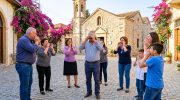
Ziziros is one of the traditional Easter games played in Cypriot villages for centuries. The name means cicada in Greek, referring to the insect sound that features prominently in gameplay. This traditional game is usually played on Easter Sunday and the days after, and it is a very funny game that causes a lot of laughs to everyone either watching or participating.

The game can be played by a group of three to eight persons. One person called ziziros stands in the middle of the group with their back turned on the other participants. The ziziros has to cover his eyes with his right hand and put his left hand under his right arm with opened fingers. One of the group’s players behind him hits him on his right hand, sometimes softly and sometimes harder.
Immediately after the hit, the rest of the players make a “ZZZZ” sound like a cicada and wave a finger in circles to confuse the unlucky one who was hit. The ziziros must guess who hit them. If the guess is correct, that person becomes the new ziziros. The lighthearted nature and resulting laughter make it popular during Easter festivities when extended families gather.
The Social Heart of Cypriot Tradition
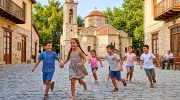
Traditional games pass cultural values across generations in ways formal education cannot replicate. Children learn rules, fairness, cooperation, and competition through play. They develop social skills by interacting with peers and adults in structured activities. According to child development theory, children form their social world as long as they interpret, follow, and make use of knowledge gained through games, helping them adapt to their society’s culture and supporting cognitive development.
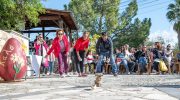
Today’s industrialization, urbanization, and technological developments have caused changes in child image and toy culture. While traditional games are increasingly ignored, game and toy sectors have emerged as industries targeting children with electronic entertainment. This shift threatens the transmission of cultural heritage embedded in traditional play.
However, some games will never stop fascinating children no matter how many years pass. We will not see them in the showrooms of children’s toy stores, nor can they be replaced by electronic games or virtual reality. The physical interaction, face-to-face competition, and community participation that traditional games require create experiences fundamentally different from screen-based entertainment.
Villages and cultural organizations work to preserve traditional games through demonstrations at festivals, inclusion in school curricula, and organized competitions. These efforts ensure younger generations learn games their grandparents played, maintaining cultural continuity and providing alternatives to digital entertainment that dominates modern childhood.