Cypriot craft villages keep making themselves visible, with pottery, weaving, and embroidery still practised in courtyards, workshops, and shopfronts rather than hidden in studios. Each tradition grew from practical geography, including red clay deposits, farming cycles, and inland trade routes, and it survived because skills stayed useful within families and local economies. This article maps where these crafts live today, what it feels like to encounter them in working spaces, and how artisans balance continuity with modern pressure.
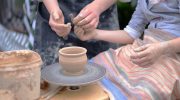
Craft Lives in Courtyards
Traditional crafts in Cyprus are closely tied to geography. They did not emerge randomly, nor were they centralised in cities. Instead, they developed in villages where materials were available, and skills could be passed down within families.
In mountain and foothill settlements, stone houses with inner courtyards created spaces where work naturally extended outdoors. In places like Lefkara, Omodos, and Fyti, narrow streets and shaded thresholds became informal workshops. Craft was never hidden. It unfolded in public view, turning villages themselves into working environments rather than static backdrops.
This visibility matters. It transforms craft from a product into a lived process, something shaped by place rather than detached from it.
Red Clay, Slow Wheels
Each craft tradition grew where it made practical sense. Pottery villages such as Kornos and Phini developed near iron-rich red clay deposits that could support large-scale vessel making. The soil itself determined the form and durability of the pottery, long before design became a conscious choice.

Textile traditions followed a different logic. Weaving and embroidery centres like Fyti and Lefkara were positioned inland, where cotton cultivation, household labour, and trade routes intersected. These villages supported slow, domestic production that could be combined with farming and family life.
The result is a craft map of Cyprus shaped by land, labour, and necessity rather than fashion.
The Weight and Patience of Red Clay
Pottery is one of Cyprus’s oldest continuous traditions, reaching back to the Neolithic period. In villages such as Kornos and Phini, red clay pottery remains a defining practice, both physically demanding and deeply rhythmic.
The process begins long before the wheel turns. Clay is dug, cleaned, mixed, and kneaded until it reaches the right consistency. Potters work low to the ground, guiding the slow wheel with foot power rather than speed. The forms they produce reflect function above all else.
Large storage jars once held wine, oil, and grain. Narrow-necked jugs cooled water naturally through evaporation. Cooking pots were shaped to withstand long hours over the fire. Even decorative elements were restrained, relying on incised patterns and small relief details rather than paint.
Firing is the most precarious stage. Traditional kilns burn for many hours, and a single mistake can undo weeks of work. The process demands patience, experience, and acceptance that not every piece will survive.
Threads That Carry Memory
Textile traditions in Cyprus require a different kind of endurance, one rooted in time rather than physical force. The work unfolds quietly, often within domestic spaces, and advances through repetition rather than spectacle.
Lefkara lace, known as Lefkaritika, emerged from a long exchange between local embroidery and Venetian influence. Its intricate geometric patterns are built entirely from memory, with no printed guides to follow. Each section must align perfectly with the next, a discipline that can stretch the creation of a single piece across months or even years.

In Fyti, weaving follows a heavier rhythm. Floor looms produce thick, textured fabrics whose raised patterns are woven directly into the cloth. These designs are not abstract. They are named after people, buildings, and moments from village life, turning everyday experience into a woven record.
For generations, these textile skills shaped women’s economic independence as well as their social standing. The work was demanding, but it was also valued, both within the household and beyond it.
The Dowry as Craft Archive
The continuity of these skills was once reinforced through the dowry system, which functioned as both preparation and preservation. From a young age, girls learned to stitch, weave, and embroider items intended for their future homes.
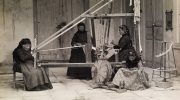
These textiles filled carved wooden chests and represented more than domestic readiness. They embodied labour, patience, and foresight. In many cases, they remained legally tied to the woman herself, providing a form of security in uncertain times.
Although the dowry system has faded, its influence remains visible. Many of the finest surviving textiles are not museum pieces, but household objects carefully stored, repaired, and remembered.
Inside the Artisan Atmosphere
Cypriot artisan spaces are defined by use rather than display. Pottery workshops carry the scent of damp earth and smoke, with tools arranged according to habit rather than aesthetics. The sound of clay being prepared and wheels turning becomes part of the environment, steady and unhurried.
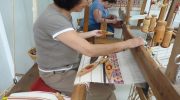
Weaving spaces offer a quieter intensity. Looms strike in measured intervals, needles move through linen, and conversation blends naturally into the rhythm of work. Shelves hold folded cloth, baskets, and tools that show signs of long use. Floors are worn smooth by decades of movement.
Nothing feels arranged for effect. Everything reflects ongoing practice.
Meeting the Makers
Many artisans still working today learned their skills in childhood, often from parents or grandparents. For them, craft is not revival or performance. It is continuity.
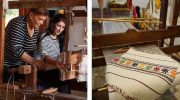
Visitors are usually welcomed into these spaces with openness. Techniques are explained slowly, movements demonstrated without rush. Questions are answered generously, and observation is encouraged. Purchasing an object comes later, if at all.
The encounter itself becomes the lasting impression. It is a reminder that craft is not only about what is produced, but about the relationship formed in the act of making.
Craft in a Modern World
Traditional crafts in Cyprus now exist within a changing economic landscape. Handmade objects cannot compete with mass production, and younger generations often pursue livelihoods beyond village workshops.
Tourism has become an important source of support, particularly in places recognised for their cultural heritage. International recognition and creative tourism initiatives have helped shift attention toward process rather than volume. Demonstrations, workshops, and short courses allow visitors to engage directly with skills instead of treating them as souvenirs.
At the same time, documentation efforts aim to preserve techniques digitally, ensuring that knowledge survives even as the number of practitioners declines.
Best Seasons for Village Visits
Artisan villages remain active throughout the year, but timing shapes how they are experienced. Summer brings heat and crowds, which can compress the rhythm of daily work. Spring and autumn offer cooler temperatures and a slower pace, allowing crafts to unfold naturally within village life.

During these quieter months, workshops feel less like destinations and more like extensions of everyday routine.
What These Places Protect
Artisan workshops endure because they offer something increasingly rare. They make time visible. Each object carries the imprint of hands, place, and patience.
In a world driven by speed and repetition, these villages preserve a different logic. Clay dries at its own pace. Patterns emerge stitch by stitch. Shortcuts are not rewarded.
To step into a pottery workshop or sit beside a loom is to witness continuity in action. This is not preservation for nostalgia’s sake. It is living knowledge, sustained because it remains human, useful, and rooted in place.