In a handful of European towns, lace is not confined to drawers or museums, but spills into streets, shopfronts, and daily routines, turning private handwork into public identity. From Pano Lefkara in Cyprus to Burano, Idrija, and Croatian lace centres, makers and local institutions keep the craft visible so it continues to shape how places look and how they remember themselves. This article traces how lace moved into urban space, what each town’s setting adds to the tradition, and why visibility is the key to lace surviving as living heritage.
- When Lace Leaves the Home
- Lefkara: Lace Meets Limestone
- Streets that function as living workshops
- A craft shaped by empires and exchange
- Burano: colour, canals, and lace in plain sight
- Idrija: where industry and lace coexist
- Visibility Keeps Skills Alive
- Tourism Changes the Terms
- The enduring power of thread
When Lace Leaves the Home
Lace has traditionally belonged to the domestic world. It was made indoors, often by women, and passed down quietly through generations. What makes certain towns remarkable is that this private craft did not remain hidden. Instead, it became visible and structural, influencing how streets are used, how buildings are decorated, and how communities present themselves.
In some places, lace patterns are scaled up and translated into murals, ceramic tiles, or architectural details. In others, the act of making lace itself becomes a street-level scene, with artisans working outdoors, visible to anyone passing by. The result is a city that tells its story through thread.
Lefkara: Lace Meets Limestone
In Cyprus, Pano Lefkara offers one of the clearest examples of lace shaping an entire settlement. Nestled in the foothills of the Troodos Mountains, the village is inseparable from Lefkaritika, the intricate lace tradition that has defined its economy and identity for centuries.

White limestone houses, narrow cobbled streets, and red-tiled roofs form a restrained architectural backdrop. Against this setting, lace feels like a natural extension of the village rather than a decorative afterthought. The patterns echo the geometry of the built environment, reinforcing a sense of cohesion between craft and place.
Streets that function as living workshops
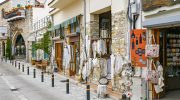
One of the most distinctive sights in Pano Lefkara is not a monument, but a daily ritual. Women known locally as ploumarisses sit together in shaded streets or courtyards, stitching lace while talking, observing, and participating in village life. The street becomes both a social space and a workspace.

This visibility matters. Lace here is not simply displayed for sale. It is witnessed in the process of being made, slowly and publicly, reinforcing its authenticity and its role in the village’s rhythm. Shops displaying finished pieces line the routes leading toward the Church of the Holy Cross, creating what feels less like a commercial strip and more like a lived-in archive of skill and memory.
A craft shaped by empires and exchange
Lefkaritika did not develop in isolation. Its techniques reflect Cyprus’s layered history, shaped by Byzantine, Venetian, and Ottoman periods of rule. During the Venetian era, local lace-makers absorbed elements of Italian embroidery and adapted them into a hybrid style that gradually became distinct.
Among the most enduring motifs is the so-called “Leonardo” pattern, linked by legend to Leonardo da Vinci’s visit to the village in the late fifteenth century. Whether taken as documented history or symbolic myth, the story reflects how deeply lace is woven into Lefkara’s sense of global connection and cultural significance.
Burano: colour, canals, and lace in plain sight
Further west, on the edge of the Venetian Lagoon, Burano presents a dramatically different but equally cohesive relationship between lace and urban space. Here, the built environment announces itself immediately through colour. Brightly painted houses line narrow canals, their reflections doubling the visual intensity of the streetscape.

Within this vivid setting, lace-making remains visible and understated. Elderly women sit in doorways or just outside shops, working quietly with needle and thread as visitors pass. The contrast between bold architecture and delicate handwork gives Burano its unmistakable character, grounding spectacle in patience and precision.

The lace itself, known as punto in aria, is made without a base fabric, constructed entirely from interlocking stitches. Historically, it was among the most prized textiles in Europe, worn by nobility and collected as a symbol of status and refinement. Today, its survival depends less on prestige and more on continuity, supported by lace schools, museums, and the quiet persistence of daily practice.
Idrija: where industry and lace coexist
In the Slovenian town of Idrija, lace occupies a very different urban context. The town developed around mercury mining, one of the most hazardous industrial activities in Europe. While the mines shaped public life and infrastructure, lace-making evolved alongside them as a domestic counterweight.
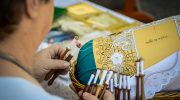
For many families, bobbin lace provided supplemental income during periods of economic instability. It was practised in homes shaped by industrial necessity, using rhythm and repetition to impose order on lives defined by risk. Over time, this parallel craft became embedded in the town’s identity rather than remaining a secondary activity.
Today, Idrija’s streets reflect this dual heritage. Former mine entrances, administrative buildings, and workers’ housing sit alongside lace schools and cultural institutions. During the annual Lace Festival, demonstrations and exhibitions spill into public space, transforming the town into a temporary workshop where industrial history and textile skill are presented as equally formative.
Visibility Keeps Skills Alive
Across Croatia, lace traditions add further depth to the relationship between thread and place. On the island of Pag, needle lace developed as a self-taught practice, passed from woman to woman without formal patterns. Each maker learned through observation, resulting in subtle variations that tied technique directly to individual hands.

In Lepoglava, bobbin lace followed a different path. Introduced by monastic communities, it evolved into a regional speciality supported by formal instruction and later celebrated through international festivals. Streets and public squares become temporary exhibition spaces during these events, reinforcing the connection between craft and locality.
On Hvar, lace takes an even more unusual form. Benedictine nuns produce lace from agave fibres, extracting threads from plant leaves and weaving them by hand within the cloister. Though largely hidden from daily street life, the practice remains deeply tied to place, linking natural environment, spiritual discipline, and material culture.
Tourism Changes the Terms
What connects all these locations is not lace alone, but visibility. In each case, craft remains embedded in everyday space rather than confined to museums or archives. Streets function not only as routes through town, but as stages where labour, memory, and identity continue to unfold in plain sight.
These traditions endure because they adapt without disappearing. Tourism, education, and contemporary markets have altered how lace is consumed and valued, yet the act of making remains legible. The craft is not frozen in time. It evolves carefully, retaining continuity while allowing new layers of meaning to form.
The enduring power of thread
Lace may appear fragile, but its role in shaping urban identity is anything but. From Cypriot stone villages to Venetian islands and Central European industrial towns, thread has become a durable form of storytelling, anchoring communities to their past while keeping them visible in the present.
To walk these streets is to read history without plaques or explanations. It is written instead in patterns, gestures, and repeated movements. The architecture of thread endures because it was never meant to be hidden. It was made to be seen, shared, and lived with.