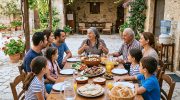
In Cyprus, the Sunday family gathering is a weekly social infrastructure, bringing extended relatives together for long meals that renew trust, care, and hierarchy without formal rules. Rooted in older agrarian and Orthodox rhythms, it persists in modern towns and cities because it offers a reliable reset: shared food, flexible time, and conversation that keeps the family network active. This article explains how the ritual works from souvla preparation to coffee and tavli, and why its slow pace remains one of Cyprus’s most durable forms of belonging.

A Ritual Designed for Presence
The Sunday family gathering is not organised for efficiency or convenience. It exists to preserve connection. In a country shaped by migration, political division, and economic change, the extended family has remained the most reliable structure of support. Sundays provide the rhythm that keeps that structure intact.
This is why the gathering is rarely rushed. Arrival times are flexible. Meals stretch. Conversations overlap. The goal is not completion but presence. What matters is that everyone shows up, not that they follow a schedule.
The Values Behind the Table
Three ideas quietly govern the Sunday gathering.
Philoxenia, often translated as hospitality, is better understood as openness. It explains why extra chairs appear without discussion and why guests are treated like relatives. The table is not guarded. It expands.

Philotimo shapes behaviour once people sit down. It is an internal sense of responsibility toward others, expressed through generosity, restraint, and respect. Elders are served first. No one leaves hungry. Conflict is softened, not sharpened.
Siga-siga, meaning “slowly, slowly,” sets the pace. In Cyprus, slowness is not a flaw. It is a sign that human interaction matters more than productivity. Sunday lunch can last all afternoon because there is no reason for it not to.
Together, these values create a social environment that feels instinctive to locals and strikingly different to visitors.
Why Sunday, Specifically
The choice of Sunday is not accidental. Cyprus has deep agrarian roots, and for centuries, life followed a cycle of labour and rest. Sunday was the pause, reinforced by Orthodox Christian tradition, when work stopped, and families came together.
Even as most Cypriots moved away from farming, the structure remained. Many urban families still return to ancestral villages on Sundays, maintaining a physical and emotional link to their past. In this way, Sunday acts as a bridge between modern life and older rhythms.
Food as a Shared Commitment
If the gathering has a centre, it is the food. Not because the dishes are elaborate, but because they require time and cooperation.
The most iconic element is souvla: large cuts of meat cooked slowly over charcoal. Preparing it is not just cooking, but participation. Someone tends the fire. Someone turns the spit. Others prepare side dishes. The process itself fills the hours before eating.

The meal is not structured into strict courses. Dishes appear, disappear, and reappear. Bread is used constantly. Plates are refilled without asking. Eating becomes something woven into conversation rather than separated from it.
Certain dishes, like kleftiko, carry historical weight. Slow-roasted in sealed ovens, it recalls periods when cooking had to be hidden and resourceful. On Sundays, that history becomes comfort rather than hardship.
The Space That Makes It Possible
The Sunday gathering depends not only on people, but on a space that can adapt to them. Traditional Cypriot homes were built with this flexibility in mind. Courtyards allowed conversations to spill outdoors. Shaded verandas absorbed heat and noise. Large central rooms expanded naturally as more relatives arrived.
Furniture was chosen for movement rather than display. Chairs could be added or removed. Tables could stretch. The house adjusted itself to the gathering, not the other way around.
Modern homes reinterpret these principles rather than abandoning them. Open-plan kitchens and living areas allow food preparation and conversation to happen simultaneously. Oversized dining tables signal readiness rather than excess. Even in apartments, the intention to host remains visible.
Decor reinforces continuity quietly. Lace tablecloths, wooden cabinets, and inherited objects carry memory without announcement. They remind everyone present that this gathering is part of a longer story, repeated rather than reinvented.
Roles at the Table
Hierarchy exists at the Sunday table, but it is expressed through care rather than authority.
Grandparents, particularly grandmothers, form the emotional and organisational centre of the gathering. They move between the kitchen and conversation with ease, remembering preferences, histories, and unresolved stories. Their influence is practical, not symbolic. They hold the family together by knowing it.

Children occupy the opposite pole. They are encouraged, indulged, and constantly addressed. Their presence is celebrated, not managed. Being raised within a crowd of relatives is understood as protection, not interference.
Adults in between carry dual responsibility. They show deference upward and support downward, often without noticing the balance being performed. These roles are rehearsed every Sunday, becoming instinct rather than obligation.
After the Plates Are Cleared
When the meal ends, the gathering does not dissolve. It simply changes pace.
Coffee arrives deliberately. It is prepared with attention and ordered precisely, with sugar preferences stated before the cup is poured. The cups are small, but the ritual is long. Conversation slows again, settling into something quieter and more reflective.
Games follow naturally. Tavli, the Cypriot version of backgammon, is common and unmistakably loud. Dice strike wood. Commentary fills the air. The performance matters as much as the outcome. Winning is temporary. Participation is the point.
This stage of Sunday is about staying rather than doing. People linger without explanation. Departure is gradual, often delayed, and never abrupt.
Unspoken Rules
The Sunday gathering functions through etiquette that is rarely articulated.
Food is accepted, even when appetite is gone. Elders are greeted first, without instruction. Political debates are approached cautiously, unless the moment invites them. Guests bring something small, not to contribute materially, but to acknowledge effort.

Thanks are offered more than once, not because they are required, but because gratitude is expected to be visible.
These rules are learned by watching, not teaching. They settle into behaviour quietly.
How It Changes, and Why It Endures
Urban life has reshaped the setting, but not the structure. Some families now gather in taverns instead of homes. Others shorten the day to accommodate work schedules. Younger generations negotiate participation differently, balancing independence with belonging.
Yet the ritual persists because it answers a need that modern life often leaves unmet. It offers a predictable connection in an unpredictable world.
Technology has been absorbed rather than resisted. Photos are shared instantly. Relatives join by video call when distance intervenes. The gathering expands without losing coherence.
Why the Ritual Works
The Cypriot Sunday family gathering is not nostalgia preserved for sentiment. It is social infrastructure. It supports emotional well-being, reinforces responsibility, and transmits cultural memory without formal instruction.

It reminds people that life is not held together only by progress or achievement, but by repetition, shared meals, and time given without urgency. In Cyprus, Sunday does not end the week. It explains it.