Syrtos of Cyprus (Local Variants) is a restrained, grounded dance form that emphasizes communal movement and continuity, with subtle differences from mainland Greek versions shaped by the island’s unique cultural blend. Performed in circles or lines, it features slow, deliberate steps that foster group harmony and emotional expression, often accompanied by laouto and violin. This dance reflects Cyprus’s historical crossroads, preserving ancient rhythms while adapting to local traditions, making it a living symbol of the island’s resilient spirit.
A Timeless Dance Form
Syrtos in Cyprus represents a core element of the island’s folk dance heritage, a form where participants link hands in a circle or line, moving with measured, flowing steps that prioritize collective rhythm over individual flair. Unlike more energetic dances, Cypriot syrtos maintains a grounded, introspective quality, with feet close to the earth and bodies swaying in unison to evoke shared emotions like joy, sorrow, or nostalgia.
This restraint stems from the island’s agrarian past, where dances served as communal rituals tying people to the land’s cycles. Regional variants add depth: the Paphos syrtos is slower and more solemn, while the Famagusta version incorporates lighter skips, reflecting local histories and influences from Greek, Ottoman, and Venetian eras. As a dance that bridges generations, it embodies Cyprus’s cultural mosaic, where movement becomes a silent language of unity.
Historical Origins and Evolution
The syrtos dance traces its roots to ancient Greek traditions, with depictions on Cypriot pottery from the Geometric period (1050–750 BC) showing circle dances in rituals honoring fertility gods like Aphrodite. The name “syrtos” derives from “syro,” meaning to drag or flow, referring to the smooth, pulling steps that mimic waves or wind—apt for an island shaped by the sea.

During the Byzantine era (4th–15th centuries AD), syrtos integrated into religious festivals, blending with ecclesiastical modes where dances accompanied hymns at saints’ feasts, as noted in 12th-century manuscripts from Kykkos Monastery.
Under Lusignan rule (1192–1489), French court dances introduced subtle elegance, but syrtos retained its communal core, adapting to include chain formations for larger groups. Venetian period (1489–1571) added Italian flair, with faster tempos in urban areas, but rural Troodos variants stayed grounded, preserving Byzantine restraint. Ottoman occupation (1571–1878) enriched it with Eastern rhythms from makams, leading to variants like the “karşılama” in Turkish Cypriot communities, where syrtos-like steps face partners with hand claps for accent.
British colonial times (1878–1960) documented syrtos in ethnographic studies by Lucy Garnett in 1894, who described village versions with laouto accompaniment, noting regional differences: Greek syrtos more melodic, Turkish with respective inflections. Post-independence in 1960, it became a symbol of cultural revival, with the 1974 invasion leading to distinct evolutions—Greek Cypriot syrtos emphasizing unity, Turkish Cypriot incorporating sirtaki-like elements. UNESCO’s 2015 recognition of Cypriot folk dances as intangible heritage highlighted syrtos’s role in modal preservation, with efforts by the Cyprus Folk Dance Association to teach variants in schools.
Archaeological finds from Salamis (8th century BC) show terracotta dancers in circles, suggesting syrtos-like forms in ancient rites. Ethnochoreologists like Alkis Raftis have analyzed steps, linking them to Minoan leap dances but with Cypriot groundedness, influenced by the island’s terrain.
Distinct Characteristics of Cypriot Syrtos
Cypriot syrtos is a circle dance with hands linked at shoulder height, steps flowing left in a slow-quick-quick rhythm, emphasizing continuity over speed. Unlike mainland Greek syrtos, which can be lively with jumps, Cypriot versions stay close to the ground, with subtle knee bends and hip sways that create a wave-like motion, symbolizing communal flow.
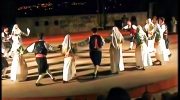
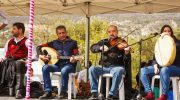
Music features laouto for rhythm, violin for melody, in modes like “ousak” for calm or “hijaz” for passion, inherited from Byzantine echos. Variants differ: the “karsilamas” faces partners with claps, common among Turkish Cypriots, adding Ottoman interactivity; Greek “syrtos” is circular with more turns, reflecting Greek influences. Steps include “sta tria” (three-step) patterns, allowing improvisation where leaders add flourishes like stamps for emphasis.
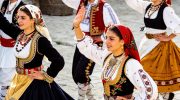
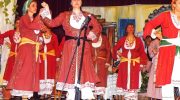
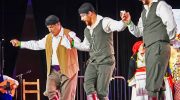
Costumes—women in embroidered skirts, men in vraka pants—enhance movement, with colors symbolizing regions: reds for Paphos passion, blues for coastal calm. This grounded style suits village squares, where dances last hours, fostering social bonds through shared rhythm. In Turkish Cypriot “karsilama,” hand gestures add narrative, while Greek Cypriot “syrtos” focuses on circle unity. The form’s restraint allows emotional expression without excess, making it accessible for all ages.
Fun Facts That Add Charm
- In 1494, a syrtos duel at a wedding reportedly inspired a fresco in a nearby chapel, linking dance to art.
- A quirky rule: if a dancer breaks the circle, they “pay” with a song, testing group harmony.
- UNESCO noted its similarity to Sardinian “ballu tundu,” traded via Venetian ships.
- Famous 20th-century dancer Panayiotis Violaris performed syrtos at the 1936 Berlin Olympics, showcasing Cypriot variants globally.
- Folklore links syrtos to nymphs dancing around Aphrodite, their steps mimicking waves—a myth in 19th-century collections by Nikolaos Politis.
One tale: during Ottoman times, syrtos was danced silently to avoid detection, its restrained steps perfect for stealth celebrations. Modern festivals feature “syrtos marathons,” lasting days with variants from all regions.
Deeper Role in Culture and Society
Syrtos’s symbolism extends to theology: in Orthodox feasts, it echoes circular eternity, linking to Byzantine hymn cycles. In rituals, it features at weddings for blessings or funerals for laments, using modes to evoke emotions—”nihavent” for sorrow draws from Ottoman influences, “rast” for joy echoes Byzantine hymns.
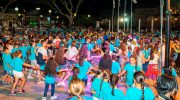
Socially, it fosters equality—all join the circle, with steps simple for participation, reinforcing community in divided Cyprus. Ethnochoreology at the University of Limassol analyzes its kinematics, noting how grounded steps reduce injury in uneven village squares, linking to practical evolution. Regional variants preserve dialects: Paphos lyrics use archaic words for love, Famagusta add Turkish phrases for melancholy.
Influences from Arab dances added claps, traded via Ottoman millets, while Venetian masques introduced turns, but purists kept circularity. This depth makes syrtos a cultural archive, preserving rhythms from ancient Minoan leaps, influenced by Phoenician trade but adapted to Cypriot terrain.
Syrtos in Cyprus Today
In contemporary Cyprus, syrtos persists as a symbol of unity, with bicommunal dances across lines featuring variants that promote dialogue. UNESCO’s 2015 listing spurred revivals, with schools teaching traditional steps to preserve heritage amid globalization. Climate change affects festival venues, prompting indoor adaptations, while artists like the Dance Group of Limassol fuse it with contemporary ballet. In a divided society, it fosters pride, with online platforms sharing tutorials for diaspora communities.
Opportunities for Exploration
Cultural centers like the Cyprus Folk Art Museum in Nicosia host syrtos demonstrations, open daily for €3. Festivals like the Ayia Napa Folk Festival in September feature live dances, free to attend with workshops. Guided cultural tours through the Cyprus Tourism Organization cost €15–20, visiting villages like Omodos for sessions. Spring or fall avoids heat, pairing with Troodos hikes where dance echoes in squares. Many venues offer online videos for remote access.
A Dance That Flows Through Time
Syrtos of Cyprus holds value as a guardian of communal movement and continuity, where its restrained form and regional variants preserve ancient rhythms in a UNESCO-recognized tradition. This wasn’t just dance; it’s a link to historical roots, blending history with emotion in every step. Knowing it enriches appreciation for Cyprus as a rhythmic crossroads. Engagement with its circle or variant evokes renewed wonder at cultural endurance.