The Souskiou cemeteries represent one of the most important archaeological discoveries in Cyprus, shedding light on burial practices and social organization from nearly 5,000 years ago. These sites, located in southwestern Cyprus near the village of Souskiou, revealed elaborate rock-cut tombs filled with grave goods that challenge previous assumptions about prehistoric life on the island.
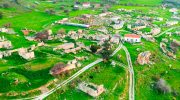
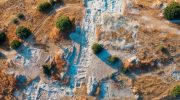
The Souskiou complex consists of four separate cemetery areas and a settlement, all dating to the Chalcolithic period around 3000 BC. The most extensively studied cemetery, known as Souskiou-Vathyrkakas Cemetery 1, sits along the southern edge of a ravine, directly opposite the contemporary settlement on the other side of a stream. This deliberate separation of the living from the dead marked a significant departure from earlier burial customs.
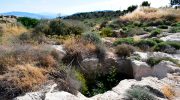
The cemeteries contain rock-cut tombs rather than simple pit graves. Most Chalcolithic sites in Cyprus buried people within settlements in basic pits, often with few or no grave goods. Souskiou took a completely different approach. The community created formal burial grounds outside the settlement and invested substantial labor in cutting elaborate tombs into bedrock. These tombs accommodated multiple burials and contained rich assemblages of objects, indicating more complex funeral practices than previously documented for this period.
Historical Background
The cemetery first came to archaeological attention in 1951 when Tryphonas A. Koulermou and George Pastos, the custodian at nearby Kouklia, discovered it while searching for settlements associated with the burials. Unfortunately, looters had already found the site, and extensive damage occurred during the early 1970s before proper excavation could begin.
Four separate archaeological missions investigated the Vathyrkakas cemetery between 1951 and 1997. These included British expeditions in the 1950s, French work in the 1960s, investigations by the Cyprus Department of Antiquities in the 1990s, and research by teams from the University of Edinburgh. Each mission excavated different sections, and their findings were initially published in scattered preliminary reports. This fragmented publication situation was finally resolved in 2006 when Edgar Peltenburg coordinated the comprehensive publication of all four missions’ results.
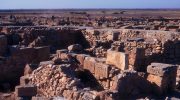
The excavated portion of Cemetery 1 covers approximately 1,800 square meters in a roughly 30 by 60 meter area. This represents only part of what may be a much larger cemetery composed of multiple burial clusters. The tombs concentrate unevenly in a zone about 30 meters wide along the ravine’s southern lip, creating a linear cemetery pattern unique in Cypriot prehistory.
Between 2001 and 2011, the University of Edinburgh team under Edgar Peltenburg also excavated the Laona cemetery on the western ridge and conducted major investigations of the associated settlement. The Laona cemetery yielded 137 excavated tombs, while three additional cemetery areas were documented at Vathyrkakas. Together, these sites provided unprecedented information about Chalcolithic burial practices and social organization.
Rock-Cut Tombs and Complex Burial Architecture
The Souskiou tombs were cut directly into the soft limestone bedrock, a technique requiring considerable effort. Workers excavated vertical shafts from the surface down to depths of two meters or more. Some tombs consisted simply of deep shafts, while others featured bell-shaped chambers at the bottom that provided more space for burials.
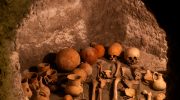
The most elaborate tombs had multiple shafts connected to larger chambers. Large capstones sealed the shaft openings after burials were complete. Some of these capstones were massive, with hourglass-shaped perforations drilled near the edges, presumably to allow ropes to be threaded through for hoisting the heavy stones into position. The effort required to create and seal these tombs far exceeded the practical requirements of simply disposing of bodies.
The Exceptional Monument of Tomb 73
Among all the tombs excavated at Souskiou, Tomb 73 stands out as truly exceptional. Located near the center of the exposed cemetery area, this tomb represents an assertive monument designed for public display. Its scale and elaboration far exceeded any other burial at the site and mobilized labor on a level not seen for any other tomb.
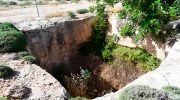
Tomb 73 consisted of two deep shafts connected to a large square chamber measuring approximately 4.5 by 4.3 meters, cut more than two meters into the bedrock. The tomb possessed glistening white facades, carefully smoothed and plastered to a quality not seen elsewhere in the cemetery. This visual distinctiveness would have made the tomb immediately recognizable to anyone approaching the cemetery.
Souskiou’s Broader Significance
The Souskiou sites fundamentally changed archaeological understanding of Chalcolithic Cyprus. Before their excavation, knowledge of the period came mainly from settlement sites with simple burials. The prehistoric archaeology of Cyprus was “unremittingly focused on evidence from settlement sites,” lacking detailed information about cemeteries, ritual practices, or activities occurring outside domestic contexts.
The Vathyrkakas and Laona cemeteries provided the first detailed account of a non-domestic Chalcolithic site. They revealed that some communities practiced elaborate multi-stage burial rituals, maintained formal cemeteries separate from settlements, and invested heavily in mortuary architecture and grave goods. These practices mark considerable breaks with both preceding and succeeding customs.
The innovations documented at Souskiou include the existence of cemeteries themselves, more spacious facilities for multiple inhumation burial systems, elaboration of tomb types, and disposal of objects as part of funeral rituals. These developments indicate growing social complexity and emerging hierarchies based on kin groups and ancestral ideologies.
Souskiou also demonstrates that Chalcolithic Cyprus participated in broader eastern Mediterranean cultural patterns. The rock-cut tombs have possible antecedents in or connections to Anatolian practices. The presence of prestige goods, specialized production, and evidence for exchange networks shows that even in prehistory, Cyprus was not isolated but engaged with neighboring regions.
Visiting the Souskiou Archaeological Area Today
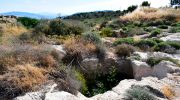
The Souskiou archaeological sites are located in the Paphos district of southwestern Cyprus, near the modern village of Souskiou. The area sits in the lower Dhiarizos River valley, where the narrow ridge between the Dhiarizos and Vathyrkakas rivers creates distinctive topography visible for kilometers.
Access to the actual excavation areas is restricted to protect the archaeological remains. The rock-cut tombs are vulnerable to damage from foot traffic, weathering, and vegetation growth. Additionally, concerns about renewed looting necessitate careful management of the sites. Visitors cannot freely explore the cemetery areas as they might visit more developed archaeological parks.
However, the broader landscape can be experienced. The ridge where the settlement and cemeteries are located offers views of the surrounding valley and mountains. Walking in the area provides a sense of why this location was chosen for settlement and burial, with its access to water, defendable position, and proximity to resource areas.
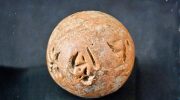
The Cyprus Archaeological Museum in Nicosia and the Paphos Archaeological Museum display picrolite figurines and other artifacts from Souskiou. These museum collections allow visitors to see the actual objects that made the site famous and understand the craftsmanship and cultural values they represent. Interpretive displays explain the archaeological significance and help contextualize the finds.
One famous picrolite figurine, known as the Yialia figure, appears on the reverse of Cypriot euro coins. This iconic image has become a national symbol, representing Cyprus’s deep prehistoric heritage. Seeing this figure in museums or on currency provides tangible connection to the Souskiou sites even when the archaeological areas themselves are not accessible.
The Legacy of Souskiou in Cyprus Archaeology
The Souskiou excavations transformed understanding of Cyprus’s prehistoric societies. They demonstrated that Chalcolithic communities achieved greater social complexity than previously recognized, with emerging elites, specialized craft production, regional ritual centers, and elaborate expressions of status through mortuary practices.
Edgar Peltenburg, who directed the major excavations from 2001 to 2011, dedicated much of his distinguished career to understanding small-scale societies in Cyprus and the ancient Near East. His work at Souskiou, published comprehensively by collaborators Diane Bolger and Lindy Crewe after his death in 2016, represents a fitting culmination of decades of research. The detailed documentation and analysis set standards for prehistoric archaeology.
The sites continue to generate research and publications. New analytical techniques applied to stored materials yield fresh insights. Comparative studies connect Souskiou to contemporary developments elsewhere in the eastern Mediterranean. Each new investigation builds on the solid foundation of careful excavation and comprehensive publication.
For Cyprus, Souskiou represents a crucial piece of the island’s long history. The period around 3000 BC was a time of innovation and transformation, setting patterns that would influence Bronze Age developments. Understanding this formative period helps explain how Cyprus evolved from small Neolithic villages to the complex societies of later millennia that participated actively in Mediterranean-wide trade networks and cultural exchanges.
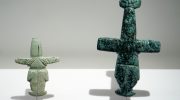
The picrolite figurines that emerged from Souskiou tombs continue to fascinate scholars and the public alike. These enigmatic objects, with their distinctive cross-like forms and careful craftsmanship, raise questions about prehistoric beliefs, artistic expression, and social values. They remind us that even 5,000 years ago, people invested skill and meaning in creating objects that transcended mere utility, objects that connected them to ancestors, marked their identities, and expressed their deepest cultural values.