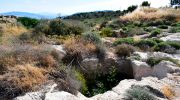
Erimi-Pamboula sits quietly in southern Cyprus, yet this ancient settlement tells one of the island’s most important stories. From 3500 to 2900 BC, this village thrived along the Kouris River, giving its name to an entire culture that shaped Cyprus for over a thousand years.
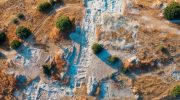
Erimi-Pamboula represents the heart of what scholars call the Chalcolithic period in Cyprus, a time when people first combined stone tools with early metalwork. The settlement stretched across 15 hectares on a low plateau just three miles from the coast, where the Kouris River provided fresh water and access to valuable resources. The village was large enough and influential enough that the entire cultural period became known as the “Erimi culture,” a name still used today.
The site rests within what is now the modern village of Erimi, located in the Kouris River valley. This valley has attracted people for thousands of years because of its natural advantages.
Historical Background
The modern story of Erimi-Pamboula begins in 1933. Cypriot archaeologist Porphyrios Dikaios arrived at the site and spent three years excavating what would become one of the most important prehistoric settlements in Cyprus. Though Dikaios only uncovered about 150 square meters, he found layers of occupation stretching 5.5 meters deep, revealing centuries of continuous human activity.

His work laid the foundation for understanding Cyprus’s Chalcolithic period. The pottery, tools, and structures he discovered became the reference point for identifying similar sites across the island. After nearly a century, the site attracted renewed attention. In July 2025, Professor Giorgos Vavouranakis of the National and Kapodistrian University of Athens led a new team back to Erimi-Pamboula, working close to Dikaios’s original excavation areas.
The Chalcolithic period itself lasted roughly 1,500 years in Cyprus, from about 4000 to 2400 BC. During this time, the island saw remarkable changes. The population grew significantly, with around 100 villages established. People began working with copper, producing the island’s first metal objects.
What Made Erimi-Pamboula Special
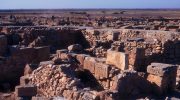
The settlement shows clear evolution in how people built their homes. Early structures were simple timber frames set in shallow depressions. Over time, builders added stone foundations to circular buildings. Eventually, they constructed entirely stone-based circular huts, some reaching impressive sizes.
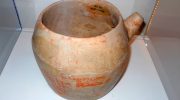
The pottery from Erimi-Pamboula is distinctive and beautiful. The most characteristic type is called Red-on-White ware, featuring red decorations painted on light-colored clay. The designs evolved from broad, bold lines to finer, more intricate patterns. This pottery became so widespread that archaeologists use it as a marker to date other sites from the same period.
Recent excavations uncovered a well-preserved house floor with a built platform and a storage pit. The team also found walls of circular buildings and a pit filled with burned deer bones and antler fragments.
The Green Stone That Changed Everything
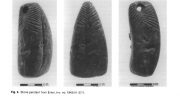
One material made Erimi-Pamboula particularly important: picrolite. This soft, blue-green stone came from water-worn pebbles in the Kouris River. While not especially rare, picrolite became highly valued across Cyprus. Skilled craftspeople shaped it into cruciform pendants, cross-shaped ornaments that became one of the most recognizable symbols of prehistoric Cypriot art.
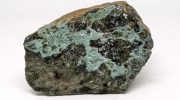
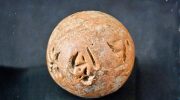
The 2025 excavations made a remarkable discovery: a partially preserved cruciform figurine carved from picrolite. These figurines are rare finds, and this one confirms that Erimi-Pamboula was likely a major center for picrolite craft production. The site also yielded raw picrolite pebbles, half-finished jewelry pieces, and completed pendants, showing the entire production process.
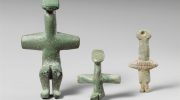
Many researchers believe Erimi-Pamboula’s size and longevity directly related to its control over picrolite resources. The settlement sat right next to the source material and had craftspeople who knew how to work it. These ornaments were exchanged across the island, making Erimi-Pamboula an economic hub.
What Recent Excavations Revealed
The 2025 excavation season brought important new evidence about the site’s timeline. The team found pottery sherds in upper layers that date to the Late Chalcolithic period, indicating people continued living at Erimi-Pamboula into the first half of the 3rd millennium BC. Archaeologists also recovered numerous stone tools, including axes, adzes, grinding stones, and scrapers. Animal bones show that deer were an important food source.
The excavation was a collaborative international effort involving experts from universities in Athens, Berlin, and Strasbourg, along with archaeologists from Cyprus. The work received support from several organizations, marking the University of Athens’s return to archaeological work in the region after more than three decades.
The End of an Era and Its Legacy
Between 2900 and 2700 BC, something dramatic happened across southern Cyprus. Major settlements like Erimi-Pamboula were abandoned. The distinctive Red-on-White pottery disappeared from archaeological records. Picrolite figurines, which had been produced for centuries, ceased to be made. An entire cultural tradition that had defined the Erimi culture vanished relatively quickly.
The reasons for this widespread change remain debated among scholars. What is clear is that this marked the end of the Chalcolithic period and the beginning of the Bronze Age. The Kouris valley wasn’t abandoned forever though. Centuries later, a completely different community called Erimi-Laonin tou Porakou emerged nearby, focused on textile production during the Middle Bronze Age.
Today, Erimi-Pamboula continues to shape our understanding of prehistoric Cyprus. The ongoing research helps archaeologists piece together how early Cypriot communities organized themselves, what they valued, and how they connected with each other.
Visiting the Site Today
The archaeological site of Erimi-Pamboula sits within the modern village of Erimi, in the Limassol District of Cyprus. Parts of the ancient settlement lie beneath the current village. Visitors to the area can explore the broader Kouris valley, which contains numerous archaeological sites from different periods. The nearby village of Kolossi features the medieval Kolossi Castle, while the Cyprus Wine Museum in Erimi village offers insights into the region’s long winemaking tradition.

Why Erimi-Pamboula Matters
Erimi-Pamboula represents more than just an archaeological site. It captures a formative moment in Cyprus’s history when island communities were establishing lasting traditions, developing specialized crafts, and creating networks of trade and exchange. The picrolite ornaments crafted here traveled across Cyprus, connecting people through shared symbols and beliefs.
The site reminds us that Cyprus has been a crossroads of culture and innovation for millennia. Long before written history, communities like Erimi-Pamboula were building substantial settlements, creating distinctive art, and shaping the island’s identity. Understanding these ancient villages helps us appreciate the deep roots of Cypriot culture and the remarkable continuity of human presence on this Mediterranean island.