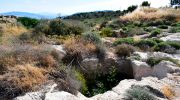
Pyla-Kokkinokremos stands as one of Cyprus’s most remarkable archaeological sites, offering a rare snapshot of life during the final decades of the Bronze Age. This fortified settlement, occupied for barely 50 years around 1200 BC, preserves evidence of a multicultural community that thrived briefly before vanishing from history.
The site occupies a rocky plateau rising 50 to 63 meters high, located about 10 kilometers east of ancient Kition (modern Larnaca) on Cyprus’s southeast coast. The plateau covers approximately seven hectares and sits roughly 800 meters from the current coastline. This naturally defensible position overlooked Larnaka Bay and connected major Bronze Age centers like Kition and Enkomi.
The settlement emerged during the Late Cypriot IIC–IIIA period, established at the end of the 13th century BC when the Late Bronze Age collapse reached its peak. Within a generation or two, by the early 12th century BC, residents abandoned the site. This brief occupation makes Pyla-Kokkinokremos invaluable to archaeologists, as it captures a precise moment in history without complications from later rebuilding.
Archaeological Discovery and Excavations
Porphyrios Dikaios first examined the site in 1952. Vassos Karageorghis conducted excavations in 1981–1982, then returned with Athanasia Kanta between 2010 and 2013. Since 2014, an international team from Ghent University, the Catholic University of Louvain, and the Mediterranean Archaeological Society has carried out systematic excavations under Joachim Bretschneider, Jan Driessen, and Athanasia Kanta.
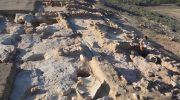
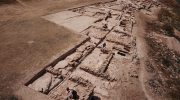
Recent campaigns, including the 2025 excavations, have revealed interconnected rooms, plaster floors, storage facilities, and evidence of various economic activities across different sectors of the plateau.
Planned Settlement Architecture
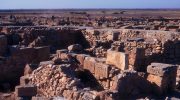
The settlement was carefully planned from its inception. A distinctive casemate wall system enclosed the community, consisting of two parallel walls with cross-walls creating chambers in between. While not particularly massive, these walls served multiple purposes beyond defense, providing storage and living space while strengthening the perimeter.
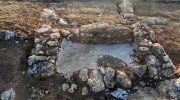
Some rooms featured polished plaster floors with a cement-like appearance, similar to those found at other Late Bronze Age sites. Excavations in 2012 identified the first gate structure at the site. Notably, the settlement had no natural water source, making water storage essential. Numerous pithoi (large storage jars) and deep pits demonstrate how seriously residents addressed this challenge.
A Mediterranean Cultural Crossroads
What makes Pyla-Kokkinokremos exceptional is its astonishing mix of cultural materials. Excavations have recovered pottery and objects from across the Mediterranean. Mycenaean Greece contributed amphoroid kraters decorated with chariots and birds. From Minoan Crete came fine vessels, including a remarkable krater showing a bull caught in a net. Canaanite jars from the Levant appear frequently.
More remarkably, Sardinian cooking vessels, some repaired with lead strips, Egyptian alabaster vessels, and items from Hittite Anatolia have been discovered alongside local Cypriot pottery. This diversity is unparalleled among contemporary Cypriot settlements, turning each household into a microcosm of Mediterranean interconnection.
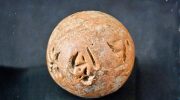
In 2012, excavators uncovered two clay tablets inscribed with the Cypro-Minoan script near the gate in Sector 4. This undeciphered writing system was used in Cyprus during the Late Bronze Age. Additional pottery sherds bearing Cypro-Minoan signs have been found throughout the site, offering clues about administration, trade, or ritual practices.
Daily Life Inside the Settlement
Evidence reveals a community engaged in diverse activities. Metalworking installations have been identified near the gate. Stone tools, querns for grinding grain, and stone vessels point to food processing. Textile production is indicated by approximately 100 unbaked loom weights found in Room 8, still in raw clay strips and malleable when abandoned.
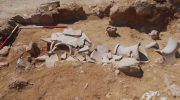
Large pithoi and storage jars appear in many rooms, highlighting the importance of long-term storage. Cooking areas with hearths and specialized vessels mark food preparation spaces. The presence of imported fine wares alongside utilitarian pottery suggests both daily practicality and the display of status or prosperity.
Sudden Abandonment of the Site
The settlement’s abandonment remains one of its most intriguing aspects. Evidence suggests the departure was both sudden and organized. Many rooms were left with their contents intact, including valuable items. Hidden hoards of precious metals, bronze figurines of Astarte, alabaster flasks filled with jewelry, and plaster spheres containing folded gold objects have all been discovered.
Since these valuables were never recovered, archaeologists believe the inhabitants were prevented from returning, possibly due to death, displacement, or enslavement. Some areas show signs of seismic activity. In Sector 4, rooms buried beneath up to three meters of deposits indicate a possible earthquake. The still-soft loom weights suggest residents fled immediately, leaving possessions behind.
The latest datable import, an early Late Helladic IIIC deep bowl from the Argolid, places abandonment around 1190 BC or shortly thereafter.
An Archaeological Time Capsule
Because the site was never reoccupied, Pyla-Kokkinokremos functions as a true archaeological time capsule. Unlike settlements with centuries of continuous use, where later construction erases earlier layers, this site preserves a single historical moment in remarkable clarity.
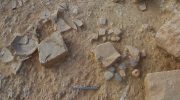
The cultural diversity found at the household level shows genuine integration rather than simple trade exchange. Residents adopted new practices and blended traditions, offering rare insight into migration, interaction, and cultural transformation during a pivotal period in Mediterranean history.
Ongoing and Future Research
The 2025 excavation season focused on Sectors 5 and 7 on the eastern lobe of the plateau. Sector 5 revealed densely packed, interconnected rooms with varied floor types and pottery assemblages. Sector 7 showed a more open layout, possibly used for storage, animals, or open-air activities.
Future excavations aim to clarify the settlement’s organization, its relationship with nearby sites in Larnaka Bay, and how environmental stress affected subsistence strategies at the end of the Bronze Age. Each season adds new layers of understanding to this short-lived yet extraordinarily important community.