Cyprus mirror-like landscapes create minimalist vistas where earth, water, and sky merge into simplified compositions perfect for contemplative viewing and photography. The Larnaca Salt Lake complex southwest of Larnaca city provides the island’s most dramatic example, transforming seasonally from a shallow reflective wetland in winter to an expansive white salt flat in summer.
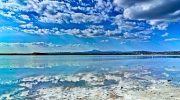
This network of four interconnected lakes, Aliki, Orphani, Soros, and Spiro, covers approximately 2.2 square kilometers and creates mirror reflections of the sky, Hala Sultan Tekke mosque, and palm trees during wet months. The minimalist aesthetic results from the flat terrain, horizontal lines, limited color palette of blue, white, and occasional pink from flamingos, and vast open spaces where human structures become small elements in much larger natural compositions.
The landscapes attract photographers seeking clean lines and negative space, nature enthusiasts drawn to seasonal wildlife including 85 bird species, and travelers looking for quiet environments that offer visual simplicity uncommon in developed Mediterranean destinations.
Seasonal Transformations and Visual Drama
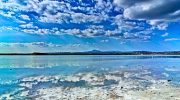
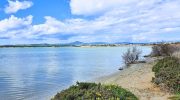
During winter months from November through March, rainfall fills Larnaca Salt Lake creating shallow water averaging 20 to 30 centimeters deep across the flats. This standing water becomes nature’s mirror, reflecting clouds, sky colors at dawn and dusk, and the architectural silhouette of Hala Sultan Tekke on the western shore. The reflections double visual elements, creating symmetrical compositions where distinguishing water from sky becomes difficult. Photographers exploit these conditions to capture images where flamingos appear suspended between identical upper and lower realms.
As spring arrives, water levels gradually decrease through evaporation accelerated by Cyprus’s intense sunshine and low humidity. The lake bottom emerges progressively, with shallow pools persisting in depressions while higher elevations dry first. This transitional period creates abstract patterns of water, wet mud, and emerging salt crust that change daily. The shrinking pools concentrate brine shrimp populations, attracting lingering flamingos and wading birds that feed intensively before migrating north.
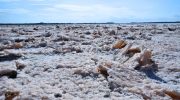
By summer, the lake transforms completely into a vast white expanse of crystallized salt covering the dry lakebed. The caked salt reflects intense sunlight, creating shimmering mirages that distort depth perception and make the flat surface appear to ripple like water. The visual effect resembles snow fields or desert playas, with the white surface contrasting sharply against blue Mediterranean sky. Walking across the salt crust produces crunching sounds as boots break through the upper layer into softer sediment below.
Autumn begins the cycle renewal as temperatures drop and occasional rains start refilling the lake. The first water creates temporary pools that gradually merge and expand until the entire lake fills again by December. This predictable seasonal rhythm has structured local activities for millennia, from ancient salt harvesting to modern wildlife observation and photography.
Flamingo Populations and Wildlife Spectacle
Between November and March, thousands of Greater Flamingos arrive at Larnaca Salt Lake during their annual migration between Europe and Africa. The birds feed on brine shrimp and other small organisms thriving in the salty shallow waters, wading through pools with their distinctive filter-feeding technique. The pink coloration comes from carotenoid pigments in the shrimp they consume, with color intensity varying based on individual diet quality.
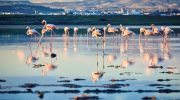
The flamingos create striking visual contrasts against the minimalist landscape. Their bright pink bodies stand out sharply against blue water and white salt, while their elongated necks and legs create elegant vertical lines in predominantly horizontal compositions. Large flocks moving in coordinated patterns add dynamic movement to otherwise static scenes, with takeoffs and landings creating temporary visual chaos before birds settle back into peaceful wading.
Beyond flamingos, the lake supports approximately 85 bird species including herons, cranes, and various waders. The protected wetland functions as a vital stopover point along the East African-West Asian migratory flyway, providing essential feeding and resting habitat for birds traveling thousands of kilometers between breeding and wintering grounds. The site’s designation as a Ramsar wetland of international importance, Natura 2000 protected area, and Special Protected Area under the Barcelona Convention recognizes this ecological significance.
Birdwatchers position themselves along the 4-kilometer nature trail encircling the lake, using the flat open terrain to scan for rare species. The lack of tall vegetation or obstructing structures creates excellent visibility across the entire wetland. Early morning and late afternoon hours provide best viewing when birds are most active and lighting conditions create optimal photographic opportunities.
Hala Sultan Tekke and Architectural Context
On the lake’s western edge stands Hala Sultan Tekke, one of Islam’s most important pilgrimage sites outside Saudi Arabia. The mosque complex surrounds the tomb of Umm Haram, a companion of Prophet Muhammad who reportedly died here after falling from a mule during the 647 AD Arab invasion of Cyprus. The architecture combines Islamic and Ottoman elements with white walls, a central dome, and minaret rising above surrounding palm trees.
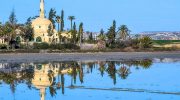
The mosque’s positioning creates powerful visual compositions where human architecture meets natural minimalism. The vertical minaret and dome provide focal points that anchor otherwise featureless horizontal expanses. The palm trees surrounding the complex add organic vertical elements that soften the stark geometry while maintaining the overall simplified aesthetic. During winter when water fills the lake, the entire complex reflects perfectly in still waters, doubling its visual presence.
The juxtaposition of sacred architecture against empty natural landscape creates contemplative atmospheres that attract photographers, spiritual seekers, and those simply appreciating aesthetic beauty. The setting demonstrates how minimal environments can emphasize rather than diminish human structures by providing clean visual contexts free from competing elements. The mosque appears more monumental precisely because it stands relatively isolated against vast open spaces.
Photography and Minimalist Aesthetics
The landscapes attract photographers specifically seeking minimalist compositions emphasizing negative space, simplified color palettes, and clean geometric lines. The horizontal division between earth and sky, with water sometimes creating a third horizontal band, provides classic minimalist structure. Photographers exploit these elements to create images where individual subjects, whether a lone flamingo, a distant mosque, or a solitary human figure, gain dramatic emphasis through isolation within vast empty spaces.
Golden hour periods at sunrise and sunset offer particularly striking conditions. The soft warm light creates beautiful colors while low sun angles produce long shadows and enhanced texture on the salt crust surface. The reflections on water surfaces intensify during calm wind conditions when even slight breezes can disturb the mirror effects. Photographers often arrive hours before dawn to secure positions for sunrise shots when flamingos are active and water is calmest.
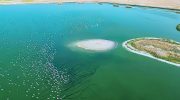
Wide-angle lenses capture the expansive character and emphasize depth through exaggerated perspective, while telephoto lenses isolate distant subjects against clean backgrounds. The lack of middle-ground clutter allows compression effects where subjects appear larger relative to distant backgrounds. Drone photography has become popular for capturing overhead views impossible from ground level, revealing abstract patterns and geometric relationships visible only from above.
Contemporary Significance and Visitor Experience
The landscapes provide counterpoint to Cyprus’s developed coastal resorts where beaches, hotels, and tourist infrastructure dominate visual experiences. The minimalist environments offer mental rest through visual simplicity, allowing contemplation impossible in visually complex urban settings. This quality attracts visitors seeking peaceful environments where they can experience nature without overwhelming sensory stimulation.
The proximity to Larnaca International Airport makes the salt lake among the first natural landmarks many visitors see upon arrival. The lake is easily accessible by car from Larnaca city center approximately 5 kilometers away, with nearby roads offering clear signage and designated viewpoints. Local bus routes connect the city to walking paths and viewing areas around the lake perimeter. The 4-kilometer trail accommodates walkers, joggers, and cyclists on flat terrain suitable for all fitness levels.
Visitor facilities remain minimal by design, preserving the landscape’s uncluttered character. Interpretive signs along the trail explain local flora, fauna, and geology without overwhelming the environment with infrastructure. Benches at strategic viewpoints allow rest and observation without disrupting sight lines. The restrained development approach maintains the very qualities that make the site valuable as a minimalist landscape experience.