Explore Cyprus with Our Interactive Map

Explore our top stories and discover ideas worth your time.

Troodos Hill Stations Platres and Square

Troodos Hill Stations Platres and Square

The Troodos Hill Stations refer to two main areas in the Troodos Mountains where the British colonial administration established summer retreats. Platres, located at an altitude of 1,100 meters on the southern slopes, became the premier mountain resort with luxury hotels, villas, and tree-lined walks. Troodos Square, situated near Mount Olympus at approximately 1,700 meters, served as the administrative center where the British governor relocated his entire government during the hot summer months. Together, these hill stations formed a unique mountain retreat system that shaped Cyprus tourism for over a century. Historical Background When Lieutenant-General Sir Garnet Wolseley arrived in Larnaca on July 22, 1878, as the island's first High Commissioner, he immediately recognized a serious problem. British troops stationed on the coastal plains suffered terribly from extreme heat that often exceeded 40 degrees Celsius, and malaria was widespread in low-lying areas. Coming from their experience in India, where hill stations had successfully reduced mortality rates among troops and civilians, the British knew exactly what to do. In September 1878, just two months after taking control of the island, construction began on the Troodos Hill Station. The site was chosen because elevations above 1,500 meters provided relief from tropical diseases and heat stress. Wooden huts were ordered from England, though records suggest these may never have arrived. By May 1879,…

Read more
Cyprus City Kingdoms

Cyprus City Kingdoms

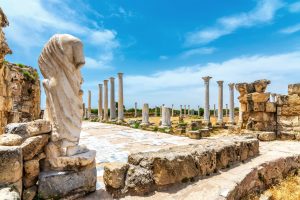
For over 3,000 years, Cyprus was home to powerful independent city-kingdoms that controlled trade routes, mined copper, and blended Greek, Phoenician, and local cultures into something uniquely Cypriot. These ancient cities left behind spectacular ruins - theaters still hosting performances, mosaic-floored villas, and temple foundations - that tell the story of a small island that punched far above its weight in the ancient world. A Patchwork of Powerful Cities Unlike many ancient lands ruled by a single king or empire, Cyprus developed as a collection of independent city-kingdoms. Each coastal city controlled its surrounding territory, built its own temples and palaces, minted its own coins, and conducted its own diplomacy with the great powers of Egypt, Persia, and Greece. At its height during the Iron Age (around 1000-300 BC), Cyprus had about a dozen of these city-kingdoms. Names like Kourion, Kition, Salamis, and Paphos appeared in ancient texts and on diplomatic correspondence. Some were founded by Greek colonists, others by Phoenician traders, but all developed distinctly Cypriot identities that blended Eastern and Western influences in architecture, religion, and daily life. From Bronze Age Towns to Iron Age Kingdoms Cyprus's city-kingdoms emerged from earlier Bronze Age settlements that had grown wealthy from copper mining and Mediterranean trade. By 1600-1050 BC, the island had become a crucial hub connecting the civilizations of…

Read more
Church of Stavros tou Agiasmati Wall Painting

Church of Stavros tou Agiasmati Wall Painting

The Church of Stavros tou Agiasmati, situated in the Troodos Mountains near the village of Platanistasa, is one of the monuments included in the UNESCO World Heritage group known as the Painted Churches of the Troodos Region. Dating to the late 15th century, the church represents a mature phase of Cypriot ecclesiastical art during a period of political change and cultural interaction. Its decoration is attributed to the painter Philip Goul, a master whose work reflects the continued vitality of Orthodox artistic traditions under Venetian rule. The church’s importance lies in the completeness and narrative richness of its fresco cycle, which preserves a vivid visual expression of late medieval theology and devotion. ayda-ru During the 15th century, Cyprus stood at a crossroads between Byzantine heritage and Western influence. Although the island was under Venetian administration, Orthodox communities maintained their religious and artistic traditions. Stavros tou Agiasmati embodies this continuity, demonstrating that rural mountain churches remained centers of creative expression and theological instruction. Its remote location contributed to the preservation of its paintings, allowing modern viewers to experience a nearly intact example of late medieval Cypriot religious art. Architectural Form and Environmental Adaptation Architecturally, the church follows the characteristic Troodos mountain type: a small, single-aisled structure built of local stone and covered by a steeply pitched wooden roof. This roof, extending…

Read more