Explore Cyprus with Our Interactive Map

Explore our top stories and discover ideas worth your time.

Safety and Crime Rates in Cyprus

Safety and Crime Rates in Cyprus

The serious crime index in Cyprus reached 584 per 100,000 inhabitants in 2022, rising from 501 in 2021 and 482 in 2020. While this upward trend appears concerning at first glance, the nature of reported crimes remains predominantly non-violent. Property offenses account for roughly 40% of serious crimes, followed by offenses harmful to the public in general at approximately 19%. Violent crimes against individuals make up a smaller proportion of the total. In 2024, authorities recorded 5,900 actual serious criminal offenses, up from 5,630 in 2023. This represents continued growth in overall crime numbers. However, the breakdown shows property crimes at 31.8% in 2024, down from 34.8% the previous year, while offenses against individuals rose to 26.8%. The police achieved a solving rate of 77.78% for serious crimes in 2025, slightly below the 81.29% recorded in 2024. Cyprus through September 2025 saw 4,096 serious crimes recorded, representing a 5.27% increase compared to the same period in 2024 when 3,891 cases were registered. Despite these increases, the island maintains safety levels that surpass most European destinations. Emergency services average 8-minute response times in urban areas, matching or exceeding European standards for rapid assistance. How Cyprus Compares Globally Cyprus does not appear in the top tier of the 2025 Global Peace Index, which ranks countries based on societal safety, ongoing conflict, and…

Read more
Agia Paraskevi Necropolis

Agia Paraskevi Necropolis

The Agia Paraskevi necropolis is an extensive Bronze Age burial ground located approximately half a mile north of the Church of Agia Paraskevi in the Nicosia district. The site occupies the edge of a plateau southwest of Cyprus's modern capital. It takes its name from the nearby Byzantine church. This cemetery was used continuously throughout the Early and Middle Bronze Age periods, roughly from 2400 BCE to 1100 BCE. The site contains hundreds of rock-cut chamber tombs where ancient communities buried their dead along with pottery, tools, jewelry, and other grave goods. These artifacts provide detailed information about how Cypriots lived, traded, and organized their societies during prehistoric times. The necropolis is particularly important because it represents the burial ground for ancient Ledra, one of the early kingdoms mentioned in Assyrian records. While the settlement itself lies buried beneath modern Nicosia, the cemetery on the plateau has survived and offers the most complete picture of life in central Cyprus during the Bronze Age. Historical Background The Agia Paraskevi necropolis came to archaeological attention in the late 19th century. In 1883 and 1884, German archaeologist Dr. Max Ohnefalsch-Richter conducted extensive excavations at the site. His work uncovered numerous tombs and established the cemetery's importance for understanding Cypriot prehistory. Ohnefalsch-Richter arrived in Cyprus in 1878 as a journalist but quickly shifted his…

Read more
Labyrinth Streets of Cyprus Villages

Labyrinth Streets of Cyprus Villages

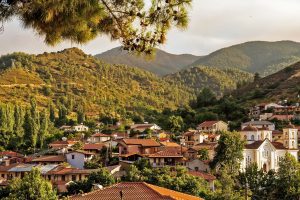
The narrow labyrinth streets of Cyprus villages create distinctive spatial patterns that developed organically over centuries without formal planning. These winding lanes, rarely exceeding 2 to 3 meters in width, twist through compact settlements where stone houses press close together along irregular paths dictated by terrain, water sources, and family land divisions. Cypriot villages were built without original master plans, with street locations determined by natural conditions including slope, rivers, and agricultural boundaries. The compact layouts served practical purposes including defense against raiders, social cohesion through proximity, protection from summer heat through shade creation, and efficient land use that maximized agricultural acreage surrounding settlements. The resulting maze-like networks connect homes to central squares where churches, mosques, coffee shops, and taverns anchored community life while radiating outward to agricultural fields and vineyards that sustained village economies. Organic Growth Without Urban Planning Traditional Cyprus villages developed through accretion as families built homes adjacent to relatives and neighbors without coordinating with central authority or following predetermined layouts. When young people married, they typically constructed new houses near their parents' property, creating family clusters that expanded outward from original settlement cores. This pattern repeated across generations, producing intricate networks of connected buildings separated by the minimum passages needed for human and animal movement. The terrain fundamentally shaped village morphology. Mountain villages like Kakopetria and…

Read more