Explore Cyprus with Our Interactive Map

Explore our top stories and discover ideas worth your time.

Sanctuary of Opaon Melanthios

Sanctuary of Opaon Melanthios

A rural shrine dedicated to a local healing deity (Melanthios), illustrating the existence of indigenous Cypriot gods worshipped alongside the Greek pantheon. The Sanctuary of Opaon Melanthios stands as a profound example of Cyprus's religious syncretism, where an indigenous deity associated with shepherds and rural healing was venerated in harmony with Greek gods like Pan and Apollo. Situated on the 'Petros Anthropos' hill north of Amargeti in the Paphos district, this rural shrine highlights the island's unique spiritual landscape, blending local Cypriot traditions with Hellenistic influences. As a healing deity, Opaon Melanthios, whose name translates to "Dark Shepherd", was invoked for protection over flocks, health, and fertility, reflecting the agrarian society's reliance on divine intervention for well-being and prosperity. This site underscores Cyprus's role as a cultural crossroads, where native gods coexisted with imported pantheons, fostering a resilient worship that endured from the Archaic period through Roman times, and continues to intrigue archaeologists today. A Rural Shrine of Syncretism The Sanctuary of Opaon Melanthios, perched on a modest hill overlooking the verdant valleys of Amargeti, embodies the quiet devotion of Cyprus's rural communities to a deity who bridged local folklore and Greek mythology. Covering a small area of rocky terrain dotted with ancient olive trees, the site features remnants of a temple structure, altars, and votive deposits that speak to…

Read more
Copper Identity of Cyprus

Copper Identity of Cyprus

The island of Cyprus owes more than just its prosperity to copper. The very name of this Mediterranean nation comes from the ancient Greek word Kúpros, which scholars believe connects to the metal that defined its economy for over 4,000 years. The English word "copper" itself derives from the Latin phrase aes cyprium, meaning "metal of Cyprus." This linguistic connection reveals a fundamental truth: Cyprus and copper are so deeply intertwined that ancient civilizations could not think of one without the other. From the fourth millennium BC to the Roman Empire and beyond, copper mining transformed Cyprus from a small island into a major economic power in the ancient world. The Ancient Discovery That Changed Everything Copper production on Cyprus began around 4000 BC, when early inhabitants discovered deposits of pure copper on the surface. These first copper workers fashioned simple tools without needing to mine underground. By 2500 BC, Cypriots had learned to smelt copper ore, initially creating an alloy with arsenic before switching to tin around 1900 BC to produce true bronze. The richest deposits lay in the Troodos Mountains, particularly in the pillow lava formations along the northern slopes. These copper-bearing ores formed 90 million years ago through volcanic activity on the ancient ocean floor, when hydrothermal vents ejected mineral-rich water that concentrated into valuable seams. As…

Read more
Cyprus Meze Social Dining Tradition

Cyprus Meze Social Dining Tradition

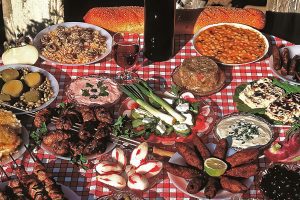
Meze in Cyprus is not a starter, a tasting menu, or a casual sharing plate. It is a complete dining ritual built around time, abundance, and company. When Cypriots sit down for meze, they are committing to an experience that unfolds slowly, dish by dish, over several hours. This article explains what makes Cypriot meze different from its Mediterranean cousins, how it is structured, why it matters socially, and how it continues to shape everyday life on the island. The goal is not to list dishes, but to show how food, pacing, and hospitality come together in one of Cyprus’s most enduring traditions. Meze as a Meal, Not a Prelude In much of the eastern Mediterranean, meze refers to small plates served before a main course or alongside drinks. In Cyprus, meze replaces the entire concept of courses. Ordering meze means you will not choose individual dishes, and you will not rush. The kitchen decides the sequence, and the table follows its rhythm. This distinction is essential. Cypriot meze is designed as a narrative rather than a collection. Each plate prepares the way for the next, building flavour and fullness gradually. What matters is not quantity alone, but progression and the shared pace that develops around the table. Why Meze Exists in Cypriot Life While the tradition grew from village…

Read more