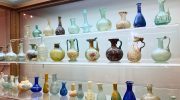
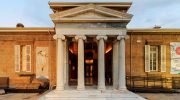
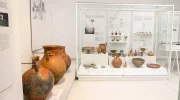
The Leventis Gallery is an art gallery in Nicosia, Cyprus. Opened in 2014, it houses a collection of over 800 paintings from Cypriot, Greek, and European artists. The institution operates under the A. G. Leventis Foundation and represents the fulfillment of a vision conceived more than fifty years earlier.
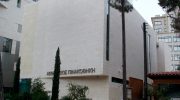
The building sits a few steps from Nicosia’s old city center and was designed by Feilden Clegg Bradley Studios through an international architectural competition launched by RIBA Competitions. The architects created a modern cultural center embodying the personality of the family collection while contributing to urban regeneration.

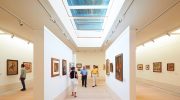
The building was conceived as a monolithic stone sculpture cut away to create courtyards, terraces, and roof gardens. The gallery features minimized energy use, enhanced insulation, airtightness, and extensive use of natural daylighting. The institution currently holds three distinct collections: the Paris Collection of European art, the Greek Collection from the 19th and 20th centuries, and the Cyprus Collection of modern Cypriot art.
Historical Background
Anastasios G. Leventis was born in Cyprus in December 1902, in the Cypriot mountain village of Lemythou. His father was a minister of the Greek Orthodox Church and worked as a schoolmaster. After World War I, Leventis went to Marseilles, where he worked and studied commerce in Bordeaux. At the age of 16, he traveled to France to look for employment and educational opportunities.

In 1920, he was employed by an Anglo-Hellenic company and assigned to managerial positions in Nigeria and later in the Gold Coast (now Ghana). In 1937, he left the firm after it was acquired by United Africa Company. Leventis then formed his own company and started out as a produce buyer.
Within a few years, his Nigerian company expanded from cotton exports to merchandise trading. By the 1960s, his firm had grown to become one of the largest distributors in Nigeria and one of the largest merchandise traders in the West African region.
Building a Cultural Legacy
Anastasios G. Leventis had been particularly active in supporting the Department of Antiquities’ restoration of two important Byzantine monuments and in helping the Cyprus Government project the image of its cultural and artistic heritage abroad.
He built up a notable collection of French and European paintings in Paris. In Athens, he acquired the important first collection of Evangelos Averoff, champion of Greek art and artists from the early 19th to the mid-20th century. In 1966, President Makarios appointed him Cyprus’s first Ambassador and Permanent Delegate to UNESCO, in recognition of his support for culture and education.
He collaborated with Makarios to found the main old people’s home in Nicosia. He was awarded the title of Babalaje of Egbaland by Alake Ladapo Ademola.
His daughter Fotini married politician Tassos Papadopoulos, who later became President of Cyprus. Anastasios G. Leventis died in October 1978, having provided for the establishment of a foundation to support educational, cultural, artistic, and philanthropic causes in Cyprus, Greece, and elsewhere.
The Three Main Collections
The Greek collection features works by 19th and 20th-century Greek artists. The early core of the collection was formed of the artworks acquired by Anastasios G. Leventis in 1973 from Evangelos Averoff-Tossizza.
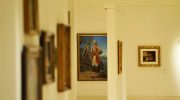
Following acquisitions in the 1990s and 2000s, the Greek Collection today numbers upward of 260 works, spanning from the aftermath of the Greek War of Independence in 1821 to around 1970. The Paris Collection showcases European art from the Renaissance to the 20th century and was Leventis’s private collection, housed in his apartment in Paris.
The interactive display features Louis XV and Louis XVI furniture, Chinese porcelain, delicate Meissen and Sévres wares, and a wealth of other objets d’art from biscuit figurines to period clocks, miniatures, and small-scale sculptures. The elegant wood-paneled room from the collector’s apartment was transported and re-erected in the gallery space, evoking the ambiance of the residence that overlooked Parisian boulevards and the Eiffel Tower.
Cyprus Collection Highlights
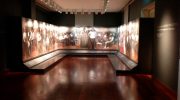
The Cyprus collection includes many iconic pieces, and at its heart is the monumental piece by Adamantios Diamantis, The World of Cyprus. The A. G. Leventis Foundation began collecting Cypriot art only quite recently, focusing on artists influenced by their education abroad at various fine art academies where they were exposed to Post-Impressionism and other contemporaneous Modernist movements.
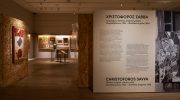
This monumental 17.5 meter long painting consists of 11 panels and was created in Cyprus between 1967 and 1972. Diamantis traveled to the island’s villages, studied people of the countryside, and depicted the simplicity of their daily lives.
In the studio, he executed 67 monumental figures in a work that symbolically brought together people from various corners of the island. Diamantis placed emphasis on line in this composition, using colour to highlight the overall effect of the drawing. He chose an earthy brown for the third colour, to instil the work with the needed warmth and because this colour symbolises the deep connection between the Cypriot villager and the land.
The Painting’s Journey Home
First presented in the Museum of Folk Art in Nicosia in 1975, the painting traveled to Greece for an exhibition at the National Gallery and was then acquired by the Teloglion Foundation of Art, where it remained following the Turkish invasion of Cyprus.
The critical situation in Cyprus after 1974 was deemed as creating insecure and unpredictable conditions for the return of the painting. There was a verbal promise to Diamantis himself that the work would return to Cyprus when conditions on the island were considered safe.
Thanks to an agreement between the Teloglion Foundation of Art and the A. G. Leventis Foundation, The World of Cyprus returned to its homeland. Adamantios Diamantis was born in 1900 and studied in London at Saint Martin’s School of Art (1920-1921) and the Royal College of Art (1921-1923).
Upon graduation, he split the First Prize for Drawing with his fellow student Henry Moore. He developed his own style through the study of classical values, delving into the work of El Greco, Cézanne, and other Modernist artists.
The Foundation’s Broader Mission
The A. G. Leventis Foundation was established in May 1979 as a result of provisions made by Anastasios G. Leventis. The range and direction of its activities were based on the philanthropic interests of the founder.
In Cyprus and Greece, there has been a focus on culture and education with special emphasis on cultural heritage. The foundation has supported restoration of monuments from various periods and enriched presentations of Cypriot antiquities in museums worldwide.
In West Africa, an area long connected with the Leventis family, the Leventis Foundation Nigeria was set up in 1988 to continue existing philanthropic programs. The scholarship program that Leventis himself initiated has been systematized and greatly expanded, almost exclusively at postgraduate level since 1992.
The foundation has also prioritized support for environmental protection, with programs in Cyprus, West Africa, and elsewhere targeted at pressing ecological problems. Medical research, disease control, and charitable causes in Cyprus have received consistent support.
Visiting the Modern Space
The gallery includes a restaurant and café that serves as a cultural meeting point. The museum shop offers exhibition catalogs, monographs, and art publications. The gallery operates educational programs for school groups and the general public.
Temporary exhibitions complement the permanent collection displays. The building provides luminous, open gallery spaces across multiple floors that invite deep engagement with the artworks. The architecture creates a dialogue between indoor and outdoor spaces through courtyards and terraces. Most visitors spend two to three hours exploring the exhibits.
The location near the old city makes it convenient to combine with visits to other historic sites in Nicosia. The gallery hosts cultural events, lectures, and workshops throughout the year. A 360-degree virtual tour is available online for those who cannot visit in person.
Why This Gallery Matters Today
The Leventis Gallery demonstrates how individual vision and philanthropy can create lasting cultural institutions. The collection bridges European, Greek, and Cypriot artistic traditions, showing how Cyprus participated in broader Mediterranean cultural dialogues while developing its distinctive voice.

The gallery preserves works that might otherwise have been dispersed or lost, particularly pieces like The World of Cyprus that document traditional Cypriot life before the island’s division. The institution makes high-quality European art accessible to Cypriots without requiring travel to major European capitals. The combination of period furniture, decorative arts, and paintings provides context for understanding how art functioned in domestic and social settings.
The gallery serves as an educational resource for students, scholars, and the general public. By housing these collections in a purpose-built modern facility, the foundation ensures their preservation for future generations while making them freely accessible to all visitors.