Explore Cyprus with Our Interactive Map

Explore our top stories and discover ideas worth your time.

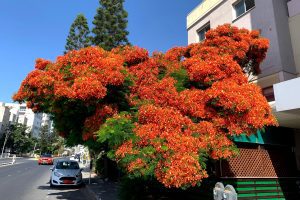
Royal Poinciana Trees in Cyprus

Royal Poinciana Trees in Cyprus

Picture a quiet street in Ayia Napa or Limassol in early June, when the heat has already settled in. Suddenly the whole canopy ignites in a blaze of scarlet and orange, as if someone has draped living flames across the branches. This is the royal poinciana of Cyprus – a tree so spectacular that locals and visitors alike stop to stare every summer. The Royal Flame in the Legume Family Delonix regia belongs to the vast Fabaceae (legume) family, specifically the Caesalpinioideae subfamily – the same group that includes carob, senna and many beautiful tropical trees. The genus Delonix is small, with just a handful of species, nearly all native to Madagascar and nearby islands. Locally it is known as Φλαμπουγιάν (Flambouyian) or Βασιλική Ποιντσιάνα (Vasiliki Pointsiána), names that echo its French nickname “flamboyant” (showy or flaming) and its older scientific synonym Poinciana regia. The genus name itself comes from ancient Greek: delos (visible or conspicuous) + onyx (claw), perfectly describing the long, claw-like petals that make each flower look like a tiny exotic bird. From Madagascar to Cypriot Shores Native to the dry deciduous forests of Madagascar, the royal poinciana was unknown to science in the wild until the 1930s, though it had already been carried around the tropics by traders and gardeners for centuries. It reached the Mediterranean…

Read more
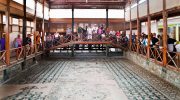
Nea Paphos Basilica Mosaics

Nea Paphos Basilica Mosaics

The basilica mosaics of Nea Paphos show how Cyprus shifted from Roman myth culture to Christian worship without abandoning its strongest visual craft. Using familiar techniques, artists replaced narrative gods and heroes with symbols, vines, animals, and geometry that guided movement and reinforced theology inside new communal basilicas. This article explains how the change happened across key churches in Kato Paphos, what motifs were repurposed, and why these floors remain one of the clearest records of cultural adaptation on the island. Mosaics You Miss at First Long before Christianity reached Cyprus, Nea Paphos was already a city of mosaics. As the island’s administrative capital during the Hellenistic and Roman periods, it developed a strong tradition of floor decoration in elite houses and public buildings. Mythological scenes, hunting imagery, marine creatures, and geometric borders filled the villas of wealthy residents. This matters because the Christian mosaics did not appear in isolation. The artisans, materials, and techniques were already present. What changed was not the craft, but the message. When Christianity began to take hold in the 4th century, the language of mosaics was repurposed rather than replaced. Paphos Already Knew Mosaic Luxury The most dramatic shift brought by Christianity was not stylistic, but spatial. Pagan mosaics belonged largely to private homes, where they reinforced status, education, and cultural identity. Christian mosaics…

Read more

Buffavento Castle Cyprus

Buffavento Castle Cyprus

Buffavento Castle stands at 960 meters above sea level in the Kyrenia mountain range of Cyprus. This medieval fortress is the highest and least preserved of three Byzantine strongholds built along the mountains. The name comes from Italian and means "Defier of the Winds," a fitting description for a castle constantly exposed to mountain winds at this elevation. The castle sits between St. Hilarion Castle to the west and Kantara Castle to the east, forming a defensive line across the Kyrenia Mountains. All three castles are visible from each other, allowing them to pass signals and warnings. Buffavento guarded the mountain passage from Kythrea to the north coast, controlling movement between the coastal plain and the interior. The location provides views in every direction. Looking north across the Mediterranean Sea, visitors can see the Turkish coast approximately 65 kilometers away on clear days. To the south, the Mesaoria Plain stretches toward Nicosia. On exceptionally clear days, Famagusta to the east and the Troodos Mountains to the south are visible. The castle overlooks nearly half the island from its rocky peak. The steep cliffs surrounding the fortress made it naturally defensible. The north, east, and west sides are protected by sheer drops, with only the southern approach allowing access. Historical Background The exact construction date remains unknown, though most historians believe…

Read more