The stone figurines of Khirokitia are among Cyprus’s earliest human representations, carved over 9,000 years ago within one of the island’s first permanent farming settlements. Found in domestic and burial contexts, they were not decoration but durable objects that helped households maintain identity, lineage, and a living relationship with ancestors buried beneath the home. This article explains why the figures are intentionally abstract, why hard stone was chosen despite the labour, and what their placement reveals about memory and belonging at the dawn of settled life in Cyprus.
Khirokitia Above the Maroni River
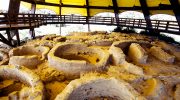
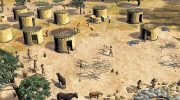
The Neolithic settlement of Khirokitia lies on a steep hillside above the Maroni River in southern Cyprus. Occupied during the Aceramic Neolithic period, it represents the island’s first permanent agricultural society. Life here was organised around circular stone houses, shared courtyards, and a tightly knit social structure built on extended families.
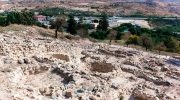
In this context, figurines were not decorative objects or isolated artworks. They were part of daily life, ritual practice, and memory. Their meaning comes not from how they look alone, but from where they were found and how they were used.
Small Figures, Heavy Meaning
More than two dozen anthropomorphic figurines have been recovered from Khirokitia, an unusually high number for a Neolithic site. Most are small, abstract, and deliberately simplified. Bodies are reduced to essential forms, faces are calm and frontal, and gender is often unclear or entirely absent.
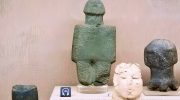
This abstraction was intentional. The figures were not meant to portray specific individuals or physical beauty. Instead, they expressed a shared idea of “being human” within the community. By stripping away personal detail, the figurines became symbols that could stand for ancestors, lineage, or collective identity rather than one person alone.
Why Stone Was Chosen
Nearly all Khirokitia figurines were carved from hard igneous stones such as diabase, collected from the Maroni River. This was not the easiest material to work with. Shaping diabase without metal tools required patience, skill, and many hours of grinding and pecking.
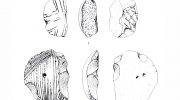
That effort matters. Choosing such resistant stone suggests these objects were meant to last. In a world where wood, skin, and plant fibres decayed quickly, stone provided permanence. The figurines endured long after their makers were gone, continuing to “exist” within the household even as generations changed.
Faces Made for Neutrality
One of the most striking aspects of the figurines is the restraint of their facial features. Eyes, brows, and noses are hinted at with minimal incisions, while mouths are often absent altogether. The result is not emptiness, but neutrality, an expression that resists emotion, age, or individuality.
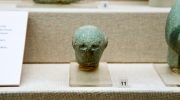
This absence of detail appears deliberate rather than unfinished. Unlike many Neolithic figurines from neighbouring regions, the Khirokitia examples rarely emphasise sexual characteristics or bodily exaggeration. Their purpose does not seem rooted in fertility symbolism or physical reproduction. Instead, the figures appear to embody continuity and presence, suggesting that what mattered most was not gendered identity, but belonging within a lineage that extended beyond a single lifetime.
Living With the Dead
The figurines gain deeper meaning when viewed alongside Khirokitia’s burial practices. Rather than separating the dead from the living, inhabitants buried family members beneath the floors of their homes. Daily activities unfolded directly above these graves, embedding memory into the fabric of domestic life.
Figurines are frequently found in or near these burial contexts. Their placement suggests they acted as mediating objects, maintaining a relationship between generations rather than marking a division. In this setting, death was not treated as an absence but as a continued presence. The figurines helped materialise that idea, offering a physical form through which remembrance could persist.
Broken Heads and Intentional Acts
A notable number of figurines, particularly stone heads, were discovered broken at the neck. These fractures are consistent and clean, leading archaeologists to interpret them as intentional rather than accidental damage.
One possibility is that the stone heads were originally attached to bodies made of wood or other organic materials that have since decayed. Another interpretation suggests deliberate breakage, perhaps marking the conclusion of a ritual role after a death or ceremonial event. In either case, the damage speaks to use and meaning. These objects were not discarded casually. They participated in social and ritual cycles, and their alteration reflects purposeful human action.
A Rare Exception in Clay
Among the stone figurines, one object stands apart: a small head made of unfired clay. Unlike the abstract stone forms, this piece is more naturalistic, with softly modelled features and carefully shaped hair.
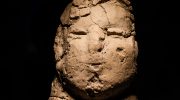
Its rarity makes it especially revealing. It demonstrates that Khirokitia’s inhabitants were capable of different artistic approaches, even if they chose not to pursue them widely. The dominance of stone was therefore cultural rather than technical. The clay head hints at aesthetic possibilities that would emerge much later in Cypriot terracotta traditions, centuries after Khirokitia was abandoned.
What the Figurines Tell Us About Early Cyprus
Taken together, the figurines point to a society deeply invested in memory, continuity, and social cohesion. They were neither idols in a later religious sense nor personal portraits. Instead, they functioned as material expressions of presence, placed within spaces where life unfolded and where ancestors remained close.
Their abstraction, durability, and domestic context reflect a worldview focused on persistence rather than spectacle. These early Cypriots were not attempting to immortalise individuals. They were affirming the endurance of the household, the lineage, and the human presence within a changing world.
Seeing the Figurines Today
Today, many of the Khirokitia figurines are housed in museums across Cyprus. Displayed behind glass, they appear quiet and restrained, far removed from the intimate spaces they once occupied. Yet understanding their original context transforms them from archaeological artefacts into witnesses of one of the Mediterranean’s earliest settled communities.
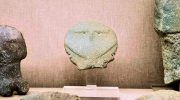
Their significance lies not in size or decoration, but in intention. These small stone forms mark the moment when life in Cyprus became permanent, and when people first sought to give lasting shape to themselves, their memories, and their place in the world.