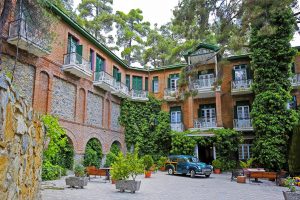
The British Colonial Law Courts building stands at the heart of North Nicosia, where it has dispensed justice for over a century. Built on the ruins of a medieval palace, this colonial structure embodies the layered history of Cyprus.
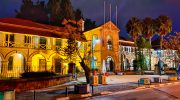
The Law Courts building occupies Sarayönü Square, also known as Atatürk Square, in central North Nicosia. For centuries, this location served as the island’s administrative center.
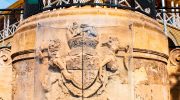
The building complex includes the main law courts, along with the Nicosia Post Office, a police station, and several government offices. The rectangular structure features an internal courtyard with several attached buildings and separate structures, all surrounded by a low sandstone wall with iron railings. The British coat of arms remains visible on the southeast corner of this wall.
Historical Background
The site has served as a seat of power for over 700 years. The Lusignan dynasty, French rulers of Cyprus, built their third royal palace here in the 15th century. Originally constructed as the residence of Sir Hugh de la Baume, the Constable of Cyprus, the building became a royal palace after the Mamluks burned the second palace during their campaigns against Cyprus between 1424 and 1426. The royal family moved in after alterations in 1427.
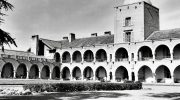
When the Venetians captured Cyprus in 1489, they modified the palace and used it as the governor’s mansion, calling it “Palazzo del Governo.” They added a granite column brought from the ancient city of Salamis to the square in 1550, topped with the Lion of St. Mark to symbolize Venetian dominance.
The Ottomans conquered Nicosia in 1570. The palace became a stronghold for the final pockets of Venetian resistance. After Governor Lala Mustafa Pasha demanded surrender, the Venetians complied, but the Ottoman forces massacred the governor and city elite. The Ottomans then used the palace as the residence for the island’s governors, referring to it as “Saray” or “Hükümet Konağı.”
The palace witnessed violence again on November 5, 1764, when enraged Cypriots stormed the building and killed Governor Çil Osman Ağa along with 18 of his men in protest against oppressive taxes.
The Decision to Demolish
When the British took administrative control of Cyprus in 1878, they continued to use the palace as an official building for part of the administration. By the late 1890s, the structure had deteriorated badly. The British colonial administration deemed the 700-year-old complex too weak and ruinous to repair.
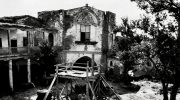
In 1896, three officials, Frank Cartwright, George Jeffery, and William Williams, created plans that would preserve the historical gate of the palace. However, keeping the gate proved technically impossible, so it was removed to what is now the Lapidary Museum. The plans to save the gate were discarded.
Building the New Courts
Charles Vincent Bellamy designed the present Law Courts building in 1899. Bellamy served as the Director of Public Works from 1898 to 1903. Born in Plymouth in 1867, he had previously worked in Ceylon, Dominica, and other British colonies. Beyond his architectural work, Bellamy published several important studies about Cyprus, including a geological map of the island in 1904 and a book titled “The Geology of Cyprus” co-authored with Alfred John Jukes-Browne.
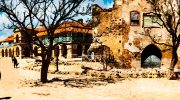
Construction began on June 14, 1900. The work took four years to complete. When the building opened in 1904, it housed the law courts, postal service, land registry office, and police. The building followed a simple modernist style without complicated forms, typical of British colonial architecture of the period.
The main structure is rectangular with an internal courtyard. Several buildings attach to the main structure while others stand separately within the walled complex. The sandstone walls and iron railings create a distinct perimeter around the grounds.
What Was Lost
The demolition of the Lusignan Palace eliminated one of Nicosia’s most important medieval buildings. The palace had stood at the center of power through the Lusignan, Venetian, and Ottoman periods. Visitors in the late 19th century described it as a large open courtyard surrounded by an arcade of pointed arches carried on short square pillars, with a balcony above and a well in the center.
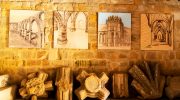
The entrance gate featured a square room with a beautiful flamboyant window facing the courtyard. This window dated to the 14th century. The rest of the palace complex included Gothic architectural details, fine stonework, and ceremonial spaces where kings were crowned and governors ruled.
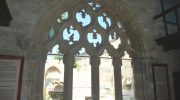
The site where raspberry trees once grew in front of the palace now holds the Venetian Column. No visible trace of the Lusignan Palace remains in Sarayönü Square today except for the salvaged Gothic window in the Lapidary Museum.
Despite the cultural loss of the medieval palace, the Law Courts building has successfully continued the site’s role as a center of government and justice. The building has served continuously as a law court since 1904, making it one of the few colonial buildings in Cyprus that still performs its original function.
The British Legal Legacy
The British brought their common law system to Cyprus when they took control in 1878. They enacted numerous codifications of common law principles, known as Chapters, many of which remain in force today. The Law Courts building became the physical embodiment of this legal transformation.

The majority of contemporary legal instruments and principles in Cyprus date back to colonial legislation enacted between 1878 and 1960. Unlike in the United Kingdom, where civil law relies purely on case law, Cyprus has Chapter 148, which governs most civil liability claims. The doctrine of precedent found in common law still applies, with first instance courts required to follow Supreme Court interpretations.
The building witnessed the development of Cyprus’s mixed legal system, which combines British common law traditions with elements of Ottoman law in property matters and continental European influences in constitutional and administrative law.
Fascinating Facts That are Worth Knowing About
The British coat of arms on the wall remains one of the most photographed features of the building. Visitors frequently stop to examine this symbol of British imperial rule carved into the sandstone.
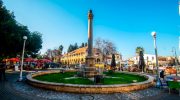
The Venetian Column in the square has had three different tops. The Venetians placed the Lion of St. Mark on it in 1550. The Ottomans removed the lion in 1570. The British re-erected the column in 1915 and placed a bronze globe on top, where it remains today.
The fountain at the corner of the Law Courts was built during the Ottoman period. Traveler Giovanni Mariti wrote about the fountain in the 1760s, noting it was well-supplied with water from the Arab Ahmet water source. The octagonal fountain has one spout on each side within niches. It no longer functions, but was restored by the Turkish Cypriot Department of Antiquities in 1976.
Bellamy’s work on Cyprus extended beyond architecture. His geological map of Cyprus and his publications on the island’s rainfall, irrigation, and climate contributed significantly to the scientific understanding of the island. He later served in World War I, rising to the rank of Lieutenant Colonel and commanding what became known as “Bellamy’s Force” in Belgium.
Visiting the Square Today
Sarayönü Square, where the Law Courts stand, functions as the center of North Nicosia. The area includes shops, cafes, and restaurants around the square. Visitors can walk to the square from the Ledra Street crossing point or enter through Kyrenia Gate, where Girne Avenue ends at the square.
The building itself is not typically open for casual tourism as it continues to serve as a working courthouse. However, visitors can photograph the exterior, examine the British coat of arms on the wall, and view the building’s colonial architecture from the square.
The Saray Hotel, built in 1962, stands just off the square. The hotel’s rooftop terrace offers panoramic views over both parts of Nicosia and provides a good vantage point to see the Law Courts building and the surrounding old city.
The nearby Lapidary Museum holds the salvaged Gothic window from the Lusignan Palace gate, located just behind Selimiye Mosque. This allows visitors to see the only surviving architectural element from the medieval palace that once stood where the Law Courts now sit.
Why Historic British Law Court Matters
The British Colonial Law Courts building tells two stories. The first is about continuity. For over a century, this site has housed the island’s courts, maintaining a tradition of centralized justice that stretches back 700 years. The building continues to fulfill the function for which it was designed.
The second story is about loss and transformation. The medieval palace that stood here represented centuries of Cypriot history under multiple rulers. Its demolition removed an irreplaceable link to the island’s past. The British chose efficiency and modernity over historical preservation, a decision that reflects the priorities of colonial administration.
Today, the building serves as a reminder that Cyprus’s legal system, governmental structures, and urban development all carry the imprint of British rule. The common law principles applied in Cypriot courts, the right-hand traffic on the roads, and even the architecture of government buildings stem from decisions made during the colonial period.