In Cyprus, kinship is a social and economic infrastructure, shaping identity, housing, childcare, business decisions, and the way trust is established in everyday life. Extended families often function across multiple homes, keeping resources close through inheritance expectations, shared labour, and rituals that renew obligation and belonging. This article explains how these networks work across communities and the diaspora, why they remain resilient after modernisation and division, and what they still provide when formal systems fall short.
Family as the Island’s Social Anchor
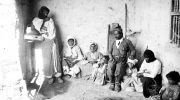
Cypriot society has long been organised around the household rather than the individual. Historically, survival depended on cooperation between close relatives, particularly in agricultural communities where land, labour, and risk were shared. This produced a culture in which loyalty to family was not optional but essential.
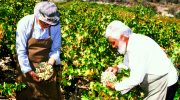
What is striking is that this emphasis cuts across communal lines. Greek Cypriot and Turkish Cypriot families, despite religious and linguistic differences, share remarkably similar expectations about kinship. Marriage, inheritance, childcare, and elder care follow parallel logics, revealing a cultural continuity that predates the island’s modern political divisions.
Even today, many Cypriots introduce themselves through family references: village of origin, surname, or extended kin connections. These markers still signal trust, reputation, and social positioning.
Living Together, Even When Living Apart
Although the nuclear family is the standard household unit, the extended family remains the functional reality of daily life. Adult children often live with their parents well into their late twenties, not because of social immaturity but because this arrangement offers financial stability and mutual support.
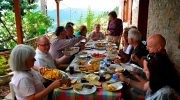
This pattern has clear economic consequences. Young adults are able to save rather than spend heavily on rent, while parents maintain close involvement in their children’s lives. Grandparents frequently provide childcare, allowing both parents to work, especially in urban centres.
Traditional housing reflected this logic physically. In rural areas, it was common for families to add an extra floor to the parental home when children married. While modern building regulations have changed this practice, the principle survives through parents providing land, apartments, or financial guarantees so that family members remain geographically close.
Kinship as Economic Infrastructure
Family does not merely support daily life in Cyprus. It actively structures economic behaviour and decision-making. Across the island, a significant proportion of businesses remain family-owned, particularly in sectors such as construction, agriculture, retail, and hospitality. These enterprises often prioritise continuity, reputation, and intergenerational stability over rapid expansion or short-term profit.

This approach reflects deeply ingrained values. A family business is not viewed solely as a commercial venture but as a shared responsibility, one that carries the family name and must therefore be protected. Decisions about investment, staffing, and growth are frequently discussed within the family, balancing opportunity against risk with future generations in mind.
Inheritance laws reinforce this framework. Cyprus operates under a system of forced heirship, ensuring that a substantial portion of an estate is legally reserved for close relatives. This prevents abrupt disinheritance and helps maintain property, land, and wealth within the family network. As a result, economic choices, from education to career paths, are rarely purely individual. They are shaped by the expectation that success should strengthen the family as a whole.
Rituals That Bind the Collective
Life events in Cyprus are not experienced in isolation. They are social moments through which family bonds are reaffirmed and extended.

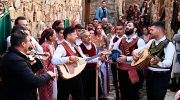
Weddings offer the clearest example. Guest lists often extend far beyond close friends, reflecting kinship ties, long-standing obligations, and shared histories. Attendance is not merely celebratory but symbolic. To be present is to acknowledge connection. The tradition of gifting money serves a practical purpose as well. Rather than symbolic presents, contributions help newly married couples establish financial independence, often offsetting wedding expenses or contributing toward housing.

Birth and naming rituals follow similar patterns. In many Greek Cypriot families, children are named after grandparents, reinforcing continuity across generations and ensuring that family names remain alive. Godparenthood creates enduring social bonds, often carrying moral and practical responsibilities that extend far beyond childhood.
Among Turkish Cypriots, initiation ceremonies such as circumcisions fulfil a comparable role. These events mark a child’s formal inclusion into both family and community, emphasising shared responsibility and collective care.
Identity Through Lineage and Place
Identity in Cyprus is layered, shaped by both lineage and geography. Individuals may identify simultaneously with their family, their village of origin, their community, and the island itself. These layers coexist rather than compete, forming a complex sense of belonging.
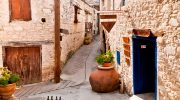
Village origin remains particularly powerful. Even among families displaced after 1974, ancestral villages continue to influence social networks, marriage choices, and emotional attachment. Surnames often act as quiet markers of origin, revealing connections that shape social interaction and trust.
For minority communities such as Maronites and Armenians, family plays an even more critical role. In the absence of territorial concentration, kinship becomes the primary mechanism through which language, religious practice, and cultural memory are preserved across generations.
Hospitality as an Extension of Family
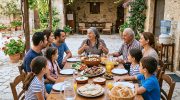
Cypriot hospitality, often described as philoxenia, is best understood as a family obligation rather than a social performance. Guests are welcomed as temporary members of the household, expected to eat, stay, and engage rather than remain at a polite distance.
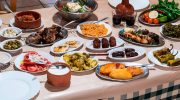
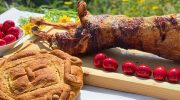
Meals are central to this process. Food is offered generously, often repeatedly, and refusal is interpreted as discomfort rather than courtesy. Time spent at the table matters as much as the meal itself, reinforcing the belief that relationships deserve attention and patience.
These habits reflect a broader worldview in which efficiency is secondary to connection. Hosting is not about presentation but about care, continuity, and mutual recognition.
Tensions in a Changing Society
Modern Cyprus is shaped by urbanisation, global mobility, and evolving gender roles, all of which influence family dynamics. Dual-income households are now common, and younger generations increasingly negotiate boundaries between independence and obligation.
These changes sometimes create friction. In family businesses, disagreements may emerge between older and younger generations over technology, management style, or succession. Within households, differing expectations around marriage, childcare, and career priorities can strain relationships.
Yet even when challenged, the family remains the primary safety net. During economic downturns or personal hardship, support still flows first through kinship rather than formal institutions, demonstrating the system’s enduring resilience.
Why Kinship Still Organises Life in Cyprus
The strength of the Cypriot family lies in its ability to adapt without losing its core logic. War, displacement, economic shifts, and globalisation have altered the surface of family life, but not its foundation. Security remains collective. Success is shared. Identity is inherited as much as it is chosen.
To understand Cyprus is to understand this framework. The island’s social rhythms, economic decisions, and cultural expectations are shaped by kinship at every level. Family in Cyprus is not simply important. It is the system through which life continues to organise itself.