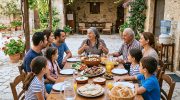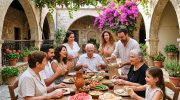
In Cyprus, extended family networks function as everyday infrastructure, shaping housing choices, childcare, financial support, and even the way people speak to one another. Although household sizes have shrunk and life is more urban, kinship still acts as the island’s most reliable safety net, especially when costs rise or institutions fall short. This article explains how these networks operate across multiple homes, how property and inheritance keep resources inside families, and why grandparents and diaspora ties remain central to modern Cypriot life.

- Family as the Island’s First Safety Net
- Living Apart, Acting Together
- Elders Who Still Decide
- Language That Preserves Hierarchy
- The Economics of Family Support
- Inheritance Keeps Assets Close
- The Quiet Power of Grandparents
- Families That Cross Borders
- Differences Across the Island
- Why Kinship Still Organises Life
Family as the Island’s First Safety Net
Long before modern welfare systems existed, Cypriot families learned to rely on themselves. The island’s history of foreign rule, displacement, and economic uncertainty reinforced a simple reality: security came from kinship. Family was not only emotional support but a practical infrastructure, providing shelter, work, care, and protection.
This pattern never disappeared. Instead, it adapted. Even today, many Cypriots instinctively turn to family first when facing financial strain, illness, childcare needs, or major life decisions. The state exists, but the family remains the primary buffer against instability.
Living Apart, Acting Together
At first glance, modern Cyprus looks similar to other European societies. Most people now live in small households, often as couples or nuclear families. Census data shows a steady decline in average household size over the last few decades.
Yet this change is misleading. While families may no longer live under one roof, they often operate as a single unit across multiple homes. Parents, adult children, grandparents, and siblings remain in close daily contact, sharing meals, resources, and responsibilities. This modified extended family allows independence without isolation.
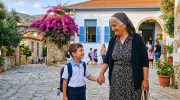
In practice, this means grandparents collecting children from school, parents supporting adult children well into their late twenties, and siblings pooling money or labour when needed. Distance is physical, not social.
Elders Who Still Decide
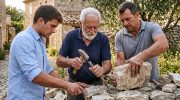
Respect for age remains deeply embedded in Cypriot culture. Elders are not marginal figures but active participants in family life, often holding authority and responsibility well into old age. Decisions about property, marriage, and caregiving are frequently influenced by older generations.
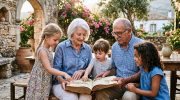
This respect is not abstract. It is reinforced through language, behaviour, and daily rituals. Younger family members are expected to listen, defer, and assist. In return, elders provide guidance, childcare, and emotional stability. The relationship is reciprocal rather than symbolic.
Language That Preserves Hierarchy
The importance of family roles in Cyprus is not only expressed through behaviour but encoded directly into everyday speech. Kinship terms are precise, carefully chosen, and socially meaningful. They signal respect, obligation, and position within the family structure long before a relationship needs to be explained.
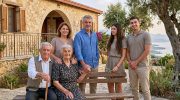
In Greek Cypriot households, formal titles are often used even among close relatives, particularly when addressing older family members. These linguistic habits reinforce hierarchy gently but consistently, reminding younger generations of expected conduct without overt instruction. In Turkish Cypriot families, kinship vocabulary draws clear distinctions between maternal and paternal relatives, immediately locating each person within a wider family map.
These distinctions are not decorative. They shape interaction. Addressing someone incorrectly is not simply a linguistic error but a social misstep, one that signals unfamiliarity with the unwritten rules governing family life. Language, in this way, does not merely reflect kinship. It actively sustains it.
The Economics of Family Support
Economic reality plays a decisive role in keeping extended family networks strong. Cyprus combines relatively high housing costs with moderate wages and new 2026 tax deductions for dependent children and students up to age 24. Families step in to bridge the gap, often long before any formal assistance is considered.

Parental support commonly takes the form of shared housing, financial help with property purchases, or long-term co-residence. Many young adults remain in the family home into their late twenties or beyond, not as a sign of failure to launch, but as a strategic choice that allows saving, study, and stability in an uncertain economy.
This arrangement has shaped the island’s housing landscape. Home ownership rates remain high, but they are sustained less by individual earning power and more by collective family effort. Property is rarely acquired alone. It is negotiated, supported, and secured through kinship.
Inheritance Keeps Assets Close
Inheritance practices in Cyprus reinforce this collective approach to wealth. The legal system strongly protects close relatives, requiring that a statutory portion (ranging from 50% to 75%) of the estate pass directly to immediate family members. Combined with the absence of inheritance tax (abolished in 2000/2001), this framework ensures that assets circulate within families rather than dispersing outward.
As a result, inheritance is rarely an afterthought. Families plan transfers carefully, often years in advance, treating property as a shared, generational resource rather than a personal possession. Homes may be built with future children in mind. Land is divided strategically. Ownership reflects continuity more than individual accumulation.

This long view helps explain why family ties remain economically relevant across generations. Wealth does not simply pass through families. It anchors them.
The Quiet Power of Grandparents
Nowhere is the role of the extended family more visible than in childcare. In Cyprus, grandparents are not occasional helpers. They are central figures in daily family life. Many households depend on them for regular, reliable care that allows parents to work, commute, or manage multiple responsibilities.
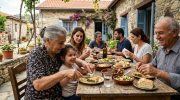
Grandmothers, in particular, form the backbone of this informal system. They cook, supervise homework, collect children from school, and maintain routines that give structure to family life. This role is not viewed as a sacrifice. It is a source of purpose, status, and connection.
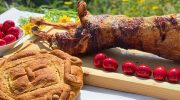
Weekly family meals, often held on Sundays, provide a recurring space where generations gather. These meals do more than feed. They transmit values, resolve tensions, and reaffirm belonging. Decisions are discussed quietly. Advice is offered indirectly. The family, once again, acts as a unit.
Families That Cross Borders
Cypriot kinship does not end at the island’s coastline. Large diaspora communities in countries such as the United Kingdom and Australia remain closely connected to relatives in Cyprus. Migration has stretched families geographically, but it has not weakened their social fabric.

Regular visits, shared property, financial support, and constant communication keep these networks active. Digital tools have further reduced the impact of distance. Messaging apps and video calls allow daily contact, making absence less disruptive than in previous generations.
Family life now operates across time zones, yet remains emotionally immediate. The extended family adapts, rather than dissolves, in response to mobility.
Differences Across the Island
Economic and political conditions influence how family networks function in different parts of Cyprus. In the south, higher education levels and global career paths sometimes draw younger generations abroad, though family support often continues remotely through money, property, and planning.
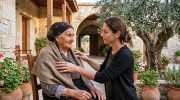
In the Turkish Cypriot community, economic pressure has reinforced reliance on family even more strongly. Where state resources are limited, kinship networks provide essential care for the elderly, the unemployed, and the vulnerable. Families absorb risks that formal systems struggle to manage.
Despite these variations, the underlying principle remains unchanged. When institutions fall short, family steps in.
Why Kinship Still Organises Life
The Cypriot extended family is not a relic preserved by tradition alone. It is a flexible social structure that continues to meet modern needs without losing its core purpose. It provides economic stability, emotional security, and a sense of continuity in a rapidly changing world.
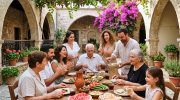
As long as family meals remain routine, grandparents remain involved, and children grow up surrounded by relatives rather than institutions, extended kinship will continue to shape Cypriot life. This is not merely a cultural preference. It is the island’s most resilient form of social architecture.