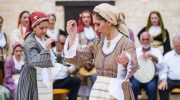
In Cyprus, summer does not fully arrive until the village square comes alive. As daylight softens and the heat loosens its grip on stone, quiet plateias begin to change character. Chairs appear as if by instinct. A few strings of lights are lifted overhead. Someone tests a violin line that hangs in the warm air for a second, then returns, clearer the next time. Little by little, the square becomes what it has been for centuries: a place where people gather not because they were told to, but because the evening feels incomplete without it.
These village cultural programs are not staged spectacles designed for crowds. They are communal summer evenings shaped by habit, hospitality, and rhythm, where locals and visitors briefly share the same space, the same food, and the same dance floor. If you want to understand Cyprus beyond beaches and brochures, you do it here, in the square, when the night is still young, and the music has just begun.
- The Square as the Heart of Village Life
- Participation Comes Before Performance
- Music That Fills Space Without Overwhelming It
- Food as an Invitation, Not a Product
- Mountain Villages and Coastal Squares
- Dance as a Social Language
- Filoxenia in Practice
- When and How to Experience Village Programs
- Why These Evenings Still Matter
The Square as the Heart of Village Life
For centuries, the village square has been the social centre of rural Cypriot life. Churches, coffee shops, and stone houses face inward, forming a natural stage where daily routines and special occasions intersect. Even in the quietest months, the square holds a kind of readiness. It is where greetings happen, where elders sit with time on their side, where news travels faster than cars can carry it.
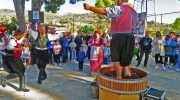
In summer, that readiness turns into motion. Tables arrive and settle into familiar patterns. Lights stretch across open space like a soft ceiling. Musicians tune their instruments while neighbours drift in without formal invitation, as if the square has been waiting for them all day. What makes these nights feel authentic is not a lack of planning, but the sense that the place itself is leading. The evening grows from the square rather than being imposed on it.
Participation Comes Before Performance
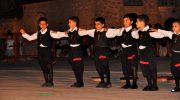
One of the defining features of village square events is how deliberately thin the line is between performer and audience. Folk dance groups may open the evening, but their role is often to invite rather than impress. You might watch a few minutes of polished steps, coordinated turns, and proud posture, and then notice the shift as the circle widens. The mood changes from “look at us” to “come with us.”
After the opening performances, spectators are encouraged into the dance circle. No prior knowledge is expected. The steps are simple, repetitive, and forgiving, allowing newcomers to follow the rhythm while experienced dancers guide the flow with small cues: a hand offered, a nod, a gentle pull back into time. This is not culture as display. It is culture as something you join.
There is something quietly powerful about watching a dance circle accept difference without making a point of it. A local grandmother moves with certainty beside a teenager who is half joking, half serious. A visitor mirrors the steps with a second of delay, then finds the beat. Children slide in and out of the line, learning patterns through repetition rather than instruction. The square teaches without lecturing.
Music That Fills Space Without Overwhelming It
Music shapes the atmosphere of village programs more than decoration or staging. Traditional instruments dominate, chosen for their ability to carry sound across open stone spaces without needing to overpower them. The violin usually leads, its melodies clear and expressive. The lute provides rhythm and structure, and drums set a pace that matches the movement of dancers rather than pushing them forward aggressively. In some villages, flutes or reed instruments add softer, pastoral tones that feel made for mountain air.

What visitors often notice is the balance. The music is loud enough to gather people, but never so loud that conversation disappears. A village square still needs to be a meeting place, not only a dance floor. Between tunes, you hear laughter, greetings, the clink of glasses, the low, steady life of the community continuing underneath the performance. That layered sound is the real soundtrack of these nights.
Food as an Invitation, Not a Product
Village cultural programs almost always involve food, but it is offered differently than at commercial festivals. Dishes are prepared by local families, community groups, or volunteers rather than vendors. The result is not a menu designed to sell, but a table designed to include.
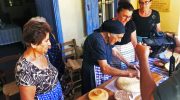
Guests are often welcomed with small tastings before the music begins: bread, olives, halloumi, or a glass of local wine or zivania. These gestures are not transactions. They are signals of belonging. Even if you arrived as a stranger, the act of eating together in the square quickly rearranges social boundaries. You are no longer watching the village. You are sitting inside it.
Food also slows the evening down in the best way. It gives you time to look around. To notice how people greet one another. To see which table is full of storytellers, which one holds the quiet observers, which one seems to collect anyone who appears alone. In Cyprus, hospitality often works like that. It is not announced. It is practised.
Mountain Villages and Coastal Squares
The character of a summer program shifts with geography, and Cyprus offers striking contrasts even over short distances.
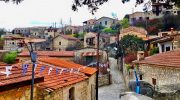
In mountain villages such as Omodos or Kakopetria, evenings are cooler and more intimate. Stone walls trap sound, creating a natural acoustic chamber. The pace feels slower, conversations last longer, and music can be more restrained, as if the village is listening as much as celebrating.
In coastal villages, programs tend to be larger and livelier. Sea breezes carry sound outward. Crowds are bigger. Performances sometimes include broader influences that reflect the island’s long relationship with travel and trade. Yet the underlying structure remains the same: shared space, shared rhythm, shared time.
What connects both settings is the feeling of continuity. Whether you are high in the hills or closer to the water, the square works as a social anchor. It gathers people into the same frame, then lets the night unfold naturally.
Dance as a Social Language
Traditional Cypriot dances are central to village programs because they translate social values into movement. Circle dances emphasise unity and cooperation. Paired dances express friendship and mutual recognition. Solo flourishes allow individuals to step forward briefly, show confidence, and then return to the group without disrupting it.
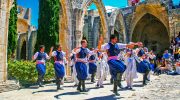
Visitors often notice how naturally people of different ages dance together. This is one of the quiet reasons the tradition survives. It is not preserved in a museum-like way. It is practised openly, in front of everyone, by everyone. Children learn the rhythm long before they can explain what they are learning. They watch, they copy, they fall out of step, they laugh, and they try again. That is how a culture keeps its memory alive, not by demanding perfection, but by making participation normal.
Filoxenia in Practice
Hospitality, or filoxenia, is not an abstract concept in village programs. It is practised with ease.
Visitors are greeted, spoken to, and often invited to join tables or dances without hesitation. Language barriers matter less than presence. A smile, a nod, or a willingness to follow the rhythm is usually enough to be welcomed into the circle. For many travellers, that openness becomes the most memorable part of the evening because it transforms the experience from observation into belonging.
When and How to Experience Village Programs
Most village square programs take place between late June and early September, often aligned with religious feast days or local harvests. Events usually begin in the early evening and continue well past sunset.
If you want the evening to feel effortless, a few simple choices help:
- Arrive early enough to watch the square fill. The build-up is part of the experience.
- Dress comfortably and modestly. You are joining a community space, not a nightclub.
- Observe first, then join when invited. The invitation usually comes naturally.
- Take photos with discretion. These are living community moments, not performances staged for documentation.
Why These Evenings Still Matter
Village square cultural programs persist because they meet a human need that has not disappeared: the need to gather without a purpose beyond being together. In a world where entertainment is often consumed individually, these evenings offer something quieter and more enduring.
They also remind you that culture is not preserved in archives alone. It survives in repeated gestures, shared meals, and familiar melodies played under open skies. For a few hours on a summer night, the village square becomes what it has always been at its best: a place where memory, movement, and belonging meet.
If you find yourself in Cyprus during the warmer months, choose one village evening and go without overplanning it. Sit where you can see the whole square. Let the music arrive. Let the circle widen. And when someone offers a hand, take it.