The ancient city of Salamis on Cyprus holds some of the Mediterranean’s most remarkable Roman architecture. Among its treasures, the Gymnasium stands out as a testament to how Romans blended physical training, social interaction, and luxury bathing into a single sprawling complex. Located on the eastern coast near modern Famagusta, this site offers visitors a direct connection to daily life in Roman Cyprus.
The Gymnasium traces its roots to the Hellenistic period, when Greek colonists first established athletic training facilities in Salamis. However, the structure visible today belongs to the 2nd century AD, specifically during the reigns of emperors Trajan and Hadrian. The transformation came after a devastating Jewish revolt in 116 AD that left much of Salamis in ruins. Rather than simply repairing the damage, Roman engineers rebuilt the Gymnasium on a grander scale.
The new complex featured a colonnaded palaestra, a large open courtyard surrounded by covered walkways on all four sides. This provided athletes with shaded areas for training and spectators with comfortable viewing spots. The Romans added sophisticated bathing facilities that transformed the Gymnasium from a simple training ground into a complete social center. An inscription found in the pavement credits Trajan with constructing the roof over one of the swimming pools, while multiple honorific decrees mention Hadrian as a benefactor and savior of the city.
The Palaestra and Training Grounds
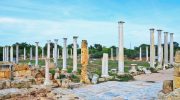
The heart of the complex was the palaestra, a vast rectangular courtyard where young men practiced wrestling, boxing, and other athletic competitions. Marble columns lined the perimeter, creating covered walkways that protected athletes and visitors from Cyprus’s intense sun. These columns, crowned with Corinthian capitals of various designs, came from multiple sources. After earthquakes struck in the 4th century AD, Byzantine Christians salvaged columns from the nearby Roman theatre and other buildings to reconstruct the palaestra.
The columns stand today as a reminder of the complex’s adaptability across different eras. Some feature traditional fluting, while others display spiral patterns. This architectural variety reflects both the practical necessity of post-earthquake reconstruction and the aesthetic preferences of different periods. The courtyard itself covered an enormous area, providing ample space for multiple training activities to occur simultaneously.
The Bath Complex and Social Life
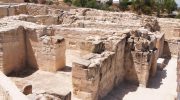
The bathing facilities attached to the Gymnasium exemplify Roman engineering and social customs. The complex included a sweating room, marble-lined pools, and separate chambers for cold and hot bathing. An exposed hypocaust system, visible today, shows how Romans heated water and rooms through underground furnaces that circulated hot air beneath floors and through walls.
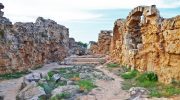
Romans viewed bathing as far more than personal hygiene. The baths served as gathering places where citizens discussed politics, conducted business, and strengthened social bonds. The Salamis complex reflected this importance through its lavish decoration. Stunning mythological mosaics covered floors in several rooms, depicting scenes from Greek legends. Frescoes adorned walls, though weather and time have eroded much of their original brilliance. The scale of the bathing facilities, combined with their artistic embellishment, demonstrates how central these spaces were to Roman urban life.
Water supply posed a constant challenge in arid Cyprus. The Romans constructed an extensive aqueduct system that brought water from springs at Kythrea, located at the foot of mountains several kilometers away. A large cistern near the city center stored this precious resource before conduits distributed it to the baths, fountains, and other public facilities. This infrastructure ensured the Gymnasium could operate its pools and heating systems year-round.
Sculptures and Religious Elements
The Gymnasium housed an impressive collection of marble statues, many of which now reside in the Cyprus Museum in Nicosia. During the Roman period, sculptures of gods, heroes, and mythological figures filled niches throughout the complex. Statues of Apollo, Asclepius, Hercules, Isis, Zeus, and Aphrodite once greeted visitors, creating an atmosphere that merged physical training with religious reverence.
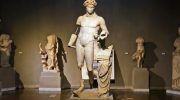
The fate of these sculptures reveals the dramatic religious transformation of the late Roman Empire. When Christianity became the state religion in the 4th century AD, many statues that represented pagan worship faced systematic destruction. Some, like those of Asclepius and Nemesis, were preserved and reused. Others, particularly those depicting nude deities, were thrown into pits, water tanks, or used as building material. Today, many of the statues remaining at the site stand headless or mutilated, silent witnesses to the religious conflicts that marked Christianity’s rise to dominance.
Earthquakes and Byzantine Reconstruction
The 4th century brought disaster to Salamis in the form of repeated earthquakes. The tremors of 332 and 342 AD caused widespread destruction throughout the city. Byzantine emperor Constantius II ordered the city’s reconstruction and renamed it Constantia in his own honor. The Gymnasium received partial restoration during this period, though on a reduced scale compared to its Roman heyday.
The reconstruction relied heavily on salvaging materials from other damaged buildings. The theatre proved a particularly rich source of marble columns, which workers dragged across the city to replace the Gymnasium’s stone pillars. This explains the architectural inconsistency visible today, where columns of different heights, styles, and proportions stand side by side. The Byzantine rebuilders prioritized functionality over aesthetic unity, creating a complex that worked but lacked the visual harmony of its original Roman design.
Discovery and Modern Preservation
Archaeological interest in Salamis began in the 1880s when early excavators uncovered portions of the Gymnasium. The site received systematic excavation in 1952, when archaeologists re-erected many of the fallen marble columns. These efforts continued through the 1960s and early 1970s, gradually revealing the complex’s full extent. The work came to an abrupt halt in 1974 when Turkey invaded Cyprus, placing Salamis in the occupied sector.
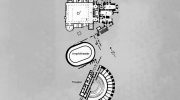
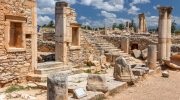
Despite this interruption, the Gymnasium remains remarkably accessible to visitors. The site extends over a square mile along the seashore, backed by sand dunes and acacia forests. Walking through the colonnaded courtyards, examining the exposed hypocaust system, and standing in the ancient latrine facilities provides an intimate connection to Roman daily life. The scale of the ruins conveys the importance Romans placed on physical fitness and social bathing.
The Site Today
Modern visitors to the Gymnasium of Salamis encounter architecture spanning several centuries. The standing columns create dramatic silhouettes against the Mediterranean sky. Mosaics peek through protective coverings in the bath complex. The latrine facilities, surprisingly well-preserved, show the Romans’ practical approach to sanitation and their willingness to make even such spaces communal gathering points.
The nearby Cyprus Museum displays many of the sculptures excavated from the site, including the headless statues of Meleager and various deities. These museum pieces complement the ruins by showing the artistic quality that once filled the Gymnasium’s niches and courtyards. Together, the site and its artifacts paint a comprehensive picture of Roman civic life in Cyprus.
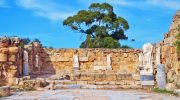
The Gymnasium stands as more than architectural ruins. It represents a social model where physical training, intellectual development, religious observance, and bathing converged in a single institution. This integration of multiple aspects of life under one roof characterized Roman urban planning throughout the empire. Salamis, though distant from Rome itself, fully embraced this cultural pattern, creating a facility that would have impressed visitors from any Mediterranean city.
Today, the ruins occupy an isolated stretch of coastline where the sounds of wind and waves replace the ancient bustle of athletes and bathers. Yet the columns still stand in their ordered rows, the pools retain their marble linings, and the hypocaust tunnels wait beneath the floors. These elements combine to offer one of the eastern Mediterranean’s most evocative glimpses into Roman civilization, when Salamis thrived as Cyprus’s principal city and its Gymnasium served as the beating heart of urban life.