Cypriot limestone “kouroi” are Archaic-era standing male statues that look Greek at first glance but functioned differently, serving mainly as clothed votive figures placed in sanctuaries as lasting representations of worshippers and elite donors. Cyprus’s lack of marble pushed sculptors toward soft local limestone, shaping a calmer, more geometric style that was originally strengthened by bright paint rather than fine anatomy. This article explains how material, ritual purpose, and cross-Mediterranean influence combined to produce a distinctly Cypriot human figure tradition.
Kouros in Name Only
The word kouros comes from Greek and refers to youthful male statues that became widespread in the Aegean world during the Archaic period. Greek kouroi are usually nude, carved in marble, and designed to embody physical perfection and idealised youth. Cyprus adopted the broad idea of the standing male figure, but transformed it completely.
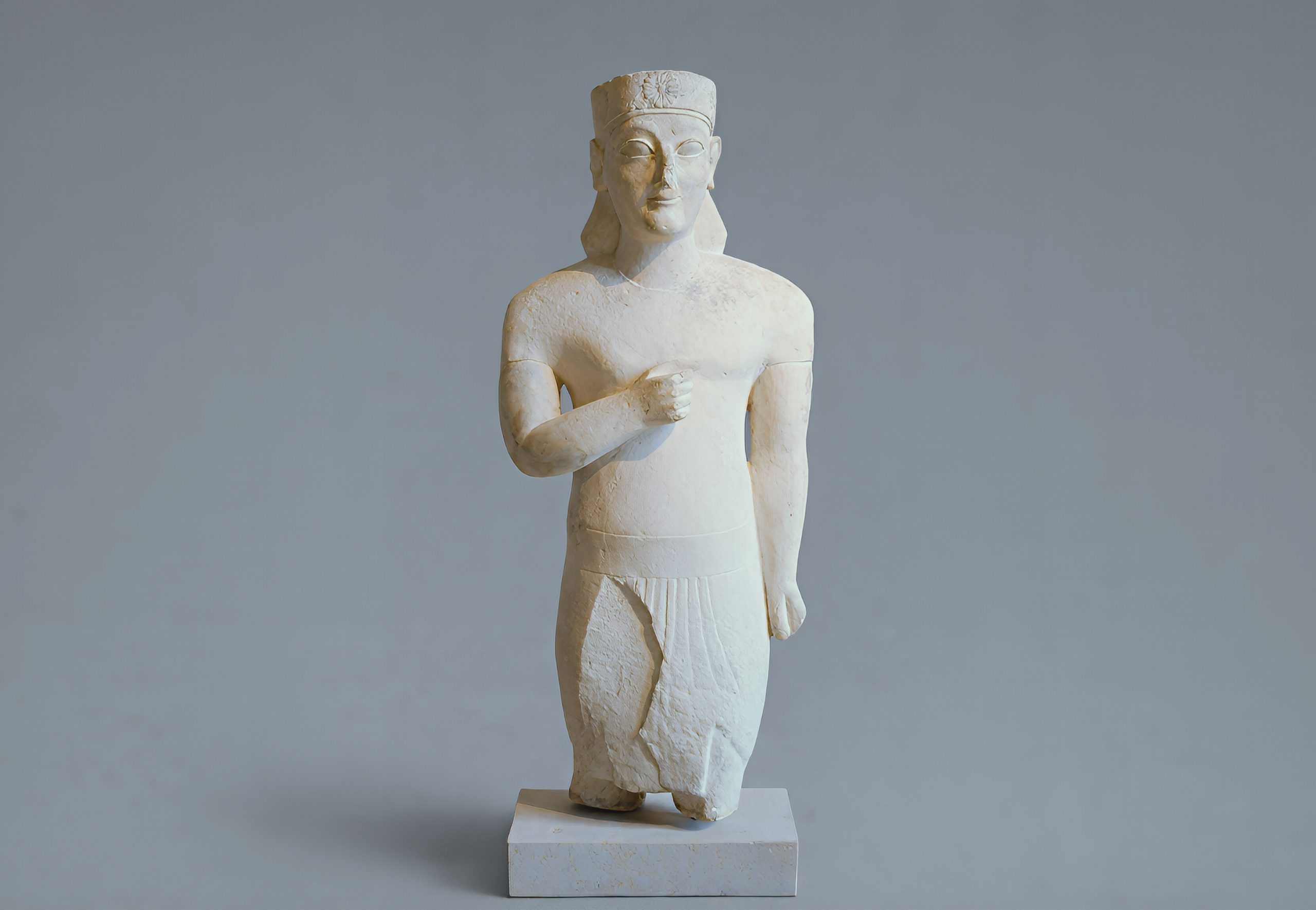
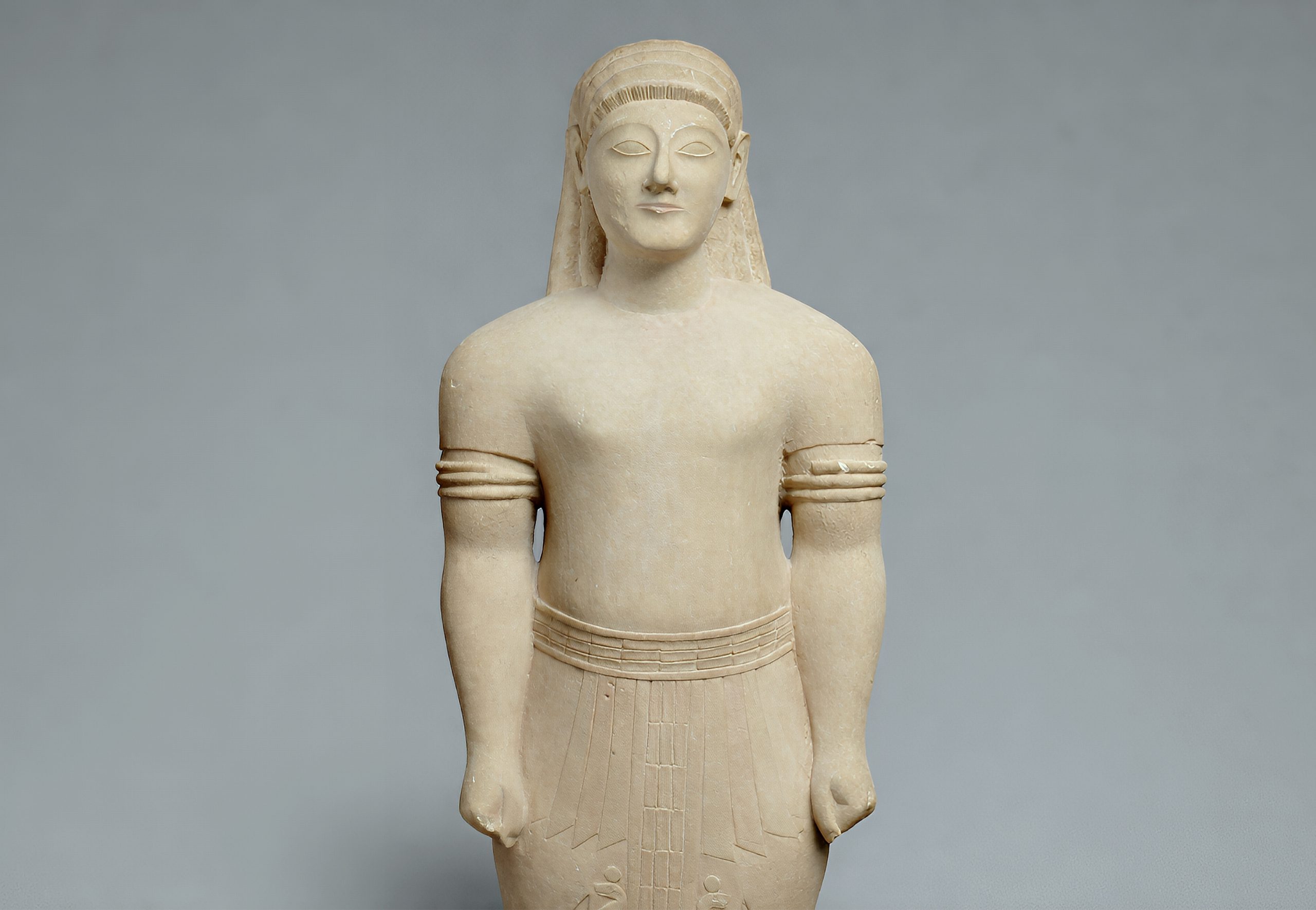
Cypriot limestone figures are almost always clothed. They wear kilts, tunics, cloaks, or ceremonial garments influenced by Egyptian, Near Eastern, and East Greek styles. Rather than celebrating athletic bodies, these statues emphasise presence and status. They represent worshippers, priests, or elite donors, figures defined by their role within religious and civic life rather than by physical ideals.
The stone that shaped the style
One reason Cypriot sculpture looks the way it does lies beneath the ground. Cyprus has no natural marble sources. Instead, sculptors worked with soft local limestone, particularly from the central Mesaoria Plain. This stone was easy to carve but unsuitable for the sharp anatomical precision seen in marble.
Rather than fighting the material, Cypriot artists adapted to it. Bodies became more geometric, surfaces smoother, and details simplified. Faces are calm and frontal, with wide eyes and faint smiles. The result is a style that feels restrained and deliberate, closer in spirit to terracotta figures than to Greek marble sculpture.
This material choice was not a weakness. Limestone absorbed pigment well, and these statues were originally brightly painted. Hair, garments, jewellery, and facial features were picked out in reds, blues, blacks, and yellows, creating figures that would have stood out vividly within open-air sanctuaries.
Designed for sanctuaries, not tombs
Unlike many Greek kouroi, Cypriot limestone figures were rarely funerary monuments. Their primary function was votive. Worshippers dedicated them at sanctuaries as lasting representations of themselves, ensuring their continued presence before the gods long after they had left.
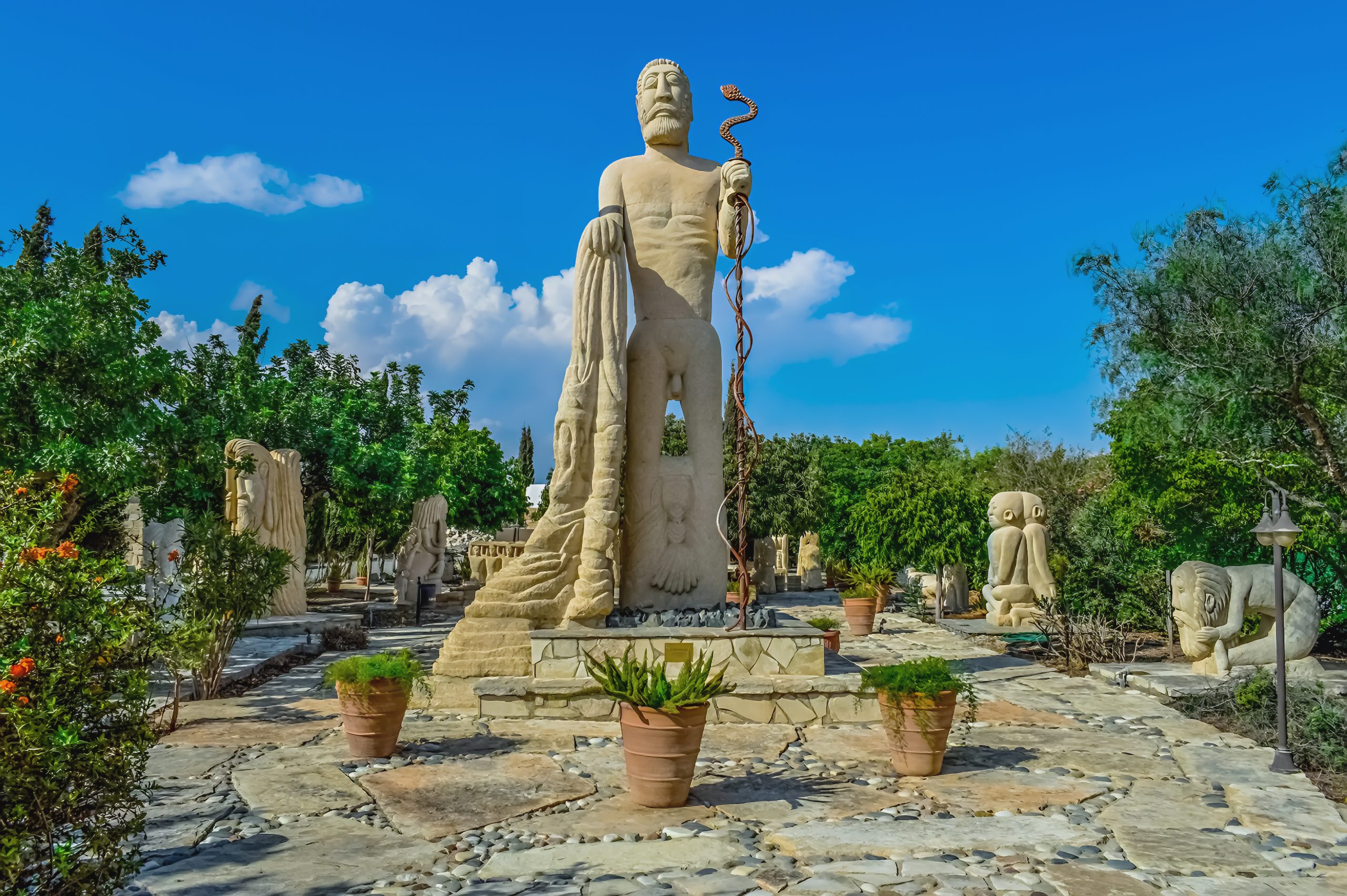
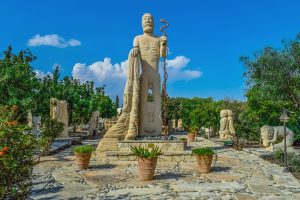
Because of this role, the statues were often arranged in rows or groups against the sanctuary walls. Many are flat-backed, carved to be seen from the front rather than in the round. The rigid stance and forward gaze make sense in this context. These figures were not meant to move or interact. They were meant to endure.
Standing together, sometimes in their hundreds, they formed what archaeologists often describe as a “stone congregation,” a permanent assembly of worshippers facing the divine.
A Stone Congregation of Donors
Cyprus in the Archaic period was deeply embedded within the movement of goods, people, and ideas that crossed the Mediterranean. Ships arriving at its ports carried not only copper and ceramics, but visual languages shaped in Egypt, the Levant, and the Aegean. Cypriot sculptors encountered these influences constantly, yet they never adopted them wholesale.
Instead, foreign elements were filtered through local practice. Egyptian-style kilts appear alongside Near Eastern hairstyles. East Greek garments are combined with distinctly Cypriot proportions. This coexistence was not accidental. It reflected an island society accustomed to negotiation and adaptation, where identity was formed through selection rather than imitation.
The resulting figures do not belong fully to any single tradition. They communicate Cyprus’s openness to the wider world while quietly asserting its independence within it.
Workshops with Regional Signatures
There was no uniform formula for carving a Cypriot limestone kouros. Across the island’s city-kingdoms, sculptural workshops developed their own preferences and habits, visible in the smallest details. Figures from inland centres such as Idalion and Golgoi often display strong vertical brows, carefully patterned hair, and solid proportions. Western workshops, particularly around Paphos, favoured more elongated eyes, slimmer mouths, and softer facial transitions.
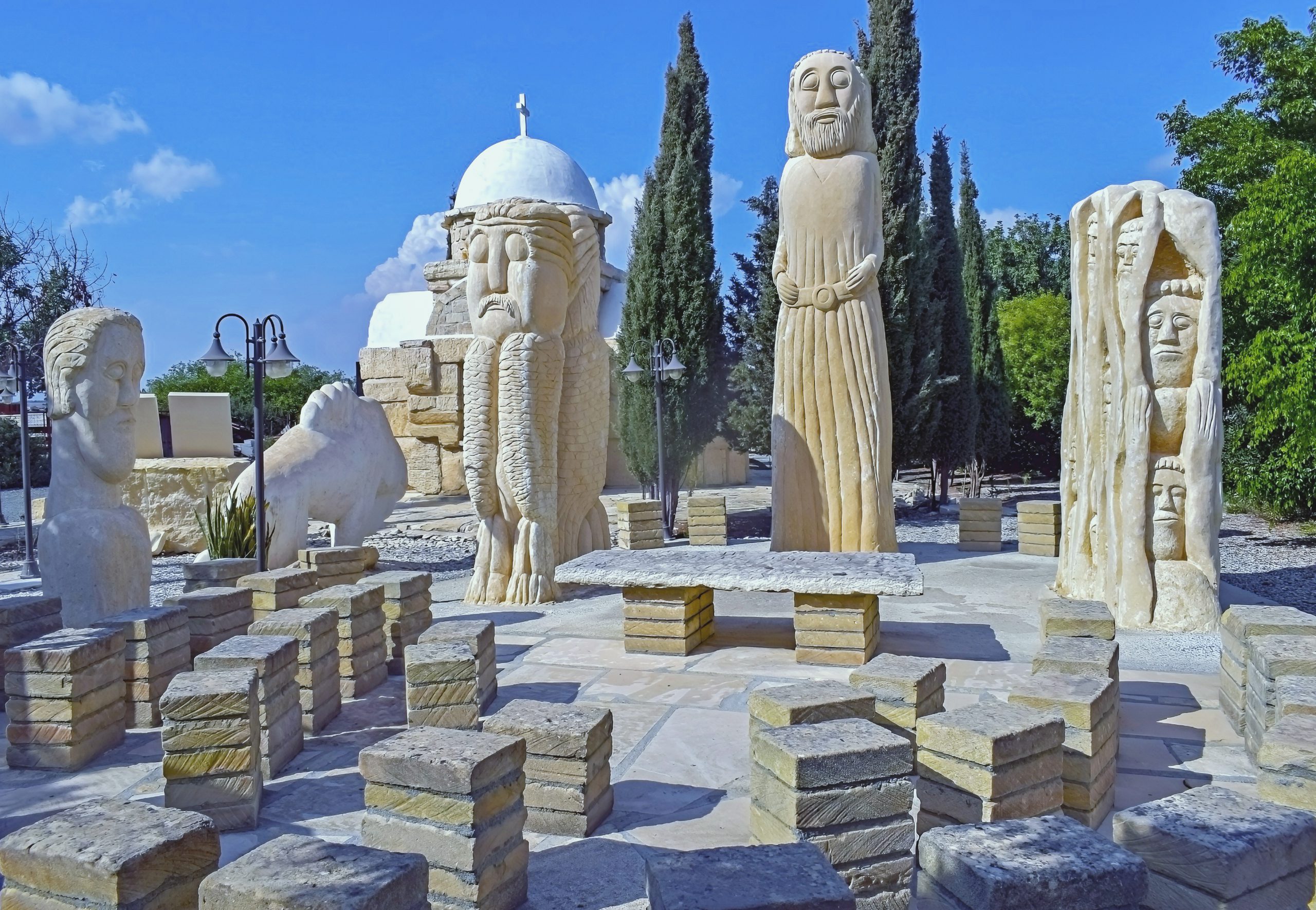
These variations are subtle, yet consistent enough that archaeologists can sometimes trace works back to specific regions or even individual hands. Repeated facial structures, carving depths, and treatment of garments reveal the presence of trained artisans working within inherited traditions.
What may appear uniform at first glance is, in fact, the result of many decisions made by individual sculptors responding to shared expectations.
Encountering the figures today
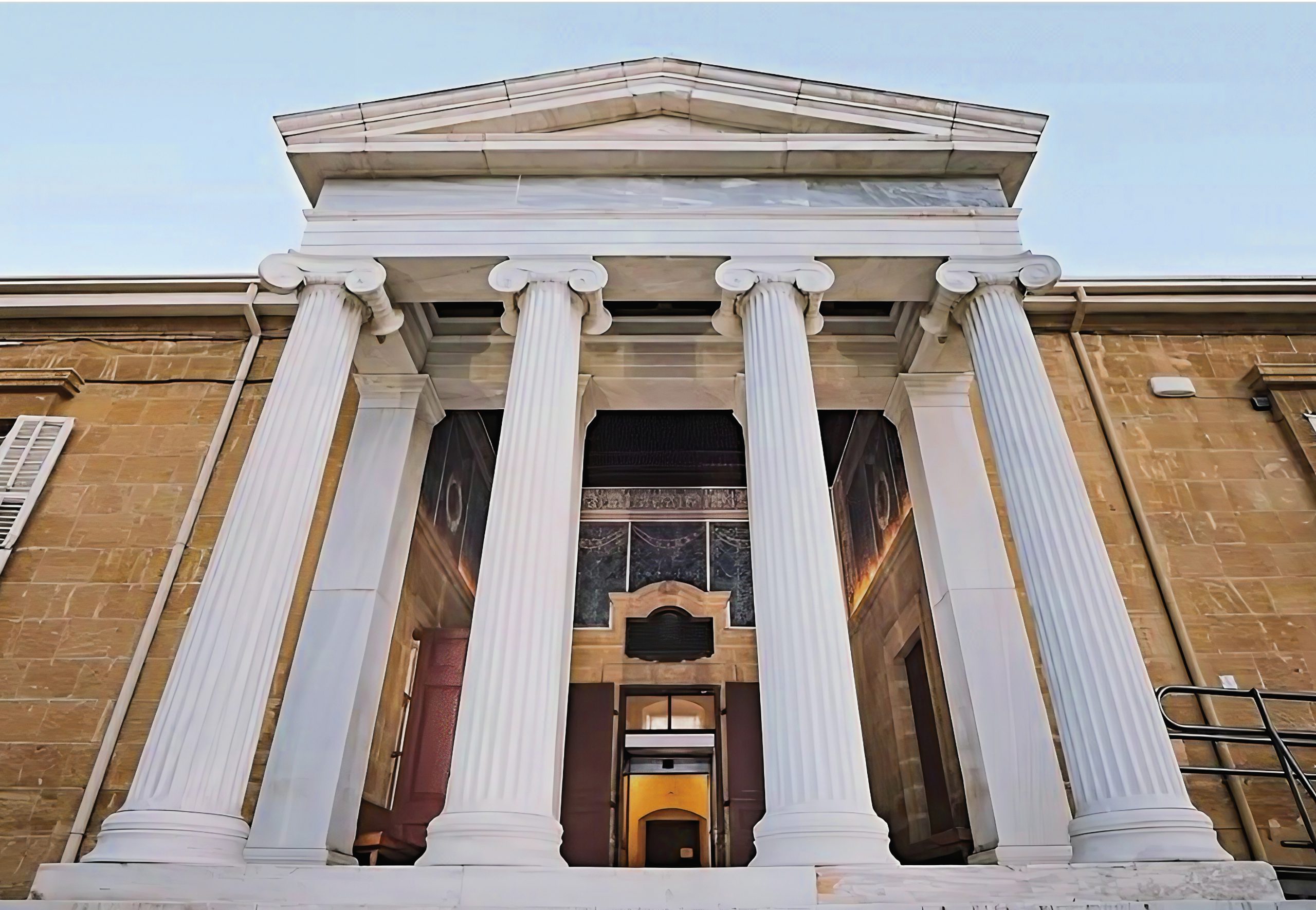
Many of the finest Cypriot limestone statues are preserved in museum collections, where they can be studied side by side. The Cyprus Museum in Nicosia holds the most extensive display, allowing visitors to observe regional variation and stylistic development across centuries. Important examples are also housed in institutions such as the British Museum and the Metropolitan Museum of Art, where they contribute to broader narratives of ancient Mediterranean art.
Seen in person, these figures reveal qualities rarely captured in photographs. Tool marks remain visible on softened stone. Traces of pigment cling to carved folds. Surfaces respond gently to light, echoing how they once stood in sunlit sanctuaries rather than enclosed galleries.
Why the limestone kouros still speaks
The Cypriot limestone kouros matters because it complicates familiar stories about ancient art. It shows that artistic influence did not move in a single direction, nor did cultural authority belong to one centre alone. Cyprus was not a passive recipient of Greek ideas, but an active participant in shaping shared visual traditions.
These statues offer insight into how Cypriots understood devotion, identity, and permanence. They were not created to impress with motion or drama, but to remain present, visible, and faithful. In their stillness lies their power.
Each figure stands as a reminder that belief in the ancient world was often quiet and sustained. Carved in limestone, painted with care, and placed among many others, the Cypriot kouros waited. And in waiting, it endured.