Lift a stone on a warm Cypriot evening – on a sun-baked hillside in Troodos, along a dry riverbed in Paphos, or among the pine roots of the Kyrenia mountains – and you may find yourself staring at one of the island’s most ancient residents.
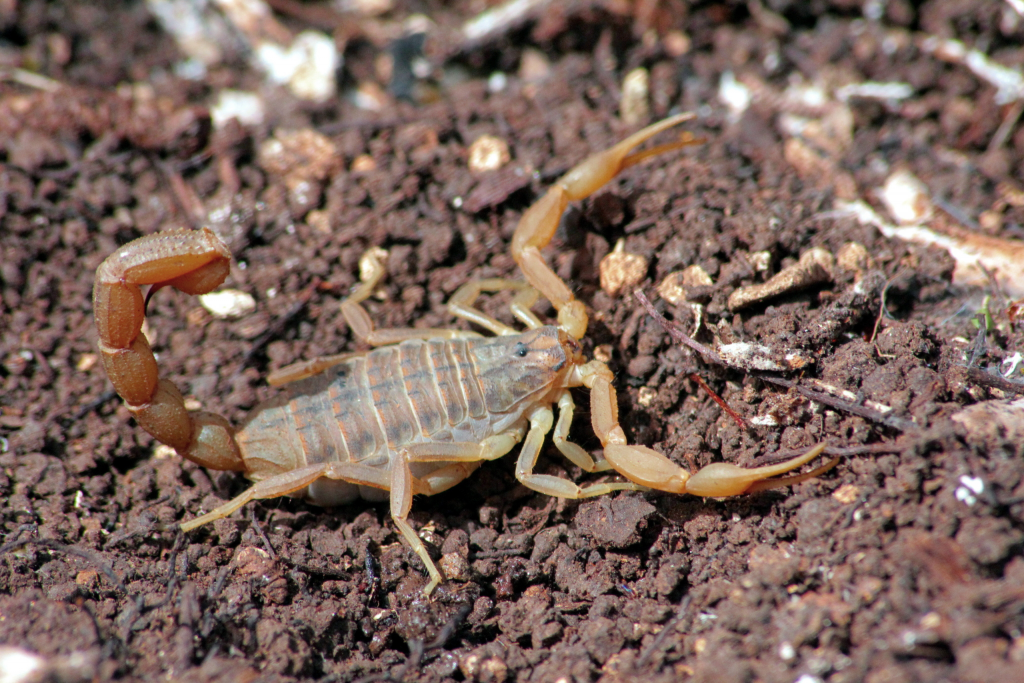
Eight legs, two grasping claws, a tail arched overhead like a question mark. A scorpion. It hasn’t moved. It doesn’t need to. It has been doing this for four hundred and thirty million years, and it knows perfectly well who should be afraid of whom.
Lords of the Stone and Shadow
Scorpions belong to the class Arachnida – the same grand family as spiders, mites, and ticks. But the scorpion stands apart. With its unmistakable silhouette – that raised, segmented tail tipped with a venomous stinger – it is one of the most recognised animals on the planet, and one of the most misunderstood.
They are predators, hunting at night by feel and vibration rather than sight. They are also extraordinary survivors, capable of slowing their metabolism almost to a standstill during extreme heat or drought, then springing back to life as though nothing happened. Worldwide, around 2,500 species have been described. Cyprus is home to a small but fascinating cast of characters – and two of them are found nowhere else on Earth.
Before the Stars Were Named
The scorpion’s history stretches back further than almost any other land animal we know. Scorpions first evolved in shallow seas around 430 to 450 million years ago – long before dinosaurs, long before flowers, long before birds or mammals existed in any form. The earliest scorpions were marine creatures. They crawled onto land around 400 million years ago and have barely needed to change since. The body plan you see under a Cypriot stone today would be recognisable to any palaeontologist examining a fossil from the Carboniferous.
Human civilisations have always been aware of them. In ancient Egypt, the scorpion goddess Serket was both feared and revered – a protector of the dead and a guardian of the canopic jars in which the organs of mummified pharaohs were preserved. She carried within herself the knowledge of poisons and their antidotes, making her one of the most ambivalent of all Egyptian deities: deadly and healing in equal measure. Her name lives on in the constellation Scorpius, which the ancient Babylonians had already mapped some five thousand years ago, calling it GIR-TAB – “the scorpion.”
In Greek mythology, the scorpion entered the night sky through a story that would appeal to any lover of drama. The giant hunter Orion, son of Poseidon, boasted that he could kill every creature on Earth. Offended on behalf of her beloved animals, the goddess Gaia sent a great scorpion to humble him. Both were lifted into the sky by Zeus as a lesson to mortals about pride. Even now, the two constellations never appear in the night sky at the same time – as Scorpius rises in summer, Orion flees below the horizon. The ancient Greeks were not merely telling stories. They were watching the actual sky.
“In ancient Egypt, the scorpion held the knowledge of both poison and cure – the same creature that could kill could also protect.”
Two Endemics and a Passing Guest
Cyprus is home to three recorded species of scorpion, two of which are found exclusively on the island.
Cyprian Checkered Scorpion Aegaeobuthus cyprius
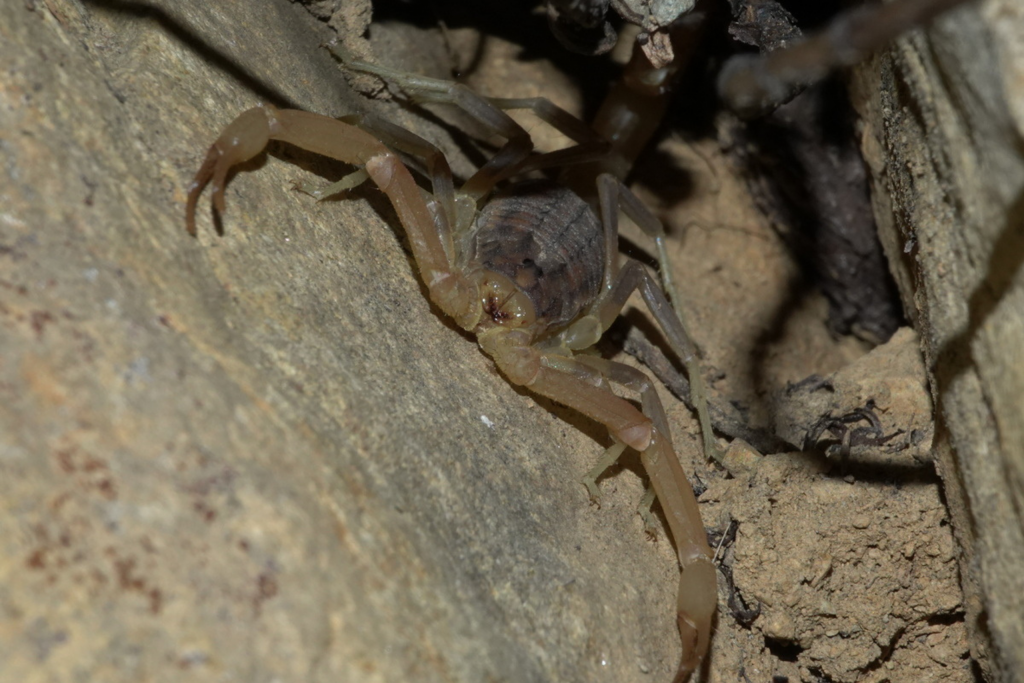
The more widespread of the two endemic species, Aegaeobuthus cyprius (formerly known as Mesobuthus cyprius), is a medium-sized scorpion with a yellowish-brown body, typically 5 to 8 centimetres in length. Its colouring is relatively lighter than its closest relative, the Mediterranean checkered scorpion of Greece and Turkey. It has a robust, somewhat bulbous tail segment (known as the telson) and, as documented in field studies across Cyprus, it occupies a remarkable range of habitats – from sea level right up to 1,900 metres in the Troodos mountains. This is a species equally comfortable among coastal scrub and cedar forest.
Scientists originally discovered it was a unique species not by looking at it, but by reading its DNA. When Swiss researchers Gantenbein and Kropf first described it as a new species in 2000, they did so primarily through molecular analysis – the scorpions of Cyprus and those from mainland Turkey looked very similar, but their genetic signatures told a different story. The separation had occurred around 5.2 million years ago, when Cyprus was cut off from the Anatolian mainland at the end of the Messinian Salinity Crisis – the extraordinary event in which the entire Mediterranean Sea almost completely dried up, then rapidly refilled. The scorpions left behind on the island evolved in isolation, becoming something entirely their own.
Kunt’s Scorpion Buthus kunti
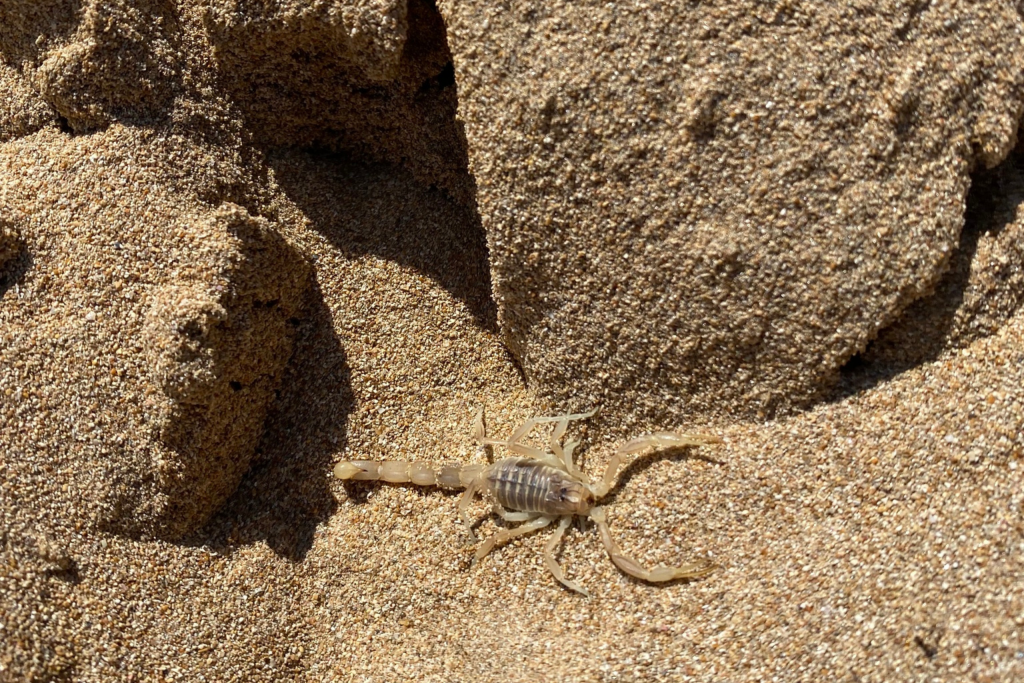
Described as a new species only in 2011, Buthus kunti was a genuine scientific surprise. Medium to large in size – up to 73 millimetres – it is mostly pale yellow to cream with brownish markings along its ridges, and its legs carry scattered brown spots. It is found primarily in sandy lowland habitats, particularly on the Karpas Peninsula and in the Güzelyurt area – a very different ecological niche from A. cyprius, which prefers rocky hillsides and mountain terrain. The two endemic species appear to have divided Cyprus between them, rarely if ever sharing the same ground.
What makes Cyprus scientifically unique is that it is the only place in the world where members of both the genus Aegaeobuthus and the genus Buthus are found together – two scorpion lineages that diverged long ago occupying the same small island, side by side in their different corners.
A third species, Euscorpius italicus, has been recorded from Cyprus but is considered a probable introduction rather than a native resident, and its population does not appear to be established.
- 1,900 m Maximum elevation recorded for Aegeobuthus cyprius in Troodos
- 73 mm Maximum recorded length of Buthus kunti
- 5.2 Mya Estimated time since Cyprus scorpion diverged from Anatolian relatives
Things Worth Knowing About Cyprus Scorpions
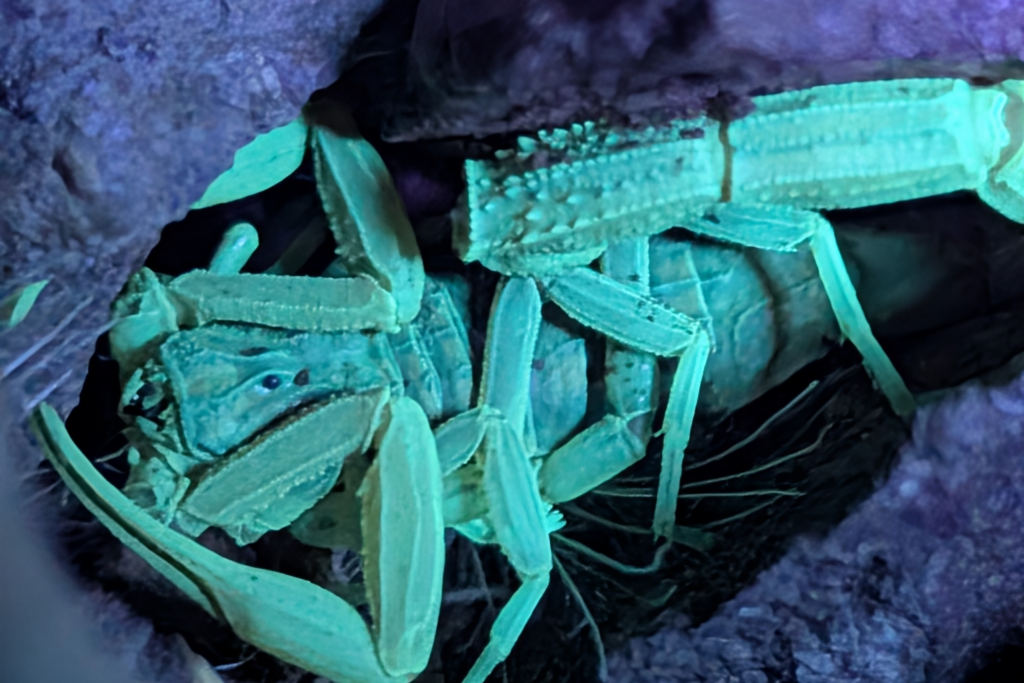
- They glow in the dark. All scorpions fluoresce a vivid blue-green under ultraviolet light, which is why researchers use UV torches to find them at night. Scientists still debate exactly why – the leading theory is that this property helps scorpions detect ambient UV and moonlight through their entire body surface.
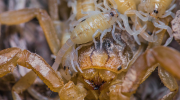
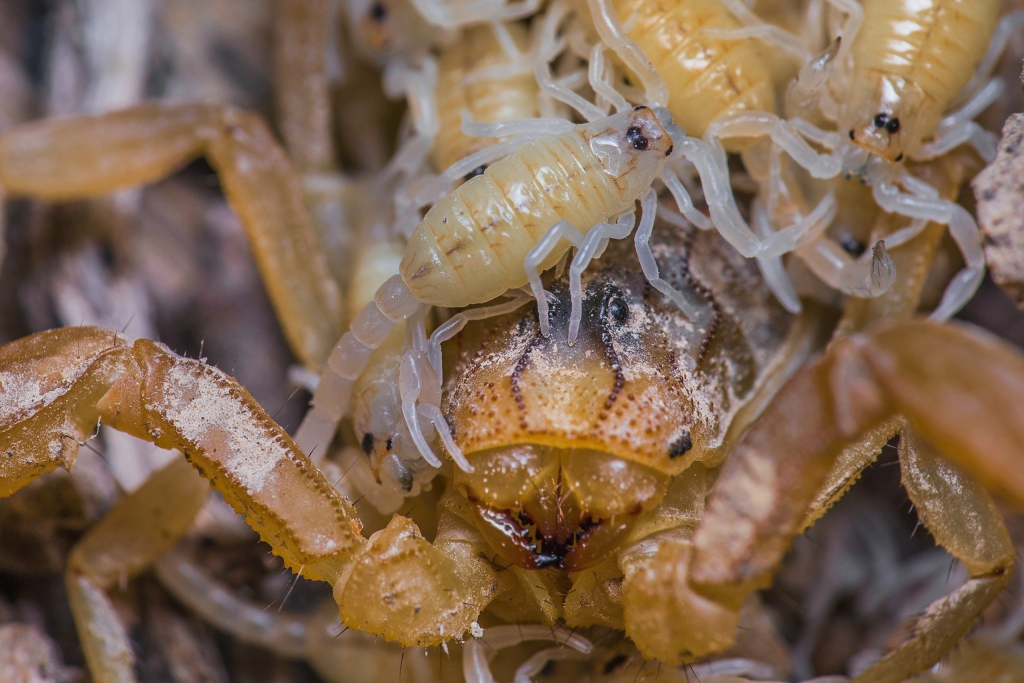
- They give birth to live young. Scorpions do not lay eggs. Mothers carry their young – up to 30 or more tiny white scorplings – on their backs until their first moult, at which point the juveniles disperse. A female scorpion carrying her young is one of the more remarkable sights a naturalist can encounter.
- Found by DNA, not by eye. The Cyprus scorpion was formally described as a new species in 2000 entirely because of molecular analysis – its DNA revealed it had been evolving separately for over five million years, even though it looks very similar to its mainland relatives.
- A sting is rarely serious for adults. Despite their fearsome reputation, the scorpions of Cyprus belong to the family Buthidae, and while their sting can be acutely painful and may cause local swelling, it is not considered life-threatening for healthy adults. Children and individuals with sensitivities should always seek medical attention after a sting.
- Survivors of the drying sea. The ancestors of the Cyprus scorpion were stranded on the island when the Mediterranean refilled around 5.2 million years ago, after the Messinian Salinity Crisis – one of the most dramatic events in geological history, when the sea essentially evaporated and then flooded back within a geological instant.
- Cyprus is globally unique. The island is the only known place on Earth where members of both scorpion genera Aegaeobuthus and Buthus share the same territory – two lineages that would normally be found on entirely different parts of the map.
Venom, Stars, and Zoological Curiosities
Hold a UV lamp above a rocky hillside on a moonless Cypriot night, and the darkness suddenly reveals its inhabitants – each scorpion burning with a cold blue-green light, like small fallen stars scattered across the ground.
The venom of Aegaeobuthus cyprius has recently begun to receive scientific attention. A research team from the University of Nicosia conducted the first proteomic investigation of its composition – meaning they catalogued the proteins it contains – and found that the venom differs meaningfully from that of its closest relative, Aegaeobuthus gibbosus, the Mediterranean checkered scorpion of Greece and Turkey. The Cyprus scorpion venom showed a distinctive protein band at 60–65 kDa not present in the mainland species. Most intriguingly, laboratory tests showed that the venom of A. cyprius demonstrated a slightly higher ability to affect the viability of certain cancer cell lines than its relative’s venom – a finding that, while still very preliminary, places it among a small group of scorpion venoms being studied for potential medical applications.
Scorpion venom research is a growing field worldwide. Many of the peptides found in scorpion venoms have properties that researchers are investigating in the context of pain management, antimicrobial compounds, and oncology. The modest scorpion under a Cypriot rock may be carrying molecules that science has barely begun to understand.
On the taxonomic front, the Cyprus scorpion’s name has changed more than once. Originally described in 2000 as Mesobuthus cyprius, it was reclassified in 2019 into the newly created genus Aegaeobuthus by Czech taxonomist František Kovařík – a genus created to better reflect the evolutionary relationships of several scorpions found around the Aegean and eastern Mediterranean. The scorpion itself has not changed; only our understanding of its place in the family tree has become more precise.
“Cyprus is the only place on Earth where members of two distinct scorpion genera – Aegaeobuthus and Buthus – share the same island territory.”
One further zoological note: in 2025, researchers confirmed that Buthus kunti has been observed engaging in cannibalism – a behaviour documented in at least two recorded instances. Scorpions are known to be capable of this across many species, particularly in competitive or stressed conditions, but its recording for this Cypriot endemic adds another layer to what remains a relatively little-studied creature.
Still Here, Still Unseen
Most Cypriots have heard of scorpions. Many have encountered one – under a flowerpot, crossing a tiled floor on a warm evening, or sheltering in a stone wall. The reaction is almost universally one of alarm, which is understandable but rarely justified. The scorpions of Cyprus are not aggressive animals. They sting only when directly handled or accidentally pressed against skin, and they spend the vast majority of their lives hidden from human view, hunting insects and spiders in the dark.
Yet both endemic species face pressures that deserve attention. Buthus kunti is restricted to a narrow range of sandy coastal and lowland habitats, and researchers have specifically noted that unplanned urban development threatens the ecological niches these animals depend on. As coastal development continues across the island, the sandy-soil habitats of the Karpas Peninsula become ever more precious.
Both species remain formally understudied compared to many European endemic animals. Field surveys are ongoing – the 2020 paper reporting new locality records for A. cyprius documented 114 specimens across 26 sites, significantly expanding our knowledge of where the species actually lives – but much remains unknown about their population sizes, seasonal behaviour, and long-term trends.
A Night Walk Under the Stars
Seeing a scorpion in the wild in Cyprus is entirely possible for anyone willing to go out after dark with the right equipment – specifically, a UV (ultraviolet) torch. These are inexpensive, widely available, and genuinely transformative: under UV light, scorpions glow a vivid blue-green against the dark ground, making them relatively easy to spot on warm evenings when they emerge from their retreats to hunt.
- Where to Look
Rocky hillsides, dry riverbeds, and pine forest edges in the Troodos foothills; stone walls and ancient ruins throughout the island. The Akamas Peninsula and Stavros tis Psokas are both documented localities. Sandy coastal areas of the Karpas Peninsula for Buthus kunti.
- When to Go
Late spring through early autumn, on warm, calm nights. Scorpions are most active at temperatures above 20°C. Allow your eyes to adjust and walk slowly along rocky ground, sweeping with the UV lamp. They often shelter under flat stones or bark during the day.
- What to Bring
A UV torch (365nm wavelength is best), closed footwear – always – and a healthy respect for the animal. Never handle a scorpion with bare hands. A macro lens or a mobile phone with a decent camera will reward patience with extraordinary photographs.
- The Experience
Searching for scorpions by UV torch on a warm Cypriot night – pine resin in the air, stars overhead, and small points of cold light appearing at your feet – is one of the island’s more unusual and memorable natural encounters. You are not likely to forget it.
Observations can be logged on iNaturalist, where both endemic species are tracked. Contributing records helps scientists better understand distribution patterns and seasonal activity – a small way for any visitor or resident to contribute to the conservation knowledge base.
The scorpions of Cyprus are not a novelty or a nuisance. They are living testimony to the island’s deep geological past – creatures shaped by a vanished sea, refined by five million years of island isolation, and carrying in their venom compounds that science is only now beginning to investigate. They share Cyprus with the mouflon and the griffon vulture, the cedar forest and the Troodos rock lizard – but they do so invisibly, patiently, and with a tenacity that has outlasted every civilisation that has ever feared them.
To know that they are there, going about their ancient business under the Cypriot stones and stars, is to understand something true about this island: that its wildness is not only beautiful, but very, very old.