Cyprus is a safe Mediterranean destination with a crime rate lower than many European countries. The island ranks 70th globally on the Global Peace Index and has a homicide rate of just 0.4 per 100,000 inhabitants, one of the lowest in Europe.

Violent crime is extremely rare, and most safety concerns for visitors involve traffic accidents and petty theft. Understanding the local driving culture, transport options, and basic precautions helps ensure a smooth trip.
Cyprus offers excellent road infrastructure and modern public services, but some unique challenges require attention, particularly for first-time visitors.
The Reality of Road Safety in Cyprus
Cyprus has a concerning road safety record. The country records 54 road fatalities per million inhabitants, which exceeds the EU average of 42. Between 2008 and 2020, Cyprus documented over 10,500 road accidents resulting in more than 15,000 injuries. Males account for 77 percent of all road fatalities, and young people aged 18 to 25 represent 21 percent of deaths, higher than the EU average of 12 percent.
Alcohol contributes to 26 percent of all road accidents, while careless driving causes 22 percent and speeding accounts for 12 percent. In fatal accidents specifically, speed plays a role in one-third of cases. The motorcyclist fatality rate in Cyprus is significantly higher than the EU average, and 57 percent of motorcyclists who died were not wearing helmets. Similarly, 64 percent of car occupants killed in crashes were not wearing seatbelts. These statistics reveal serious compliance issues with basic safety measures.
Understanding Left-Hand Traffic
Cyprus follows left-hand traffic, a legacy of British colonial rule until 1960. This means vehicles drive on the left side of the road, and cars have right-hand drive with the steering wheel positioned on the right. For visitors from countries with right-hand traffic, this system requires adjustment and concentration.

The most dangerous moments occur during the first few hours behind the wheel, particularly when making turns and exiting parking spaces. The brain instinctively wants to turn into the right lane, and only conscious control prevents driving into oncoming traffic. Insurance statistics confirm that most tourist accidents happen at roundabouts and during right turns. Drivers forget to look right and yield to traffic already in the roundabout, leading to collisions.

On motorways, the far-left lane serves as the slow lane for relaxed driving, while the right lane is for overtaking. Exits also appear on the left, requiring drivers to move into the left lane well in advance. Road signs appear in both Greek and English, making navigation easier for international visitors.
Essential Traffic Rules and Regulations
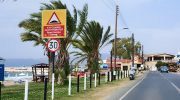
Speed limits are clearly marked and straightforward to remember. In built-up areas, the limit is 50 kilometers per hour, dropping to 30 kilometers per hour near schools and in villages. Country roads allow 65 to 80 kilometers per hour, while motorways have a maximum of 100 kilometers per hour and a minimum of 65 kilometers per hour. Speed cameras are common, and fines range from 25 to several hundred euros depending on the violation.
The legal blood alcohol limit is 0.22 per thousand for drivers with over three years of experience and 0.09 per thousand for newer drivers. Random alcohol testing can occur at any time. Exceeding 0.71 milligrams results in court referral, fines up to 4,000 euros, potential one-year imprisonment, and license suspension. Cyprus introduced a penalty points system in 2020, where accumulating 12 points results in a six-month license suspension. Points remain on record for two years.
Using mobile phones while driving is illegal unless hands-free. Even if the car is stationary with the engine running, this counts as driving. The fine is 150 euros. Eating and drinking while driving is also prohibited, as both hands must remain on the steering wheel. Seatbelts are mandatory for all occupants, front and back. Children under five must use appropriate car seats, and children under 12 require suitable restraints. Smoking in a vehicle with anyone under 16 present is illegal.
Public Transport and Alternative Options
Public buses operate in major cities like Nicosia, Limassol, Larnaca, and Paphos, connecting urban areas and running intercity routes. Buses are well-maintained, affordable, and reliable for short trips.

However, service is limited outside urban centers, with reduced schedules, fewer routes, and earlier evening service, particularly in winter. Rural areas often lack bus connections entirely, making car rental essential for exploring remote locations.

Taxis are regulated, licensed, and generally safe. In cities, taxis use meters, but in rural areas, agreeing on a price before the journey is standard practice. Ride-hailing apps are available in major cities. Theft can occur on public transport, so passengers should watch their belongings closely.

Crime and Personal Safety
Cyprus maintains a low crime rate with a Safety Index of 66.3 out of 100 according to recent data. Petty theft, particularly pickpocketing and bag-snatching, occurs in crowded tourist areas, beaches, and urban centers. Violent crime is extremely rare. Most visitors experience no serious safety issues beyond minor property crime.
Certain nightclub scams target unsuspecting tourists, especially in areas like Ayia Napa. These scams lure patrons inside and then inflate bills exponentially, demanding payment through threats of force. Some establishments involve victims of sex trafficking forced to perform. Being suspicious of overly friendly strangers offering invitations to parties helps avoid these situations.

Sexual assaults are infrequent but do occur. Drink spiking poses a risk, including with substances like GHB and liquid ecstasy. Travelers should buy their own drinks, keep them in sight at all times, and avoid splitting up from friends. Women travelers generally report feeling very safe in Cyprus, though standard precautions like avoiding poorly lit areas at night and securing belongings remain sensible.
Practical Safety Measures for Travelers
All drivers must be at least 18 years old and possess a full valid driving license. Car rental companies typically require drivers to be 21 or older, with additional fees for those under 25 or over 75. A credit card in the main driver’s name is necessary for security deposits. Cyprus has zero-tolerance policies for illegal drugs, including cannabis and laughing gas, with severe penalties including heavy fines and imprisonment.
Healthcare facilities meet international standards, but travel insurance covering medical expenses is essential. Emergency services are reliable and efficient. The emergency number is 112 for police, fire, and ambulance services. Emergency operators may not always speak English, though this is uncommon in tourist areas.
When parking, avoid yellow lines, disabled spaces, pedestrian crossings, and sidewalks. Parking illegally can result in an 85-euro fine, while parking in disabled spaces carries a 1,285-euro fine or up to one year in prison. Most areas outside city centers offer free parking, but popular urban locations like Limassol require payment.
How to Stay Safe on Cyprus Roads
First-time drivers in countries with left-hand traffic should take extra time to adjust. Driving slower than traffic flow during the first few days is acceptable and safer than rushing. Concentrating fully on the road without distractions is essential. Using a GPS navigation system helps significantly, as it provides turn-by-turn directions that reduce confusion.

Defensive driving is crucial, as local driving standards can be inconsistent. Some Cypriot drivers show poor lane discipline, fail to use indicators, and drive aggressively. Maintaining safe following distances, anticipating sudden maneuvers, and avoiding confrontations with aggressive drivers all contribute to safety.
Avoid driving during peak summer months in heavily touristed areas, as traffic increases dramatically and road conditions become more chaotic. Early morning and late evening driving in summer should account for reduced visibility and potential wildlife on rural roads. Mountain roads in areas like Troodos can be narrow, winding, and poorly lit, requiring extra caution.
Navigating Cyprus Safely
Cyprus combines beautiful scenery with genuine safety challenges on the roads. The statistics show that accidents are preventable through proper seatbelt use, helmet compliance, avoiding alcohol, and controlling speed. Tourist drivers face additional risks due to unfamiliar left-hand traffic and aggressive local driving habits. However, thousands of visitors successfully drive in Cyprus each year by taking appropriate precautions and staying alert. Understanding the unique traffic system, respecting local regulations, and maintaining defensive driving practices transforms Cyprus into an accessible destination rather than a dangerous one. The island’s low crime rate and excellent emergency services provide reassurance beyond the roads, making it a welcoming place for informed travelers.