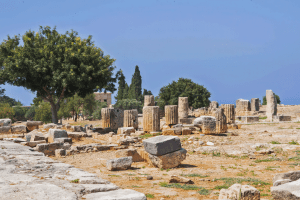
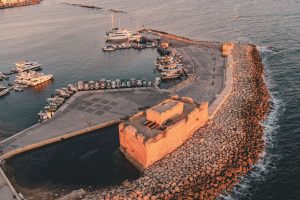
During the Hellenistic age, Cyprus quietly transformed from a collection of local kingdoms into one of the most strategically important naval centers in the Mediterranean.
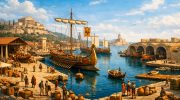
Under centralized rule, the island became a command hub for fleets, shipyards, and sea routes that linked Egypt, the Levant, and the Aegean. This was not accidental power. It was administrative, geographic, and deeply intentional.
- When the Sea Became the Center of Power
- From City-Kingdoms to Central Command
- Cyprus as the Nerve Center of Ptolemaic Sea Power
- Harbors Built for Permanence, Not Passage
- The Resources That Made Fleets Possible
- Life Inside a Naval Province
- Control of Sea Lanes and Supply Routes
- War, Rivalry, and Constant Readiness
- The End of an Era, Not of a System
- Why Hellenistic Naval Cyprus Still Matters
When the Sea Became the Center of Power
Cyprus has always faced outward. Its position at the crossroads of three continents made the sea unavoidable, but during the Hellenistic period, maritime control became the island’s defining function.
After the death of Alexander the Great in 323 BCE, his successors fought to control the eastern Mediterranean. Among them, the rulers of the Ptolemaic Kingdom quickly understood that Egypt’s security depended on the sea. Cyprus, lying directly between Egypt and its rivals, became essential.
From this moment onward, Cyprus was no longer a peripheral island. It became a naval extension of Egypt itself.
From City-Kingdoms to Central Command
Before Hellenistic rule, Cyprus was divided among independent city-kingdoms such as Salamis, Kition, and Paphos. Each ruled locally, minted its own coinage, and maintained limited autonomy even under Persian oversight.

That system ended decisively under Ptolemaic control. Local kings were removed, sometimes violently, and replaced with a single centralized administration loyal to Alexandria. The island was no longer governed as a collection of cities but as one strategic unit.
This shift mattered. Naval power requires coordination, predictability, and hierarchy. Fragmented rule could not sustain fleets or protect sea lanes. Centralized rule could.
Cyprus as the Nerve Center of Ptolemaic Sea Power
By the third century BCE, Cyprus had become the primary naval headquarters of the eastern Mediterranean. Fleets were assembled, repaired, and dispatched from its ports. Command decisions made on the island shaped military outcomes far beyond its shores.
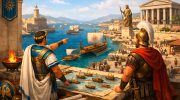
The governor of Cyprus held extraordinary authority. Known as the strategos, this official controlled civil administration, military forces, and eventually naval command as well. When the title of nauarchos, or admiral, was added, it formalized Cyprus’s role as the heart of Ptolemaic naval operations.
From here, ships could be sent north toward Asia Minor, east toward the Levant, or south to protect Egyptian waters. Cyprus functioned as a forward operating base long before the concept existed.
Harbors Built for Permanence, Not Passage
Naval dominance depends on infrastructure, and Hellenistic Cyprus invested heavily in it.
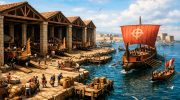
Nea Paphos was chosen as the island’s capital not for tradition, but for logistics. Its harbor provided a direct sea route to Egypt, reducing travel time and increasing reliability. From Paphos, orders, supplies, and fleets could move efficiently between island and mainland.
Other ports played specialized roles. Kition developed large ship sheds where warships were hauled ashore for maintenance during winter months. Salamis remained a commercial hub, linking Cyprus to long-distance trade networks.
These were not temporary facilities. They were permanent installations designed for a standing navy, signaling a long-term commitment to maritime control.
The Resources That Made Fleets Possible
Cyprus was valuable not only for its location, but for what it could supply. Egypt lacked timber suitable for large-scale shipbuilding. Cyprus did not. Forests in the Troodos Mountains provided wood for hulls, oars, and masts. The island’s copper mines supplied bronze for fittings, tools, and weapons.

These resources were placed under state control. Timber and copper extraction became regulated industries tied directly to naval demand. Cyprus was not just hosting fleets. It was feeding them materially.
In effect, the island became a self-contained naval economy.
Life Inside a Naval Province
The transformation of Cyprus into a naval center reshaped daily life. Shipbuilding yards employed carpenters, metalworkers, rope makers, and sail weavers. Ports attracted sailors, merchants, and officials from across the Hellenistic world.
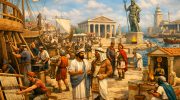
Greek became the language of administration and trade. Urban spaces changed accordingly, with gymnasia, theaters, and agoras appearing in major cities. At the same time, local traditions persisted, blending with Greek and Egyptian influences rather than disappearing.
Religious life reflected this mixture. Deities associated with the sea, protection, and royal power gained prominence, mirroring the island’s new role within a wider imperial system.
Control of Sea Lanes and Supply Routes
Naval administration was not only about ships. It was about movement.
From Cyprus, the Ptolemies controlled key maritime corridors. Grain shipments from Egypt passed safely through Cypriot waters. Trade between the Aegean and the Levant moved under the watch of Ptolemaic fleets.

This control allowed the kingdom to project power without constant warfare. The presence of ships alone could deter rivals, protect allies, and influence regional politics. Cyprus became a stabilizing force, but one backed by force.
War, Rivalry, and Constant Readiness
The eastern Mediterranean during the Hellenistic period was never peaceful for long. Cyprus played a central role in conflicts between the Ptolemies and their rivals, especially the Seleucid Empire.
Fleets based on the island supported campaigns during the Syrian Wars and protected Egypt from invasion by sea. Even when battles were fought elsewhere, Cyprus remained the logistical backbone of naval operations.
Its importance made it a target, but its fortifications and fleet presence ensured it was rarely vulnerable for long.
The End of an Era, Not of a System
When Rome annexed Cyprus in 58 BCE, the island’s naval importance did not disappear. The Romans retained much of the existing infrastructure, administration, and port hierarchy.

Roman Republic recognized what the Ptolemies already knew. Cyprus worked best as a maritime hub. The systems built during the Hellenistic period continued to function under new rulers, proving their durability.
Why Hellenistic Naval Cyprus Still Matters
Hellenistic Cyprus matters because it shows how power can be organized quietly and effectively. There were no single monuments announcing naval dominance. Instead, there were harbors, ship sheds, forests, mines, and administrators.
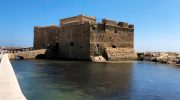
The island did not rule the sea by accident. It was shaped into a naval province through planning, geography, and centralized control. That legacy still defines Cyprus’s relationship with the Mediterranean today.
Long after fleets vanished and empires fell, the island remains oriented toward the sea, not as a boundary, but as a connective force. That identity was forged most clearly during the Hellenistic age, when Cyprus became not just an island, but the hinge of maritime power.