The Kamares Aqueduct stands as one of the most impressive monuments from Ottoman Cyprus. It was built in the 18th century to solve the city’s water shortage. Water infrastructure was essential for urban centers throughout the Ottoman Empire. Cities needed reliable water sources to support growing populations, public baths, fountains, and agricultural activities. The Ottomans inherited Roman and Byzantine engineering knowledge and adapted these techniques to meet their needs.
Cyprus became an Ottoman province in 1571 after the conquest of the Venetian-controlled island. Under Ottoman administration, Cyprus experienced periods of both prosperity and hardship. Water supply infrastructure represented one area where Ottoman governors made significant investments, recognizing that access to clean water directly affected public health and economic development.
Aqueducts transported water from distant sources using gravity rather than mechanical pumps. The channels needed to be angled just enough for water to flow steadily without stagnating or moving so fast it damaged the structure.
Historical Background
By the mid-18th century, Larnaca had grown into an important commercial port on Cyprus’s southern coast. Mediterranean trade brought increasing numbers of merchants, sailors, and residents to the city. This population growth created a serious problem: Larnaca lacked sufficient local water sources.
The nearest reliable springs and the Tremithos River (also called the Arpera River) lay approximately 10 kilometers away from the city center. Before the aqueduct’s construction, residents had to manually carry water from these distant sources, a labor-intensive process that took approximately two hours each way. This situation limited the city’s ability to grow and made daily life significantly harder for ordinary people.
The water shortage affected everyone. Households needed water for drinking, cooking, and basic hygiene. Public facilities like bathhouses and fountains required steady supplies. Agricultural areas around the city depended on irrigation during Cyprus’s dry summer months. Without adequate water infrastructure, Larnaca could not fully capitalize on its strategic position as a trading hub.
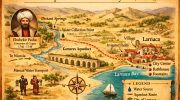
Ebubekir Pasha was born in 1670 in Alaiye (modern Alanya, Turkey) and became one of the most distinguished Ottoman statesmen of his era. In 1740, he married Safiye Sultan, daughter of Sultan Mustafa II, becoming son-in-law to the sultan himself. This connection strengthened his political position but also demonstrated the trust the imperial family placed in him. Ebubekir Pasha served as governor of Cyprus from 1746 to 1748. These three years, especially during his governorship, were a period of development and relative prosperity for Cyprus.
He recognized that infrastructure improvements would benefit the island’s economy and population. Beyond the famous aqueduct, he helped revitalize the local economy by having 23 shops built in Nicosia, financed by his personal funds.
His approach to governance emphasized public works that would have a lasting impact. Rather than simply extracting taxes and wealth from Cyprus, he invested in projects that would improve the quality of life. This forward-thinking administration style made him memorable among Ottoman governors of the period.
Construction of the Kamares Aqueduct
Construction of the aqueduct commenced in 1747 and was completed in 1750, costing a total of 50,000 qirsh, which was paid by Ebubekir Pasha. The governor personally financed the entire project from his own resources rather than imposing additional taxes on the local population. This generous approach to public infrastructure won him praise from both residents and foreign observers.
The project required careful planning and substantial labor. Engineers had to survey the route from the water source to Larnaca. Construction teams excavated underground channels, dug ventilation shafts, and built the visible arches that would carry water across valleys and low-lying areas.
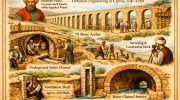
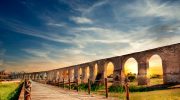
The structure consists of 75 arches in total, though sources vary slightly on exact measurements. The aqueduct extended approximately 16 kilometers in total length, combining underground channels with above-ground sections. The underground portions included approximately 250 ventilation shafts at regular intervals. These shafts allowed workers to access the channel for maintenance and helped regulate air pressure within the system.
The water channel itself was built to Roman specifications, maintaining a consistent gradient that allowed water to flow steadily. Engineers designed the system to deliver approximately 4,500 cubic meters of water daily to Larnaca. This volume provided roughly 360 liters per person based on the city’s population at the time, sufficient for drinking, cooking, bathing, and other needs.
How the Water System Functioned Daily
The aqueduct drew water from springs and the Tremithos River located 10 to 15 kilometers from Larnaca. The exact distance depended on which source fed the system at any given time, as water availability varied seasonally. Underground channels carried water from these sources through carefully excavated tunnels.
The system utilized gravity flow exclusively, meaning water moved downhill through the entire route from source to city. This required precise engineering to maintain the correct slope angle. Too steep, and water would rush through too quickly, potentially damaging the channel walls. Too shallow, and water would barely move or stagnate.
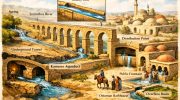
When the channel encountered valleys or low-lying areas, the water flowed through raised stone arches. These elevated sections maintained the proper gradient while crossing terrain that would otherwise interrupt the flow. The visible arches near Larnaca represent the most dramatic portion where the aqueduct crossed a significant depression in the landscape.
At the Larnaca end, the aqueduct terminated at distribution points where water flowed into the city’s fountain system. Public fountains allowed residents to collect water for household use. The system also supplied bathhouses, which were important social and hygienic facilities in Ottoman urban culture. Some water was directed to irrigation channels for agricultural areas around the city.
The aqueduct operated continuously once water began flowing. Unlike modern systems with valves and controls, Roman-style aqueducts maintained constant flow. Excess water that wasn’t immediately used overflowed into drainage systems or collection basins. This continuous operation ensured reliable supply but also meant the system had to be monitored and maintained regularly.
Maintenance Challenges and Long-Term Operation
Maintaining an aqueduct required constant attention. The 250 ventilation shafts along the underground sections served dual purposes during operation. They allowed air to circulate, preventing pressure buildup. They also gave maintenance workers access points to enter the channel for repairs and cleaning.
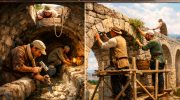
Limestone deposits gradually accumulated inside the water channel. Cyprus’s water contains high mineral content, and as water flowed through the aqueduct, these minerals slowly built up on the channel walls. Workers had to periodically clean these deposits to maintain proper water flow. Access through the ventilation shafts made this work possible without dismantling the structure.
The exposed stone arches faced different challenges. Weather, earthquakes, and simple aging could damage the masonry. Inspection and repair of the arches required skilled stonemasons who understood the structural principles. The survival of many arches into the present day demonstrates that maintenance work was generally effective throughout the Ottoman period.
Plant growth posed another problem. Roots could penetrate cracks in the stonework, gradually expanding them and threatening structural integrity. Workers had to remove vegetation that took hold in the aqueduct’s joints and surfaces. This ongoing battle with nature required vigilance and regular attention.
Cyprus experiences occasional earthquakes that could damage aqueduct sections. Historical records suggest the structure survived various seismic events during its operational period, though repairs were likely needed after significant tremors. The robust construction and regular maintenance helped the aqueduct weather these natural challenges.
Nearly Two Centuries of Continuous Service
The aqueduct was abandoned in 1939 and its function replaced by modern pipes. For 189 years, from 1750 to 1939, the Kamares Aqueduct reliably delivered water to Larnaca. This remarkable operational lifespan spanning nearly two centuries demonstrates both the quality of original construction and the effectiveness of ongoing maintenance.
By the late 1930s, modern water technology had advanced significantly. The British, who controlled Cyprus from 1878 onward, introduced new infrastructure including pressurized pipe systems. These modern pipes could pump water over hills rather than relying solely on gravity, offering greater flexibility in routing. They required less maintenance and could deliver water more directly to individual buildings.
The Aqueduct’s Role in Larnaca’s Identity Today
The Kamares Aqueduct has become one of Larnaca’s most recognizable symbols. It appears in tourist promotional materials, local business logos, and civic imagery. This adoption as a city emblem reflects how the monument has transcended its original Ottoman-era context to become part of shared Cypriot heritage.
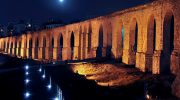
Cultural events occasionally take place near the aqueduct, using the historic backdrop to add significance to gatherings. The combination of the illuminated arches and the open space around them creates an atmospheric setting for concerts, festivals, and community celebrations. These modern uses demonstrate that the aqueduct remains relevant to civic life.
Kamares Aqueduct as Living History
The Kamares Aqueduct successfully bridges past and present. It began as functional infrastructure solving a practical problem, served that purpose for nearly two centuries, and now continues to serve by educating, inspiring, and connecting people to Cyprus’s Ottoman heritage. This evolution from utility to monument demonstrates how buildings can acquire new meanings over time.
Unlike many historical structures that require extensive restoration to remain standing, the aqueduct’s survival largely resulted from its original quality and basic maintenance. The limestone construction proved durable enough to withstand centuries of exposure. This natural preservation, rather than heavy-handed reconstruction, allows visitors to experience authentic Ottoman engineering.
The monument’s accessibility makes it democratic in a way that elite structures like palaces or mosques are not. Anyone can visit the aqueduct freely, walk among the arches, and appreciate both the engineering achievement and the civic spirit that created it. This openness makes the historical experience available to all rather than restricted to those who can afford admission fees or special access.