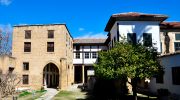
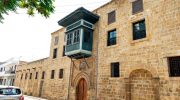
The Hadjigeorgakis Kornesios Mansion stands in Nicosia’s old Saint Antonios quarter as the finest surviving example of 18th century Ottoman urban architecture in Cyprus. Built in 1793, this two story residence once belonged to the island’s most powerful dragoman and now serves as the Cyprus Ethnological Museum, winner of the 1988 Europa Nostra award for cultural heritage restoration.
The dragoman served as the official interpreter between the Ottoman Sultan’s Divan and the local Greek Cypriot population. This position emerged at the start of Ottoman rule in Cyprus in 1571 and continued until the Greek War of Independence in 1821. The dragoman acted as a liaison between the pasha and the occupied population.
In the early years of Ottoman rule, dragomans were foreigners or Greek Franks. Later, the Ottomans appointed Orthodox Greek Cypriots to the position. The office required mastery of both Greek and Turkish languages and went only to highly educated individuals.
Historical Background
Hadjigeorgakis Kornesios came from Kritou Terra, a village in the Paphos district of western Cyprus. He served as dragoman of Cyprus from 1779 to 1809, a period of 30 years that made him the longest serving and most prominent holder of this office. Around 1796, Sultan Selim III issued a special edict granting Kornesios the title of lifelong Dragoman of Cyprus, an unusual distinction that reflected his importance to the Ottoman administration.
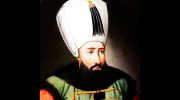
The people and clergy held Kornesios in high esteem. His cooperation with the Orthodox Church proved instrumental in the dismissal of the tyrannical Governor Hatjibakkis. Contemporary accounts and a poem composed after his execution describe him as a man who used his wealth and power for charitable purposes rather than personal benefit. He contributed his own money to construction projects, provided financial and moral support to the Church of Cyprus, and promoted education across the island.
The 1804 Revolt and Its Consequences
Despite his reputation for charitable work, Kornesios faced significant opposition. His rise, together with that of the Archbishop, caused anxiety among the Turkish aghas who had previously dominated political and financial authority. Many in the population resented the heavy taxes they paid, and Kornesios, as the official responsible for tax collection, became a target of that resentment. The French consuls also opposed him because they viewed him as a Russophile and therefore an enemy of French interests.

These tensions exploded in 1804 when a revolt erupted across the island. The uprising began as a response to increased taxation and a wheat shortage that created hardship for the Ottoman population. The insurgents initially directed their anger at the imperial authorities, but Ottoman officials successfully redirected the mob’s wrath toward the Church and the dragoman.
The angry mob broke into Kornesios’s mansion and sacked it. The dragoman escaped with his family to Constantinople, where they remained for three years. Before leaving, Kornesios appointed his assistant, Nikolaos Nikolaides, as his commissary to manage affairs in his absence. Nikolaides took advantage of this position to enrich himself through tyrannical tax collection methods, collaborating closely with the muhassil.
The Final Years and Execution
When Kornesios was cleared of all charges, he returned to Cyprus in 1807 to conduct an audit of the accounts. The audit revealed Nikolaides’s abuses and threatened to expose the corrupt practices of Nikolaides and Hasan Agha. To avoid accountability, they sent a slanderous report to the Sultan accusing Kornesios of wrongdoing. This report prompted an order for the dragoman’s arrest and a full examination of his accounts covering the previous 20 years.
Informed of this development, Kornesios fled once more to Constantinople to prove his innocence. This time his efforts failed. The Grand Vizier Kör Yusuf Ziyaüddin Pasha, who harbored personal resentment against Kornesios, ordered his execution. The ambassadors of England and Russia attempted to intervene on his behalf, and the Sultan eventually issued an order for his release. The order arrived too late. On March 31, 1809, Hadjigeorgakis Kornesios was beheaded in Constantinople.
Following his execution, Ottoman authorities confiscated his estate. His family suffered years of exile and imprisonment. Hatice Hanim, from the Turkish family of Magnisali, purchased the mansion for 13,000 kuruş. In 1830, Yiangos Tselepi, the dragoman’s youngest son, returned from Constantinople and bought back the mansion with a loan from the Archdiocese. He settled there with his wife Iouliani, née Vondiziano.
The Architecture of Power and Comfort
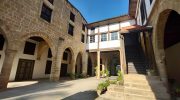
The mansion was constructed in 1793 using local block-cut sandstone. A marble tablet inside the entrance displays the owner’s monogram and the date of construction. The architectural plan follows the shape of the Greek letter Pi, with three wings surrounding a central garden that contains a fountain and a private hammam (Turkish bath) with three rooms.
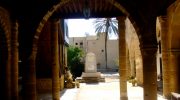
The ground floor housed the servants’ quarters and the kitchen. Roofed wooden stairs with a stone base lead from the courtyard to the entrance hall on the first floor. The first floor contained the official reception room and the living areas, all of which opened onto the reception hall. This layout followed common Ottoman practice, separating public functions on the upper floor from service areas below.
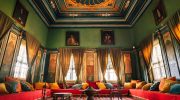
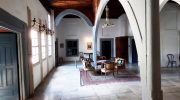
The official reception room, known as the onda, occupies the end of the east wing. This room differs dramatically from the other spaces in the mansion through its exceptional carved wooden decoration, gilding, and painted surfaces. The wooden panels on the walls feature multicolored floral compositions. Built in cabinets are set into the north wall, including one with a secret compartment that leads to the roof. The cabinets display faux marble painted decoration.
High windows are positioned in three walls of the raised floor sitting area. The ceiling preserves its original painted decoration. Four portraits hang on the walls, including two oil paintings on the south wall that depict Hadjigeorgakis Kornesios holding a firman and wearing his official attire: a sheepskin fur coat (miloti) and a sable fur kalpak (samourokalpako), a high crowned cap that signified his rank. Two additional portraits on the east and west walls show his son Tselepi Yiangos and daughter in law Iouliani Vondiziano.
The decoration in the official reception room resembles similar rooms in mansions throughout the Ottoman Empire, particularly those in urban centers across the Mediterranean region. This similarity reflects the spread of Ottoman architectural and decorative styles through official networks and craftsmen who traveled between major cities.
The Museum Collections Today
The mansion now functions as the Ethnological Museum of Lefkosia. The furnishings displayed throughout the building are not original to Kornesios’s time but date from the late 19th to early 20th century. The last owner of the mansion donated these items. While not historically connected to the dragoman himself, the furnishings provide authentic examples of how wealthy Cypriots lived during the final decades of Ottoman rule and the early British period.
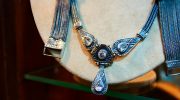
The ground floor west wing contains various exhibits from the Ottoman occupation and the first decades of British rule in Cyprus. The collection includes copperware, breech loading rifles, jewelry, pipes, and coins. These objects document material culture across a period of significant political transition. Silversmithing and goldsmithing flourished in Cyprus from the 17th to the 19th century, and Lefkosia served as a particularly important center for these crafts.
Fascinating Facts Of Hadji Georgakis Kornesios Mansion
The entrance door to the mansion sits low, a design feature intended to prevent horsemen from sweeping directly into the courtyard. Visitors had to dismount and bow slightly to enter, a practical security measure that also enforced respect for the residence.
The hammam in the central courtyard remains one of the mansion’s most distinctive features. Turkish baths were common in Ottoman urban residences, particularly those of the wealthy. The three room structure follows traditional hammam design, with spaces for different temperature zones. While no longer operational as a bath, the structure provides insight into daily life and hygiene practices during the Ottoman period.
The central garden with its fountain created a cool, shaded space in the hot Cypriot climate. Ottoman architecture emphasized interior courtyards as private outdoor spaces where families could enjoy fresh air away from public view. The fountain provided both practical water access and the pleasant sound of running water, a luxury in the Mediterranean climate.
Visiting the Ethnological Museum
The museum operates Tuesday through Friday from 8:30 AM to 3:30 PM and Saturday from 9:30 AM to 4:30 PM. It closes on Mondays, Sundays, and public holidays. The entrance is located at 20 Patriarchou Grigoriou Street in old Nicosia, within walking distance of other historic sites including the Archbishop’s Palace and the Cathedral of Agios Ioannis.
Admission is free, making the museum accessible to all visitors interested in Cypriot history and Ottoman period architecture. The museum has no air conditioning, which can make summer visits uncomfortable. Visiting during cooler months or early in the morning provides a more pleasant experience. The upper floors are accessed by stairs, which may present challenges for visitors with mobility limitations.
Why This Building Matters
The Hadjigeorgakis Kornesios Mansion represents a unique intersection of architectural history, political power, and cultural heritage. It stands as the finest surviving example of Ottoman period urban architecture in Nicosia, a city that once contained many such grand residences but lost most of them to 20th century development and conflict.
The building documents how power operated under Ottoman rule, with the dragoman serving as a crucial intermediary between rulers and ruled. The mansion’s size and decoration reflect the wealth and status that came with this position. At the same time, Kornesios’s tragic end illustrates the precarious nature of that power and how political fortunes could shift rapidly.
For modern Cyprus, the mansion provides a tangible connection to a period when the island’s different communities lived side by side under Ottoman administration, before the nationalist conflicts of the 20th century divided the island. The building’s survival, restoration, and recognition through the Europa Nostra award demonstrate the value placed on preserving this complex heritage.