4 minutes read See on map

Cyprus offers a unique winter sports experience where skiers can enjoy slopes under beautiful Mediterranean blue skies, then drive to the beach for afternoon swimming on the same day. Skiing can be enjoyed on the slopes of Mount Olympus at 1,951 meters above sea level, usually from the beginning of January until the end of March.

alamy-com

The Troodos ski resort sits only 2 kilometers from Troodos Hill resort, about an hour’s drive from the seaside town of Limassol and the capital Nicosia. The ski season depends heavily on weather conditions, with temperatures in the Troodos Mountains dropping to minus 5 degrees Celsius at night and around 4 degrees Celsius during the day when snow coverage reaches as much as 2 meters on lower slopes and 2.5 meters on the highest peaks.

The Slopes and Lift System

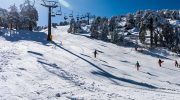
The Cyprus Ski Club on Mount Olympus operates as the center of all skiing activity in the Troodos range with four main slopes named after Greek gods and goddesses. Aphrodite, also called Sun Valley I, serves beginners with a 150-meter run. Hera, or North Face II, provides the second beginners slope at 350 meters long. Hermes, known as Sun Valley II, offers 150 meters for intermediate level skiers. Zeus, or North Face I, starts very near the peak of the mountain at 1,915 meters and challenges advanced skiers with a 500-meter run.
alamy-com

Four ski lifts transport visitors up the mountain, including a 380-meter-long chairlift and three T-bars varying in length between 125 and 262 meters. The lifts help minimize queuing time even during busy weekends and holidays. The slopes operate from 9:00 AM daily, with approximately 4 to 5 kilometers of runs total. The resort features 100 percent snowmaking coverage to supplement natural snowfall and extend the season when conditions allow.

Equipment and Facilities

The ski shop located in the Sun Valley area is operated by the Cyprus Ski Club and run by trained technicians. The shop carries approximately 300 pairs of alpine skis and 400 pairs of ski boots, 50 snowboards with boots, and 50 pairs of cross-country skis and boots. Until recently, only skis were available to rent from the store situated next to the cafe adjacent to the Sun Valley run, but snowboards have become more widely available as locals increasingly recognize the sport.
alamy-com

Full-day and half-day ski passes can be purchased at the ski hut just below Mount Olympus at Sun Valley. Rental equipment costs remain reasonable compared to European Alpine resorts, though prices increase during peak periods. During heavy snowfall, local police stop vehicles from reaching the slopes unless drivers have a 4×4 vehicle or use snow chains, so checking road conditions before departure is essential.

Accommodations Near the Slopes

Troodos Square ranks as the closest resort to the Ski Club with two well-equipped hotels and a row of tourist shops. Platres is the biggest of the Troodos resorts, located on the southern slopes 8 kilometers from the Ski Club. This village is one of the island’s Krasochoria or wine villages, despite many vineyards being changed to orchards for growing fruit trees. When snow does not settle adequately for skiing, Platres offers beautiful waterfall-laden nature trails and cycling routes.

Pedoulas lies 17 kilometers from the Ski Club in the Marathasa valley and features pretty nature trails through surrounding pine woods and cherry trees. The village offers culture through the local Byzantine and Folkloric Museums and the Chapel of Archangel Michael. Kakopetria sits 20 kilometers from Troodos Square but is perhaps the most beautiful option. Surrounded by thick forest and facing the Troodos range, the village is built along the banks of two rivers which unite in its center to form the Klarios River.

Why Skiing in Cyprus Is Special

The uniqueness of Cyprus skiing lies in its contrast with typical Alpine destinations. Skiers can enjoy slopes in the morning, then drive to the coast for beach activities in the afternoon when sea temperatures remain mild even in winter. The ski season is not very long between December and April, and luck plays a role in catching perfect snow conditions. The snow melts much quicker on south-facing slopes, so webcam views from below can be misleading.

alamy-com

Skiing has been popular in the area for at least 85 years. The first recorded ski descents were made in the early 1930s, and the first ski lift was installed more than 70 years ago in 1947. An International FIS Skiing Competition is organized every year by the Cyprus Ski Federation and takes place at the Zeus Slalom Homologated Piste, demonstrating that the resort maintains international standards despite its small size.
Discover more about the fascinating edges of Cyprus

Walking and Seaside Visits in Cyprus

Walking and Seaside Visits in Cyprus

Cyprus life revolves around the Mediterranean Sea and the simple pleasure of walking. The island's 650 kilometers of coastline and 326 days of annual sunshine create perfect conditions for daily seaside visits that locals consider essential rather than optional.  CyprusMail Walking serves multiple purposes in Cypriot culture, from exercise and social connection to mental relaxation and community participation. The coastal promenades and beaches function as outdoor living rooms where families gather, friends meet, and strangers become acquaintances through repeated casual encounters. The History of Coastal Walking Traditions The tradition of evening coastal walks, known as the volta, traces back to ancient Greek and Roman practices of gathering in public spaces. During Byzantine times, promenades along harbor areas served as meeting points for merchants, fishermen, and community members. The Ottoman period introduced coffee culture that complemented these walking traditions, creating social patterns that persist today. British colonial rule added formal promenade design to coastal cities, particularly in Limassol and Larnaca where waterfront development emphasized public access. The modern promenade culture emerged after Cyprus independence in 1960, when cities began investing in coastal infrastructure. The Paphos promenade development connected the medieval harbor with archaeological sites, while Limassol created the Molos, a palm-lined waterfront park that opened in 2014. These projects reclaimed seafronts for public use after decades of commercial and industrial dominance,…

Read more
Mirror-Like Landscapes of Cyprus

Mirror-Like Landscapes of Cyprus

Cyprus mirror-like landscapes create minimalist vistas where earth, water, and sky merge into simplified compositions perfect for contemplative viewing and photography. The Larnaca Salt Lake complex southwest of Larnaca city provides the island's most dramatic example, transforming seasonally from a shallow reflective wetland in winter to an expansive white salt flat in summer.  35photo-pro This network of four interconnected lakes, Aliki, Orphani, Soros, and Spiro, covers approximately 2.2 square kilometers and creates mirror reflections of the sky, Hala Sultan Tekke mosque, and palm trees during wet months. The minimalist aesthetic results from the flat terrain, horizontal lines, limited color palette of blue, white, and occasional pink from flamingos, and vast open spaces where human structures become small elements in much larger natural compositions.  The landscapes attract photographers seeking clean lines and negative space, nature enthusiasts drawn to seasonal wildlife including 85 bird species, and travelers looking for quiet environments that offer visual simplicity uncommon in developed Mediterranean destinations. Seasonal Transformations and Visual Drama During winter months from November through March, rainfall fills Larnaca Salt Lake creating shallow water averaging 20 to 30 centimeters deep across the flats. This standing water becomes nature's mirror, reflecting clouds, sky colors at dawn and dusk, and the architectural silhouette of Hala Sultan Tekke on the western shore. The reflections double visual elements, creating symmetrical…

Read more
Cyprus Tourist Travel Routes

Cyprus Tourist Travel Routes

Cyprus offers distinct travel paths that showcase different aspects of the island within compact distances. The most popular routes connect coastal cities, ancient archaeological sites, mountain villages, and natural landmarks. mycyprustravel-com Each path reveals unique character, from beach-focused coastal routes to cultural exploration in the mountains. The island spans just 240 kilometers east to west and 96 kilometers north to south, making multiple routes accessible during a single visit. Well-maintained roads, clear signage in both Greek and English, and short drive times allow travelers to experience varied landscapes within hours. These established paths have developed over years of tourism, balancing accessibility with authentic experiences. The Coastal Circuit from East to West The main coastal route runs from Larnaca through Limassol to Paphos, covering approximately 130 kilometers. This path represents the classic Mediterranean Cyprus experience with beaches, resorts, and seaside culture. Larnaca serves as the typical starting point, located near the island's main international airport. The city offers Finikoudes Beach with its palm-lined promenade and the Church of Saint Lazarus, a 9th-century structure housing the saint's tomb. commons-wikimedia-org. The route continues east to Ayia Napa and Protaras, known for exceptional beaches. Nissi Beach in Ayia Napa features fine white sand and crystal-clear waters, ranked among Cyprus's prettiest beaches. Cape Greco National Forest Park provides coastal walking trails, sea caves, and the…

Read more