Cypro-Minoan is Cyprus’s Late Bronze Age writing system, preserved on about 250 short inscriptions but still undeciphered because no bilingual “key” exists and the underlying language remains unknown. Found mainly at major production and trading centres, and occasionally beyond Cyprus, it shows that writing was used as a practical tool for control and exchange rather than as palace display. This article explains where the script appears, what objects carry it, why scholars cannot yet read it, and how it likely connects to the later Cypriot Syllabary.

Alashiya at a Trade Crossroads
During the Late Bronze Age, Cyprus sat at a strategic intersection between the Aegean, the Near East, and Egypt. Known in contemporary texts as Alashiya, the island was a major exporter of copper, a resource essential for tools, weapons, and trade. This constant movement of goods also carried ideas, technologies, and administrative practices.

It was within this environment that the Cypro-Minoan script emerged. The writing system shows clear visual connections to the Linear A script of Minoan Crete, but it was not simply imported. It was adapted, reshaped, and used in ways that reflected Cyprus’s own economic and social needs rather than those of a centralised palace culture.

A Script Without a Rosetta Stone
The most striking feature of Cypro-Minoan is not how it looks, but what it lacks. There is no bilingual inscription, no text written in both Cypro-Minoan and a known language that could unlock its meaning. Without such a key, scholars have no secure way to assign sounds or words to the signs.

The surviving material is also limited. Approximately 250 inscribed objects are known, and most contain only a handful of signs. This makes statistical analysis difficult and prevents the kind of pattern recognition that helped crack scripts like Linear B.
As a result, Cypro-Minoan remains undeciphered, not because scholars have failed to try, but because the evidence itself is stubbornly incomplete.
Where the Inscriptions Appear
Cypro-Minoan inscriptions do not appear randomly across the island. They are concentrated around major Late Bronze Age centres such as Enkomi, Kition, and Kalavasos-Ayios Dhimitrios, settlements closely tied to metallurgy, trade networks, and administrative activity. These were places where goods were processed, stored, and exchanged, and where written control would have been most useful.

Equally revealing is the script’s presence beyond Cyprus itself. A small number of Cypro-Minoan inscriptions have been recovered from sites such as Ugarit in modern Syria and from locations in the Aegean world. Their appearance abroad suggests that Cypriot traders and officials carried written records with them, using the script as part of long-distance commercial interaction rather than as a purely local or ceremonial system.
Writing, in this sense, followed trade routes. It moved with people, cargo, and agreements, reinforcing Cyprus’s role as an active participant in a wider Mediterranean economy.
Writing on Unusual Objects
Unlike many contemporary Bronze Age scripts, Cypro-Minoan was not primarily recorded on standardised tablets stored in centralised archives. Instead, it appears on a diverse range of objects, many of them small, portable, and practical.

The most common examples are tiny clay balls, often no larger than a marble, each bearing only a few signs. These objects were likely used as administrative markers, identifiers, or control tokens, linking written signs to specific goods or transactions. Clay cylinders inscribed with longer sequences of text have also been found, particularly at Kalavasos, where archaeological context suggests a connection to the management and distribution of olive oil.
A small number of tablets survive as well, indicating that longer written documents were possible, even if they were not the dominant form. Together, these objects show that writing in Cyprus was flexible, adaptable, and embedded in everyday economic practice rather than confined to formal archives.
One Script or Many?
For much of the twentieth century, scholars debated whether Cypro-Minoan represented several distinct scripts rather than a single system. Differences in sign shape, spacing, and execution led to proposals for multiple sub-types, each associated with specific regions or periods.
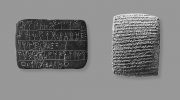
More recent research has questioned this division. When differences in writing material, surface texture, and engraving tools are taken into account, many of the apparent variations become easier to explain. Writing on soft clay produces different results than writing on hard metal or stone, even when the same signs are used.
From this perspective, Cypro-Minoan appears less fragmented and more unified than once believed. Rather than multiple scripts, it may represent a single adaptable writing tradition, capable of adjusting to different contexts while maintaining a shared visual language.
Why Decipherment Remains Elusive
Despite sustained scholarly attention, several obstacles continue to prevent the decipherment of Cypro-Minoan. The surviving corpus is small, many signs occur only once, and numerical or pictorial elements are rare. These limitations severely restrict comparative analysis.
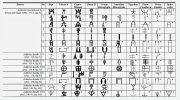
The greatest challenge, however, lies in the unknown language behind the script. Without knowing whether Cypro-Minoan recorded a local Cypriot tongue, an Anatolian language, or a Semitic one, assigning phonetic values remains speculative. Over the past century, numerous decipherment attempts have been proposed, but none have produced results that work consistently across the entire body of inscriptions.
As a result, Cypro-Minoan remains unread not because of scholarly neglect, but because the surviving evidence does not yet allow certainty.
From Mystery Script to Living Legacy
Although Cypro-Minoan disappeared at the end of the Bronze Age, writing itself did not vanish from Cyprus. Instead, it transformed. The Cypriot Syllabary of the Iron Age, later used to write Greek, appears to have developed from the same local tradition.

Through this continuity, Cypro-Minoan occupies a crucial position in the island’s intellectual history. It forms a bridge between the early writing systems of the Aegean and the historically documented scripts of the classical period. Even unread, it demonstrates that Cyprus was not merely receiving ideas from elsewhere, but reshaping them to suit its own needs.
What the Silence Still Proves
The importance of the Cypro-Minoan script lies not in what it says, but in what it proves. Each short inscription represents an act of record-keeping, communication, or control within a complex society. Together, they show that Late Bronze Age Cyprus understood the value of writing as a tool for organisation and exchange.

The script remains silent, yet it is not empty. It stands as evidence of a literate culture operating confidently at the heart of the ancient Mediterranean, even if its words have slipped beyond our reach.