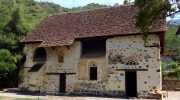
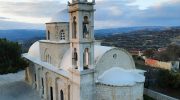
Nestled near the northwestern coast of Cyprus, close to Morphou Bay, stands one of the Mediterranean’s most important archaeological discoveries.
Ayia Irini was a sacred sanctuary that served the people of ancient Cyprus for over a thousand years, from 1200 B.C. until around 500 B.C. The site became famous after excavations revealed thousands of terracotta statues left as offerings to the gods.
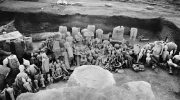
Today, it remains a testament to how people in ancient Cyprus expressed their religious beliefs through art and ritual. The sanctuary’s discovery transformed our understanding of Cypriot religion and culture during the Iron Age, making it one of the most studied sacred sites of the ancient Mediterranean.
From Bronze Age Shrine to Iron Age Center of Devotion
The sanctuary’s history began in the Late Bronze Age around 1200 B.C. and continued until the end of the Cypro-Archaic period. The site underwent significant transformations throughout its long existence.
Originally, it consisted of rectangular houses built with mud brick walls on stone foundations. These buildings were arranged around a large open court, with some structures serving as living spaces and storerooms for the priests, while others were dedicated to religious ceremonies.
The sanctuary was flooded multiple times, and at the beginning of Cypro-Archaic II, it was covered with layers of sand and gravel. Rather than abandon the site, the community rebuilt. A new sanctuary was constructed on top of the old one, different in design.
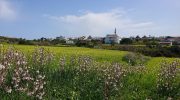
Instead of enclosed buildings, this new phase featured an open-air sacred space surrounded by a wall. The worship practices at the sanctuary reveal much about ancient Cypriot society. The excavators concluded that the cult was agrarian in nature, worshipping deities who protected crops and cattle, with products like corn, wine, olives, honey, and vegetables probably offered to the gods.
The Dramatic Discovery in a Farm Field
The story of how Ayia Irini was found is as remarkable as the site itself. In summer 1929, a local priest named Papa Prokopios caught a looter digging in his field. He brought a sixth-century B.C. terracotta statue to the museum in Nicosia.
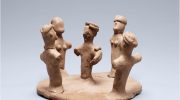
This small artifact caught the attention of the Swedish Cyprus Expedition, led by Einar Gjerstad. The expedition obtained excavation rights and commenced work on Prokopios’ field in November 1929, discovering that the site was an undisturbed sanctuary.
The excavation proved to be extraordinary. The sanctuary produced one of the richest collections of terracotta figures and figurines ever discovered in the ancient Mediterranean. Over two thousand statues emerged from the earth, each one a window into the beliefs and practices of ancient Cyprus.

These figures date from between 650 and 500 B.C., with about half sent to Sweden and the other half remaining in Cyprus. The Swedish collection now forms the centerpiece of the Mediterranean Museum in Stockholm.
Thousands of Stone Offerings Tell Ancient Stories
The terracotta statues found at Ayia Irini reveal what the people who worshipped there believed in. Most votive offerings were terracotta bulls, placed around the altar, which was covered with layers of ash, carbonized matter, and animal bones. These findings suggest that sacrifice played an important role in the sanctuary’s rituals.

Over time, the types of figures changed. Human figures and minotaurs began to appear alongside animals, showing how the understanding of the deity evolved. Most terracotta figures portrayed armed male figures and bulls, suggesting that a fertility deity, possibly male in character, was most likely worshipped at Ayia Irini.
Food and drink were central to the sanctuary’s activities. Large amounts of bowls and plates indicate that food and drink consumption was important to the cult, while closed shapes like jugs, jars, and amphorae suggest storage of offerings. The sanctuary was not just a place for solemn prayer. Evidence suggests a rural yet composite cultic practice that included sacred banquets and dances.
A Sacred Place That Outlasted Empires
The sanctuary eventually faced challenges that would end its active use. At the beginning of the final phase of Cypro-Archaic, around 510-500 B.C., a severe flood caused the sanctuary to be abandoned.
This timing coincides with significant political changes in Cyprus. The chronology fits the political upheavals that followed the Persian conquest of Cyprus in 525 B.C. During the first century B.C., a revival of the cult took place, but this was a much smaller and poorer practice that did not leave many remains behind.
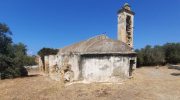
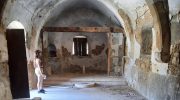
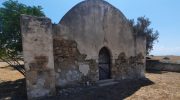
Eventually, a small church dedicated to Ayia Irini, meaning Holy Peace, was built on the same sacred ground.
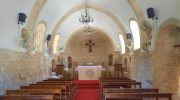
The sanctuary then faded from memory, becoming just another farm field until Papa Prokopios’s accidental discovery in 1929.
Understanding the Deity and Its Worshippers
Despite the wealth of artifacts, the exact identity of the deity worshipped at Ayia Irini remains a mystery. In the absence of written records or inscriptions, discussion of the cult is based on the votive offerings, especially the terracotta figures.
The sanctuary’s location, in a neutral zone between different city-kingdoms, suggests it may have served multiple communities. The sanctuary had strong visibility towards the sea and the territory of Soloi, suggesting economic, political, or religious connections to that region.
The sanctuary’s importance extended beyond religion. It functioned as a central gathering place where communities could come together, exchange goods, and reinforce their social bonds.
The quality and variety of offerings suggest that people from different social levels participated in the sanctuary’s activities, from wealthy landowners to ordinary farmers seeking divine protection for their crops and animals.
Nearby Caretta Beach and Its Living Sanctuary
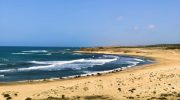
Just a short distance from the archaeological site lies Caretta Beach, located in the nearby Guzelyurt area of the Kyrenia District. While Ayia Irini preserves the memory of ancient worship through stone and clay, Caretta Beach represents nature’s own sacred space. Caretta Beach is home to one of the most successful sea turtle conservation programs in North Cyprus, where volunteers release over 2,000 green turtle hatchlings into the sea.
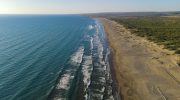
The beach serves as a nesting ground for endangered sea turtles during the summer months, continuing a natural cycle that has existed for thousands of years. Visitors to the region can experience both the human spirituality of the ancient sanctuary and the wonder of witnessing these magnificent creatures returning to the sea, creating a unique connection between ancient and modern understandings of sacred spaces in the landscape.
Visiting the Ancient Sanctuary Today
The excavated area of Ayia Irini lies in a military zone in the northern part of the island and is currently inaccessible to the public. However, visitors interested in the sanctuary can see the largest collection of artifacts at the Mediterranean Museum in Stockholm, Sweden, where detailed information about the site and its history is available.
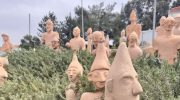
In Cyprus itself, half of the excavated materials are housed in the Cyprus Museum in Nicosia, allowing visitors to experience the terracotta figures directly. Scholarly publications and academic research projects continue to reveal new information about daily life and religious practices at this remarkable sanctuary.
A Window into Ancient Cyprus That Still Speaks
The sanctuary of Ayia Irini is arguably one of the most impressive discoveries of the Swedish Expedition in Cyprus, made between 1927 and 1931. For modern Cypriots, the sanctuary represents an important part of their island’s identity and heritage. It shows how their ancestors understood the sacred, how they organized their communities around shared beliefs, and how they adapted to environmental challenges.
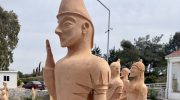
The thousands of terracotta figures, once humble offerings to unknown gods, have become invaluable records of ancient Cypriot civilization.
Each statue, bowl, and piece of pottery tells a story about people who lived centuries ago, their hopes for good harvests, their desire for protection, and their search for meaning. Ayia Irini proves that the desire to connect with something greater than ourselves is not new. It has existed across cultures and centuries, expressed through art, ritual, and the simple act of leaving an offering at a sacred place.