The marble portraits of Roman Salamis turned authority into something citizens met daily, placing emperors, local benefactors, and symbolic figures inside gyms, baths, theatres, and civic halls. Because Cyprus had no native marble, each imported head and statue also signalled access to imperial trade, wealth, and cultural alignment, while local workshops adapted Roman styles through Cypriot hands. This article explains where these portraits stood, how they communicated loyalty and status, and how recutting, earthquakes, and Christian transformation reshaped what survives today.
A Roman City Built on Visibility
Under Roman rule, Salamis evolved from a Hellenistic centre into a fully Roman metropolis. Its harbour connected Cyprus to trade routes linking Asia Minor, the Levant, and the Aegean, while its public buildings reflected imperial ideals of urban life.
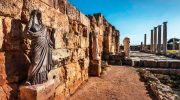
In this environment, sculpture was not optional. Portraits were central to how Roman cities functioned. They filled spaces where people exercised, bathed, watched performances, or gathered for civic business. To move through Salamis was to move among faces carved in stone, each reinforcing the city’s place within the Roman world.
Portraits That Claimed Authority
Roman portrait sculpture followed a visual hierarchy. Emperors and members of the imperial family occupied the most prominent positions, often displayed in niches or along colonnades where their likenesses were impossible to ignore.
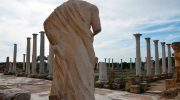
These portraits followed official models distributed across the empire. The goal was recognisability rather than individuality. A visitor arriving in Salamis would immediately know who ruled, just as they would in Rome, Ephesus, or Antioch.
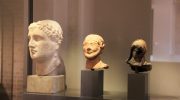
Yet these images were not distant symbols. Positioned in everyday public spaces, they blended political power into daily routine. Authority was not abstract. It had a face, a gaze, and a physical presence.
Local Elites in Roman Costume
Alongside emperors stood the local elite of Salamis. Magistrates, benefactors, gymnasiarchs, and wealthy patrons commissioned marble portraits to mark their status and contributions to the city.
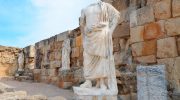
Men were typically shown wearing the toga, the visual shorthand of Roman citizenship and civic responsibility. Women appeared draped in Roman fashion, their hairstyles carefully carved to reflect trends set by imperial women in Rome itself.

These portraits balanced two identities. They presented their subjects as loyal participants in Roman civic culture, while also asserting their local prominence. In marble, Salaminian elites made it clear that they belonged both to Cyprus and to the empire.
Where the Statues Stood
The placement of these sculptures was never accidental. Most were positioned within the northern sector of the city, where Salamis concentrated its most important public buildings and ceremonial spaces.
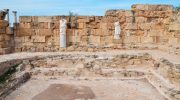
The gymnasium formed the heart of this sculptural landscape. Far more than a place for exercise, it functioned as a social, educational, and political arena, where bodies, status, and civic ideals were continuously on display. Portraits here presided over athletic training, public instruction, and elite interaction, embedding authority into moments of routine.
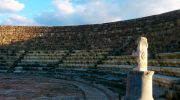
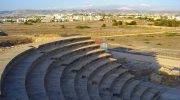
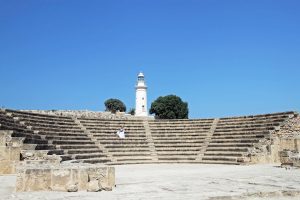
Nearby, the theatre and bath complexes performed similar roles. Leisure spaces doubled as stages for political visibility, ensuring that imperial and local power remained present even during relaxation. Sculpture, architecture, and movement worked together, shaping how citizens experienced the city.
Imported Marble, Imported Status
Cyprus possessed no natural marble sources, making every marble portrait in Salamis an imported statement. Blocks arrived from quarries in Asia Minor and the Greek mainland, transported across sea routes that tied the island into imperial exchange networks.

Choosing marble was therefore an act of communication. It signalled wealth, access, and cultural alignment with Rome. At the same time, it demanded technical adaptation. Local workshops, long experienced in limestone carving, had to master a harder and less forgiving material.
By the second century AD, Salaminian sculptors had achieved increasing refinement, blending imperial stylistic conventions with local craftsmanship. The result was not imitation, but translation, Roman imagery rendered through Cypriot hands.
Repair, Reuse, and Political Change
Marble’s value ensured that statues rarely remained static. Portraits were repaired after damage, relocated as buildings were repurposed, or subtly altered to reflect shifting political realities.
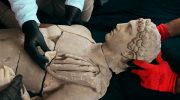
When emperors fell from favour, their likenesses could be reworked rather than destroyed. Facial features were recarved, inscriptions adjusted, and identities reassigned. This practice allowed Salamis to update its public loyalties without discarding costly materials.
Traces of these interventions remain visible today. Tool marks, mismatched proportions, and reused statue bodies reveal a city constantly negotiating continuity and change through stone.
Earthquakes Broke the City’s Script
Natural disaster reshaped Salamis as decisively as politics. A series of major earthquakes, particularly in the fourth century AD, damaged large portions of the urban fabric and accelerated cultural transformation.
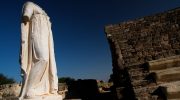
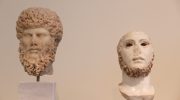
During rebuilding, the city was renamed Constantia and increasingly defined by Christian identity. Pagan statuary lost its original function. Many portraits were dismantled, defaced, or broken apart, with heads often removed deliberately. Some fragments were reused as building material, stripped of meaning and reduced to stone.
The fragmentary condition of the surviving portraits reflects these layered histories. What remains is not simply what survived, but what was actively selected, altered, or discarded.
From Civic Presence to Museum Object
Today, most marble portraits from Salamis no longer stand where they once shaped daily life. They are preserved in museums, including the Cyprus Museum, with others dispersed to collections such as the British Museum.
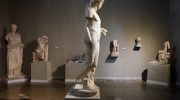
In these settings, the sculptures are appreciated for their artistry and historical value. Yet their original purpose was fundamentally different. They were designed to be encountered in motion, framed by architecture, noise, and crowds.
Understanding their original urban context restores their meaning. These were not isolated artworks, but instruments of visibility within a living city.
These Faces Reflect Power
The marble portraits of Salamis are more than remnants of Roman rule. They document how a provincial city expressed power, negotiated identity, and asserted belonging within a vast imperial system.
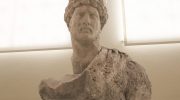
Through imported materials, official imagery, and local adaptation, Salamis presented itself as Roman without erasing its regional character. The damaged, headless figures that survive today speak of authority claimed, contested, and transformed over time.
Seen together, these stone faces reveal how power was made visible, how loyalty was displayed, and how a city at the eastern edge of the Mediterranean understood its place in the Roman world.