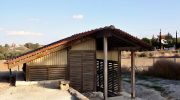
Southwest of Nicosia, near the modern village of Politiko, stand two monumental burial chambers that tell the story of ancient Cyprus’s wealthiest inland kingdom. The Royal Tombs of Tamassos represent the height of 6th century BCE Cypriot architecture and demonstrate the immense prosperity that copper mining brought to this ancient city-kingdom.
These tombs, carved from limestone blocks and built to resemble wooden houses, remain among the most impressive examples of pre-Hellenistic burial architecture on the island.
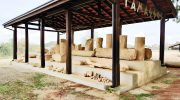
The Royal Tombs of Tamassos are two monumental burial chambers constructed in the mid-6th century BCE. They belonged to the local rulers or elite aristocrats of the ancient city-kingdom of Tamassos, one of the ten major kingdoms of ancient Cyprus.
The tombs were built using massive ashlar blocks of limestone and feature architectural details that imitate wooden construction techniques, including carved representations of roof beams and door locks.
Historical Background
Tamassos was strategically positioned near rich copper deposits in the northeastern foothills of the Troodos Mountains. The area had been inhabited since the Chalcolithic Age (around 3900 BCE), but population growth accelerated dramatically during the Late Bronze Age when copper mining intensified.
By the 8th century BCE, Tamassos had developed into a major city-kingdom.
The kingdom is mentioned in the Assyrian Prism of Esarhaddon from around 673-672 BCE, where it appears as “Tamesi.” The inscription lists King Atmesu (possibly Admetos) as one of the Cypriot rulers paying tribute to the Neo-Assyrian Empire.
This reference confirms that Tamassos was recognized as an important political entity in the eastern Mediterranean during the Iron Age.
Ancient writers frequently mentioned Tamassos in connection with copper. The Greek geographer Strabo described it as a wealthy city known for its copper production. Stephanus of Byzantium called it “mesogeia,” an inland city with copper of excellent quality.
Some scholars even identify Tamassos with “Temese,” a copper marketplace mentioned by Homer in the Odyssey. In Book I, the goddess Athena tells Telemachus about traveling to Temese with iron to trade for copper.
The Discovery and Early Excavations
German archaeologist Max Ohnefalsch-Richter conducted the first excavations at Tamassos between 1889 and 1894. He discovered the two royal tombs, sanctuaries dedicated to Apollo and the Mother of the Gods, and nearly 50 rock-cut tombs.
These excavations yielded large quantities of pottery, jewelry, bronze objects, and other artifacts. Many of these finds were sold to museums around the world.
The German Archaeological Institute and the University of Giessen resumed excavations in the 1970s under the direction of Hans-Günter Buchholz. This phase of work uncovered remains of a temple dedicated to Aphrodite, residential houses, and copper-processing workshops.
The excavations confirmed what ancient writers had claimed about Tamassos being a major center of copper production.
Sporadic excavations between 1970 and 1990 in areas surrounding the ancient city revealed additional structures, including fortification walls from the Archaic period, more tombs, copper-processing installations, and various religious objects.
However, major excavation of the city center has been limited because much of ancient Tamassos lies beneath the modern village of Politiko and the nearby Greek Orthodox Monastery of Agios Herakleidios.
Architecture and Design of the Royal Tombs
The two royal tombs demonstrate sophisticated architectural knowledge and expensive construction methods.
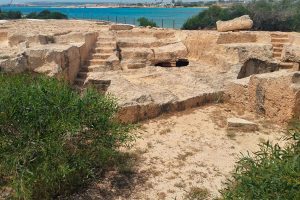
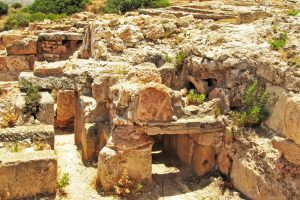
The larger tomb, known as Tomb 5, features a stepped dromos that descends to an entrance flanked by a volute capital, also called a proto-Aeolic capital. This decorative element shows Phoenician and Egyptian influences.
The entrance has a recessed door with a lintel carved to imitate wooden roof beams.
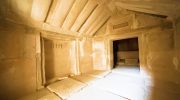
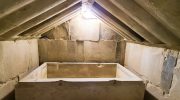
Inside, the tomb consists of two chambers. The walls are built from large ashlar blocks, squared limestone pieces precisely cut and fitted together.
The saddle-shaped roof is constructed from two massive stone slabs that rest on the side walls and lean against each other at the top.
Along the rear wall of the burial chamber sits an open stone sarcophagus where bodies were placed.
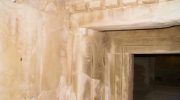
The second tomb features similar construction but includes more elaborate decorative elements. The walls are carved to imitate wooden construction, with molded details representing logs and beams.
A molded beam runs lengthwise at the top of the roof, supporting the saddle-shaped covering. The first chamber contains two square niches shaped like false doors.
The upper parts of these doors have carved representations of door locks, complete with four vertical projections through which a horizontal bar passes. This architectural detail mimics actual wooden door-locking mechanisms.
These imitations of wooden architecture in stone are particularly significant. Archaeologists have linked this feature to Anatolian influence during the zenith of Tamassos in the 6th century BCE.
The practice of creating stone monuments that replicate timber construction appears in various ancient Mediterranean cultures but is especially prominent in regions with strong Anatolian connections.
The Christian Era and Medieval Transformation
Tamassos became one of Cyprus’s first Christian bishoprics in the mid-1st century CE. Saint Herakleidios, who accompanied Saint Paul on his missionary journeys to Cyprus, became the first bishop of Tamassos.
Saint Mnason, mentioned in the Acts of the Apostles, also had strong connections to the region.
A large three-aisled basilica was erected during the Early Christian period over Saint Herakleidios’s burial place, southeast of ancient Tamassos. This basilica eventually fell into ruins.
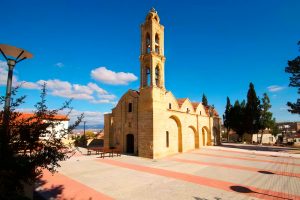
Multiple churches were constructed on the site over the centuries until the present church took its final form in 1773. The Monastery of Agios Herakleidios continues to function today as a convent.
The city’s prosperity began declining in the 10th century CE as the copper mines became exhausted. The economy, so dependent on mining and metallurgy, could not sustain urban life once this resource was depleted.
Gradually, the population dispersed to smaller agricultural villages in the surrounding area.
The Modern Villages and Cultural Heritage
Today, eight villages occupy the territory of ancient Tamassos: Psimolofou, Episkopeio, Pera Orinis, Ergates, Politiko, Kampia, Analyontas, and Kapedes.
These settlements developed over past centuries from poor agricultural communities of about 10 families each into villages with populations around 1,000 inhabitants.
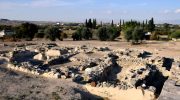
The village names reflect connections to the ancient past. “Politiko” references the brilliant ancient city it replaced (from the Greek word “polis” meaning city).
“Episkopeio” recalls Tamassos’s role as an episcopal see. “Ergates” derives from the Greek word for workers, as this was the area where mine workers lived.
“Pera Orinis” means “opposite the mountains,” referring to its position across from Politiko in a hilly area.
Pera Orinis and Politiko retain many older buildings at their village centers, which are considered culturally significant.
These include the church of Panagia Odigitria, the Old Mill, educational buildings, and the recently restored chapel of Saint George.
The Tamassos Cultural Association, established in 1989, represents the eight communities that constituted the ancient kingdom and works to preserve their shared heritage.
Visiting the Archaeological Site Today
The Tamassos Archaeological Site is located about 21 kilometers southwest of Nicosia, near the village of Politiko.
The site is open to visitors during specific hours. From September 16 to April 15, the site operates Monday through Friday from 8:30 to 16:00.
From April 16 to September 15, hours are Monday through Friday from 9:30 to 17:00. The site is closed on weekends and major holidays.
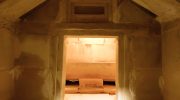
Visitors can explore the two royal tombs, portions of the Temple of Aphrodite, sections of the city fortifications, and various other structures.
Informational signs in Greek and English provide historical context. The site offers views across the agricultural plain of Mesaoria, the same landscape that ancient Tamassos overlooked.
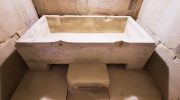
The tomb interiors can be entered, allowing visitors to experience the scale and craftsmanship of these monuments firsthand.
The carved details imitating wooden construction, the massive stone roof slabs, and the stone sarcophagi all remain visible.
Evidence of ancient grave robbing can be seen in a hole in the roof of the larger tomb