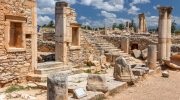
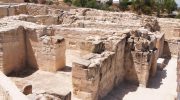
Vouni Palace was a Cypro-Classical hilltop complex built around 500 BC to control coastline movement and project authority over a contested landscape near Soli. Its architectural reliefs and capitals show Persian imperial symbols, including Hathor imagery, rosettes, and royal protection motifs, translated through local limestone carving and later blended with Greek spatial elements as political alignment shifted. This article explains why the site’s position mattered, how decoration was used to regulate experience inside the palace, and what the surviving fragments reveal about Cyprus negotiating empire without simply copying it.

- A Hilltop Built to Watch Soli
- 500 BC: A Palace of Tension
- Architecture as a Statement of Allegiance
- Stone, Skill, and Local Craftsmanship
- Hathor Capitals, Royal Protection
- Lion and Bull, Reframed
- Rosettes and Winged Discs
- A Palace That Recorded Political Change
- Discovery and Archaeological Context
- Where the Reliefs Are Today
- Vouni in transition
A Hilltop Built to Watch Soli
Vouni was never meant to be subtle. Rising roughly 250 meters above sea level, the hill offers uninterrupted views across the coast and inland plains. From here, movement along the shoreline could be monitored with ease, especially the nearby territory of Soli, a city-kingdom that repeatedly resisted Persian authority.
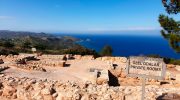
The location makes the palace’s purpose immediately clear. Vouni was built to watch, to assert presence, and to project authority outward. Comfort and urban life were secondary. This was a place where geography itself became part of governance.
500 BC: A Palace of Tension
The palace was constructed around 500 BC, during a period when Cyprus stood at the intersection of competing powers. The island was under the control of the Achaemenid Persian Empire, yet many Cypriot city-kingdoms maintained strong cultural and political ties to the Greek world.
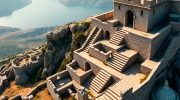
Vouni is traditionally linked to Doxandros, a pro-Persian ruler of nearby Marion. Following the Ionian Revolt, the palace functioned as a strategic outpost, allowing loyal rulers to keep a close eye on rebellious neighbours. Its architecture reflects this role. Vouni was not a capital city. It was a fortified residence designed to stabilise authority in a contested landscape.
Architecture as a Statement of Allegiance
The earliest phase of Vouni followed architectural principles familiar across the Persian administrative world. The layout centred on large courts, controlled entrances, and tripartite halls, arrangements intended to regulate access and reinforce hierarchy.
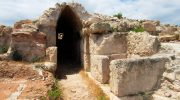
Over the course of roughly a century, the palace underwent several remodelling phases. These changes track shifts in political alignment rather than aesthetic fashion. Later renovations introduced more Greek-style elements, including a megaron-like structure and reoriented entrances, signalling a gradual move away from Persian affiliation toward a more Hellenic identity.
Yet the decorative language did not reset overnight. Older symbols remained in place, creating a layered architectural conversation between empire and locality.
Stone, Skill, and Local Craftsmanship
The architectural reliefs of Vouni were carved almost entirely from local limestone, a material readily available in the surrounding region and well suited to large-scale construction. For more refined decorative elements, including capitals and sculptural details, a smoother light-green limestone sourced from Paradisotissa was often preferred. This distinction reflects both practical knowledge of material properties and a conscious effort to balance durability with visual clarity.
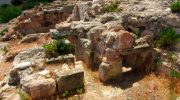
What emerges from the reliefs is not the hand of imported imperial artisans, but the work of regional workshops accustomed to Cypriot building traditions. Forms tend toward rounded volumes rather than sharp edges, responding to the softness of the stone and the outdoor exposure of many architectural features. In several cases, traces of pigment suggest that these reliefs were once brightly colored, reinforcing their visual impact within courtyards and porticoes.
Decoration at Vouni followed a clear spatial logic. Reliefs were placed at thresholds, along circulation routes, and within ceremonial areas where authority needed to be both encountered and reinforced. Their placement ensured that movement through the palace became a controlled experience shaped by symbolism as much as by walls.
Hathor Capitals, Royal Protection
Among the most distinctive architectural elements uncovered at Vouni are the Hathor capitals that once crowned columns around the central courtyard. These capitals depict a stylised female face combining Egyptian religious iconography with distinctly Cypriot carving conventions.
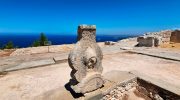
Hathor, widely associated with protection, legitimacy, and royal favour, had already spread across the eastern Mediterranean as a symbol of sanctioned power. At Vouni, her image served a political function rather than a strictly devotional one. The calm, frontal faces, framed by a naos-like structure, conveyed stability and divine oversight, reinforcing the palace’s role as a protected seat of authority.
Rendered in local stone and adapted to regional aesthetics, the Hathor capitals demonstrate how imperial symbols were translated rather than transplanted. Their meaning remained recognisable, but their execution rooted them firmly in the Cypriot landscape.
Lion and Bull, Reframed
Another powerful visual motif associated with Vouni is the lion-and-bull combat scene, a theme well known from Achaemenid imperial art, particularly at Persepolis. At Vouni, this imagery appeared in bronze reliefs discovered within the Temple of Athena, the highest and most symbolically charged space within the palace complex.
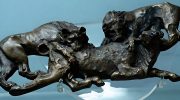
In Persian ideology, the lion and bull represent cosmic struggle, renewal, and the authority of kingship. At Vouni, however, the motif was deliberately repositioned. By placing it within a Greek religious context, the image was allowed to communicate across cultural boundaries, resonating with Persian concepts of power while remaining legible within a Hellenic framework.
This act of visual reframing was strategic. It allowed local rulers to signal loyalty to imperial authority without alienating Greek-aligned elites, reinforcing the palace’s role as a mediator between worlds.
Rosettes and Winged Discs
Beyond the more prominent reliefs, a series of smaller decorative fragments reveals the consistent use of symbols associated with Persian court culture. Rosettes, long tied to divinity and royal favour, appear repeatedly across architectural elements. Winged discs, another emblem of divine protection and sanctioned rule, further reinforce the presence of imperial ideology.
These motifs were never overwhelming in scale or quantity. Instead, they functioned as subtle signals, embedded within the architecture rather than dominating it. Their effectiveness lay in recognition rather than spectacle, communicating legitimacy to those familiar with their meaning while remaining unobtrusive to others.
At Vouni, power was not shouted. It was implied, structured, and quietly reinforced through repetition.
A Palace That Recorded Political Change
One of Vouni’s most revealing qualities is how transparently it documents shifts in political allegiance. As regional control changed hands, architectural priorities evolved. Entrances were blocked or redirected, spatial axes altered, and Greek forms gradually replaced Near Eastern layouts.
Importantly, these changes did not erase what came before. Persian-derived symbols such as Hathor capitals and rosette motifs remained in use even as the palace adopted more Hellenic spatial organisation. The result was not inconsistency, but coexistence, a built record of negotiation rather than rupture.
This architectural layering mirrors Cyprus itself, an island whose history is defined less by replacement than by accumulation.
Discovery and Archaeological Context
Vouni Palace was excavated between 1928 and 1929 by the Swedish Cyprus Expedition under the direction of Einar Gjerstad. The excavation was pioneering for its time, emphasising stratigraphy, construction phases, and spatial relationships rather than isolated artefacts.

The findings revealed a carefully planned complex of more than 130 rooms, complete with water management systems, ceremonial spaces, and administrative zones. The reliefs uncovered were not decorative afterthoughts. They were integral to the palace’s function as a political and symbolic structure, shaping movement, visibility, and authority throughout the site.
Where the Reliefs Are Today
Today, architectural fragments from Vouni are divided primarily between the Cyprus Museum in Nicosia and the Medelhavsmuseet in Stockholm. Capitals, relief fragments, and sculptural elements are displayed alongside material from other Cypriot sites, offering a broader view of artistic and political change during the Classical period.
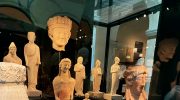
The site itself remains largely unadorned. Standing on the hilltop, visitors encounter the palace much as its builders intended, through space, elevation, and view rather than explanatory signage.
Vouni in transition
Vouni Palace matters because it captures identity in transition. Its architectural reliefs do not belong exclusively to Persia or Greece. They belong to Cyprus, a place that absorbed imperial languages and reshaped them to fit local realities.

Rather than choosing sides outright, Vouni’s rulers used architecture and imagery to remain legible to multiple audiences. In doing so, they created one of the clearest material expressions of cultural hybridity in the eastern Mediterranean.
In the quiet fragments of stone and relief, Vouni preserves a lesson that continues to resonate. Power is not only imposed. It is translated.