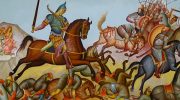
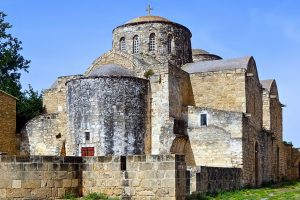
Digenis Akritas stands as one of the most celebrated heroes in Byzantine literature and Greek folklore. His stories blend historical events with supernatural feats, creating a figure who represents courage, strength, and the defense of Christian lands against invaders.
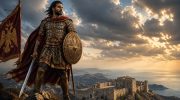
The name Digenis means “two bloods” or “of two peoples,” referring to his mixed Byzantine Greek and Arab heritage. Akritas translates to “border lord” or “frontiersman,” reflecting his role as a defender of the Byzantine Empire’s eastern frontiers.
While the epic poem about his life originated in the 12th century, oral traditions about Digenis existed for centuries before and continue to this day, particularly in Cyprus, Crete, and Asia Minor.
Historical Context
The epic poem of Digenis Akritas emerged from the tradition of Acritic songs, narrative ballads that celebrated the warriors who defended the Byzantine Empire’s borders. These defenders, called Akrites, received land grants along the empire’s edges in exchange for military service. They lived dual lives as both farmers and soldiers, working their fields during peace and taking up arms when Arab raiders threatened Byzantine territory.
The Arab incursions into Byzantine lands from the 7th to the 11th centuries provided the historical context for these stories. The border regions, particularly around the Euphrates River and in Cappadocia, witnessed constant skirmishes and raids.
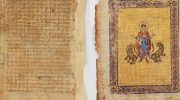
The epic poem itself exists in six known manuscripts, with the two oldest being the Escorial version with 1,867 lines and the Grottaferrata version with 3,749 lines. Both manuscripts date to approximately the 12th century, though the Escorial text appears closer to the original composition while the Grottaferrata version shows more scholarly editing. The oldest surviving manuscript was discovered in a Greek monastery in Grottaferrata, Italy in 1879.
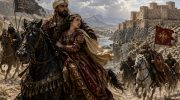
The poem follows a two-part structure. The first half tells the romantic story of Digenis’s parents. An Arab emir invades Cappadocia and abducts the daughter of a Byzantine general. Rather than forcing her into marriage, he falls in love with her, converts to Christianity, and marries her properly. They settle peacefully in Byzantine territory, and their union produces a son named Basileios Digenis Akritas.
The Superhuman Feats of the Hero
The second half of the epic focuses on Digenis himself and his extraordinary abilities. From childhood, he displayed strength that exceeded normal human limits. At age three, he was already a proficient warrior. During a hunting trip with his father, the young Digenis killed two bears with his bare hands.
As a young man, Digenis followed his father’s example by abducting and marrying Strategovna, the daughter of another Byzantine general. This act was driven partly by love and partly by prophecy. According to the epic, a soothsayer predicted that Digenis would live only sixteen years if he married the Amazon warrior Maximo, but sixty-six years if he married Strategovna instead.

His martial achievements extended beyond wild beasts. Digenis defeated a dragon that terrorized the countryside. He confronted a group of bandits called apelates and challenged their three strongest leaders to single combat, defeating each one individually. In one version of the epic, he single-handedly destroyed an entire Arab army of 4,000 soldiers. Even the formidable female warrior Maximo, with whom he committed adultery, could not match his fighting skills.
Remarkable Facts About the Legend
The poem marks the beginning of Greek vernacular literature. Written in demotic medieval Greek rather than the learned language of scholars, it uses fifteen-syllable blank verse with minimal rhyming. Each line stands independently and maintains careful balance in its construction. The verse flows smoothly without harsh sounds or excessive repetition, making it well-suited for oral performance.
An Old Slavonic version of the epic exists under the title “Deeds of the Brave Men of Old.” This adaptation was produced in a bilingual Greek and South Slavic environment, probably in Macedonia during the 14th century Serbian Empire. The Slavonic version shows features of oral-formulaic composition, demonstrating how the story spread beyond Greek-speaking regions.
The hero’s strength was often elevated to supernatural status in folk traditions. Some versions claim he possessed abilities that defied natural laws, performing feats that would be impossible for any mortal man. This exaggeration reflects the tendency of oral storytelling to amplify heroic qualities with each retelling.

Georgios Grivas, the leader of the EOKA resistance movement against British rule in Cyprus from 1955 to 1959, adopted the nom de guerre Digenis. This choice deliberately connected him to the legendary Byzantine hero, invoking the archetype of the border defender protecting his homeland from foreign invaders. The name resonated deeply with Greek Cypriots who viewed their struggle against British colonialism through the lens of Byzantine resistance against external threats.
Different regions developed their own variations of the Digenis stories. The versions from Cyprus, Crete, and Pontus each contain unique elements reflecting local geography, history, and cultural concerns. This regional diversity demonstrates how a single legendary figure could be adapted to serve different communities’ needs for heroic narratives.
The Legend’s Special Connection to Cyprus
Cyprus developed particularly strong associations with Digenis Akritas through local folklore. The island’s landscape itself bears the supposed marks of his superhuman strength. The Pentadaktylos mountain range, which runs along northern Cyprus, takes its name from the Greek word for “five fingers.” According to legend, Digenis gripped this mountain range with one hand as he leaped from the sea to defend Cyprus from Saracen raiders. The distinctive peaks that resemble five fingers rising from the earth represent his handprint forever embedded in the rock.

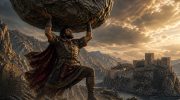
The famous Petra tou Romiou rock formation at Aphrodite’s birthplace also connects to Digenis. One version of the legend states that he threw a massive boulder from the Troodos mountains all the way across Cyprus to strike Saracen ships threatening the coast. The rock landed at Paphos, creating the formation known as the Rock of the Greek. This story explains the alternative name for the site, which is associated both with Aphrodite’s birth and with Digenis’s defense of the island.

According to Cypriot tradition, Digenis would leap between Cyprus, Crete, and Anatolia in pursuit of Saracen raiders. His footprint supposedly remains visible on Mount Psiloritis in Crete, just as his handprint marks the Pentadaktylos range in Cyprus. These geographical legends transformed the hero from a literary character into a protector saint-like figure who watched over the islands from supernatural threats.
Experiencing the Legend in Cyprus Today
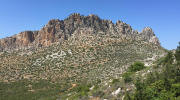
Visitors to Cyprus can see the landscape features associated with Digenis Akritas. The Pentadaktylos range dominates the northern horizon when viewed from Nicosia and the Mesaoria plain. The distinctive five-fingered peak stands out clearly, making it easy to understand how the handprint legend developed. The mountains rise dramatically from the surrounding lowlands, creating an impressive silhouette that suggests supernatural forces shaped the terrain.

Petra tou Romiou offers another physical connection to the legend. The large limestone rocks rising from the sea create distinctive white foam as waves crash against them. Visitors can stand at the beach and imagine Digenis hurling the massive boulder from the distant Troodos mountains, a feat worthy of a hero with superhuman strength.

Museums in Cyprus display Byzantine artifacts and artwork that provide context for understanding the historical period when the Digenis stories emerged. The Cyprus Museum in Nicosia contains extensive Byzantine collections including weapons, armor, religious items, and everyday objects that illustrate life during the era when the Akrites defended the empire’s borders.
Folk music performances featuring acritic songs occur at cultural centers and festivals throughout the year. These events allow audiences to hear the stories in their original oral form, performed with traditional instruments and singing styles. The experience connects listeners directly to the centuries-old tradition of storytelling through song.
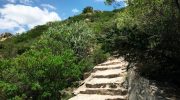
Hiking trails in the Pentadaktylos mountains offer opportunities to explore the legendary landscape firsthand. Walking through these peaks while knowing the Digenis stories adds mythological dimension to the natural beauty. The mountains contain medieval castles and monasteries that date to the Byzantine and Lusignan periods, providing tangible links to the historical context behind the legends.
The Timeless Appeal of a Border Hero
The tales of Digenis Akritas endure because they address fundamental human concerns about courage, identity, and the struggle between civilization and chaos. The hero represents an ideal that combines strength with virtue, military prowess with moral character. His mixed heritage speaks to the complexity of identity in border regions where cultures meet and blend.
The stories remind modern audiences that Cyprus has always existed at the crossroads of civilizations. The island’s strategic position made it vulnerable to invasions but also exposed it to diverse cultural influences. Digenis, with his dual Byzantine and Arab ancestry, embodies this reality of cultural mixing and the possibility of reconciliation through mutual respect and conversion.

His superhuman strength serves as metaphor for the extraordinary courage required to defend one’s homeland against overwhelming odds. The Akrites were often outnumbered farmers turned soldiers who faced professional armies and raiders. Their victories required not just physical strength but also strategic intelligence, local knowledge, and unwavering determination. Digenis represents all these qualities amplified to legendary proportions, creating an inspirational figure who showed that dedicated defenders could overcome seemingly impossible challenges.