Digenis Akritas stands as the most famous epic hero to emerge from the Byzantine Empire, celebrated in folk ballads and a lengthy epic poem that originated in the 10th century and developed further in the 12th century. The name Digenis means “two-blood” or “of two peoples,” referring to his mixed Byzantine Greek and Arab heritage.
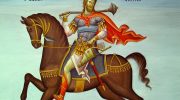
Akritas translates to “borderer” or “frontier guard,” identifying his role defending Byzantine territory. The protagonist became the archetype of the ideal medieval Greek hero, frequently appearing in traditional folk songs particularly popular in Crete, Cyprus, and Asia Minor. For Cypriots specifically, Digenis Akritas represents more than legend, symbolizing bravery, strength, and the eternal fight for freedom against foreign invaders.
The Epic Story and Family Origins
The epic details the life of the hero Basil, whose epithet Digenis Akritas refers to his unique parentage. The first half of the epic, written in an epic tone, describes how his parents met. His mother, a Byzantine noblewoman named Eirene from the aristocratic Doukas family, was abducted during an Arab raid by his father, an Arab emir named Mousour. After capturing Eirene, the emir fell in love with her and she with him. To marry her, Mousour converted to Christianity, reconciling the two peoples through marriage and representing the triumph of Christianity over Islam.
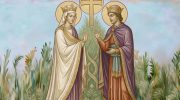
The reconciliation between Byzantine and Arab cultures through this union became a key theme. The rest of the story unfolds against a background of peaceful coexistence between the two peoples, though the hero himself faces constant threats requiring his intervention. This marriage between cultures reflected historical realities of the Byzantine borderlands where Greeks, Armenians, Arabs, and other groups mixed despite political conflicts.
The second half of the epic, written in a more romantic atmosphere, discusses Basil’s early childhood and later his struggles and acts of heroism on the Byzantine borders, often told from a first-person point of view. Allusions to Greek mythological elements appear throughout, including the Hercules-like childhood of Basil. By age three, the child already demonstrated proficient warrior skills, foreshadowing his future as the empire’s greatest defender.
Superhuman Feats and Epic Battles
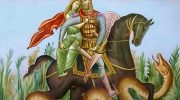
Digenis Akritas possessed strength often elevated to supernatural status. Like his father before him, he carried off the daughter of a Byzantine general and married her. The hero killed a dragon, paralleling Saint George’s famous deed and demonstrating how Byzantine culture blended classical Greek mythology with Orthodox Christian hagiography. He defeated the apelates, a group of bandits, and then bested their three leaders in single combat.
No one could match his prowess, not even Maximu, an amazingly strong female warrior with whom he committed adultery. This affair with an Amazon warrior echoed classical Greek mythology while adding human flaws to his otherwise perfect character. Despite this moral failing, Digenis remained the ideal hero, representing both physical perfection and martial excellence.
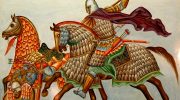
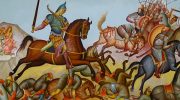
In one version of the epic, Digenis Akritas defeated an entire Arab army of 4,000 men completely alone. The epic descriptions of mounted knights and battles are marked by drama, swift pace, and lively visual detail. These battle scenes gave readers thrilling accounts of frontier warfare that defined Byzantine life during the Arab-Byzantine conflicts lasting from the 7th to early 11th centuries.
Having defeated all his enemies, Digenis built a luxurious palace by the Euphrates River where he ended his days peacefully. In the later tradition, preserved in Acritic folk songs, Digenis eventually faced Death personified as either Charon or Thanatos. This final battle was the only one he lost, though he died with characteristic defiance.
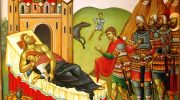
In one version, his final words declared, “if only the Earth had steps and the sky handles: I would stand on the steps, I would grab the handles, climb up to Heaven, curl up and sit there and shake the Heavens down.”
Digenis in Cypriot Legend
Cypriot traditions recognized Digenis as the protector of the island alongside Crete. Legend tells that Digenis would grab hold of the Pentadaktylos mountain range north of Nicosia, leaping over to Anatolia and then to Crete in pursuit of Saracen raiders. The peak of the Pentadaktylos, meaning Five Fingers, was said to represent the imprint of Digenis’s hand where he gripped the mountain to make his giant leap.

According to another Cypriot legend, Digenis once threw a large rock across Cyprus to repel invading Saracen ships. The rock, hurled from the Troodos Mountains, landed in Paphos at the site of Aphrodite’s birthplace. This location is known to this day as Petra tou Romiou, the Rock of the Greek. The massive limestone formation rising from the sea thus became associated with both the goddess of love and the epic hero, linking two of Cyprus’s most important mythological traditions.

The Pentadaktylos mountain range, resembling five knuckles sprouting from the ground, continues reminding Cypriots of their legendary protector. During the 7th to 10th centuries when Arab raids threatened Cyprus, stories of Digenis provided hope and inspiration. The hero symbolized resistance to foreign invasion and the strength to defend homeland against overwhelming odds.
The Acritic Songs and Folk Tradition
Before manuscript discovery, Digenis was known primarily through Acritic songs, narrative vernacular ballads typically in political verse that originated during the Byzantine period. These songs reflected episodes and characters associated with the epic romance. Collected primarily from 19th-century oral sources, the best examples came from the fringes of Asia Minor like Pontus and from Cyprus.

In the Acritic tradition, warriors appeared as paragons of elegance and nobility, called leventia in Greek. They resided in luxurious houses typically on the edges of the Christian world and sometimes bore names from Byzantine aristocracy. These songs preserved the Digenis legend through centuries when manuscripts remained unknown or inaccessible.
The folk songs remain particularly vital in Cyprus, where oral tradition transmitted the hero’s exploits across generations. Cypriots sang these ballads at festivals, weddings, and community gatherings. The tradition ensured every generation learned about Digenis, maintaining his status as a national symbol.
Why Digenis Matters for Cyprus
The story of Digenis Akritas has had its greater impact in modern Greek culture, particularly in Cyprus. The protagonist became the archetype of the ideal medieval Greek hero, frequently appearing in traditional folk songs, represented in art, and used in modern literature as a symbol of medieval Hellenism and Byzantine heroism.
For Cyprus, Digenis embodies several crucial values. His mixed heritage represents Cyprus’s position as a crossroads between East and West, Greek and Arab, Christian and Muslim. The island’s history involved constant interaction between these cultures, sometimes through conflict but also through peaceful exchange. Digenis symbolizes the possibility of reconciliation between opposing forces.
His role as border defender resonates deeply with Cypriots who have faced repeated foreign invasions throughout history. From Arab raids in medieval times to Ottoman conquest, British colonialism, and the 1974 Turkish invasion, Cyprus has continuously struggled for independence and territorial integrity. Digenis represents the eternal vigilance required to protect homeland.
The hero’s superhuman strength and courage provide inspiration during difficult times. When Cyprus faced threats, stories of Digenis throwing mountains and defeating armies reminded people that determination and bravery could overcome seemingly impossible challenges. This psychological function of the myth remains relevant today.