Explore Cyprus with Our Interactive Map

Explore our top stories and discover ideas worth your time.

Religious Processions with Musical Accompaniment in Cyprus

Religious Processions with Musical Accompaniment in Cyprus

In Cyprus, religious processions are not confined to church interiors. On major feast days, faith moves outward, carried through streets, village lanes, and open squares by chanting voices, ringing bells, and slow communal steps. These processions turn ordinary space into sacred ground, if only for an evening. They are not performances staged for an audience, but living traditions that reveal how religion, sound, and community remain tightly bound in Cypriot life. thisisathens-org What makes them unforgettable is often the sound. Not a concert sound, not a soundtrack added for effect, but the steady human voice, the measured toll of bells, the hush that falls over a neighbourhood when an icon approaches. In Cyprus, sacred music is not something you only listen to. It is something you walk with. When Worship Leaves the Church Walls In the Orthodox tradition of Cyprus, a procession is a deliberate act. It represents the Church stepping beyond its sanctuary to bless the world outside. Icons, crosses, and relics are carried through public space to remind participants that faith is not separate from daily life. commons-wikimedia-org The structure is recognisable across the island. Clergy lead. Chanters follow. The community moves together behind them. Candles flicker in the evening air. Incense drifts slowly, sometimes catching in the folds of stone alleys and lingering under balconies. The pace…

Read more

Cyprus Infrastructure Projects

Cyprus Infrastructure Projects

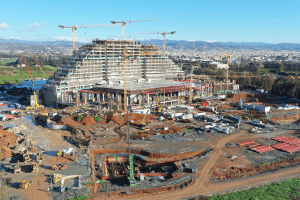
Cyprus has committed over 1.3 billion euros to infrastructure development in 2025, representing one of the most ambitious public investment programs in the island's recent history. President Nicos Christodoulides announced this figure in January 2025, emphasizing the government's determination to modernize public works legislation and introduce electronic systems to increase transparency and efficiency. shutterstock-com The infrastructure push covers multiple sectors, from road networks and smart city technologies to hospital construction and educational facilities. These projects aim to transform Cyprus into a more connected, sustainable, and economically competitive nation. However, several flagship projects have faced significant setbacks, including the troubled 1.2 billion euro Larnaca port and marina redevelopment, which saw its original concession terminated in 2024 after years of delays and financing problems. The Road Network Modernization Program The Ministry of Transport, Communications, and Works has prioritized road infrastructure development, allocating 439.3 million euros through September 2026 for a comprehensive highway and road network upgrade. The program includes ten major projects designed to reduce travel times, improve safety, and decrease urban congestion. These infrastructure interventions represent the most significant road construction effort in Cyprus in over a decade. shutterstock-com The Nicosia Perimeter Motorway represents the centerpiece of this program. Phase A1, which connects the Lakatamia Industrial Area to the Dali Industrial Area, includes 7.5 kilometers of four-lane highway plus approximately 10…

Read more
Saranda Kolones Fortress

Saranda Kolones Fortress

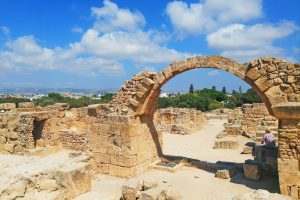
Inside the Paphos Archaeological Park, just north of the old harbor, a pile of broken stones and toppled columns marks where one of Cyprus's most important medieval fortresses once stood. Saranta Kolones, which translates to Forty Columns, served as the main defensive stronghold protecting Paphos during a turbulent period when Arab raids threatened the island. Today, visitors walk among its ruins and discover a fortress that endured multiple rebuilds, witnessed crucial historical events, and met a violent end in one of the worst earthquakes ever to strike Cyprus. tripadvisor-com Historical Background The fortress was built at the end of the 7th century AD under Byzantine rule. Historical records indicate that Theodore, the brother of Emperor Heraclius I, supervised its construction. At that time, the Arab Caliphate had emerged as a powerful force in the Middle East, and Cyprus found itself in the path of expansion. Arab forces launched raids on the island, making coastal cities particularly vulnerable. Paphos, with its strategic harbor and position on shipping routes, needed strong defenses. hotel-com The Byzantine builders created a formidable structure. The fortress featured walls three meters thick, substantial enough to resist siege weapons of that era. Four massive corner towers anchored the defenses, with four additional intermediate towers positioned along the connecting walls. A moat surrounded the entire complex, and access was…

Read more