Explore Cyprus with Our Interactive Map

Explore our top stories and discover ideas worth your time.

Tourism and Conservation Research Partnerships in Cyprus

Tourism and Conservation Research Partnerships in Cyprus

Research partnerships in Cyprus bring together tourism operators, conservation organizations, universities, and government agencies to address environmental challenges while supporting the island's economy. These collaborations develop science-based solutions for protecting natural and cultural resources that attract visitors. The partnerships combine local knowledge with international expertise, creating programs that benefit both ecosystems and communities. financialmirror-com The Cyprus Institute operates as a regional center of excellence for the Eastern Mediterranean and the Middle East, focusing on climate change, environmental sciences, high-performance computing, and cultural heritage. These arrangements ensure that tourism development proceeds alongside meaningful protection efforts. How Partnerships Evolved Over Time The Cyprus Sustainable Tourism Initiative formed in 2006 following a two-year project by the Travel Foundation that created a partnership of UK tour operators, environmental Cypriot NGOs, the Cyprus Tourism Organization, travel agents, and village producers.This marked a shift from isolated conservation efforts to coordinated action. The University of Cyprus established its Oceanography center to conduct research on Eastern Mediterranean marine systems. oceanography.ucy.ac.cy The centre studies marine biodiversity, alien species biology and ecology, climate change impacts, environmental education, creation of diving routes for thematic tourism, and marine pollution.The Cyprus Institute's Science and Technology in Archaeology and Culture Research Center was founded in partnership with the Centre de recherche et de restauration des musées de France, applying advanced imaging and materials science…

Read more
Church of Stavros tou Agiasmati Wall Painting

Church of Stavros tou Agiasmati Wall Painting

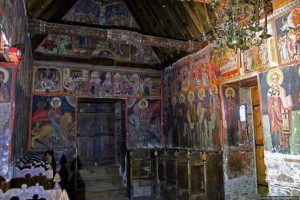
The Church of Stavros tou Agiasmati, situated in the Troodos Mountains near the village of Platanistasa, is one of the monuments included in the UNESCO World Heritage group known as the Painted Churches of the Troodos Region. Dating to the late 15th century, the church represents a mature phase of Cypriot ecclesiastical art during a period of political change and cultural interaction. Its decoration is attributed to the painter Philip Goul, a master whose work reflects the continued vitality of Orthodox artistic traditions under Venetian rule. The church’s importance lies in the completeness and narrative richness of its fresco cycle, which preserves a vivid visual expression of late medieval theology and devotion. ayda-ru During the 15th century, Cyprus stood at a crossroads between Byzantine heritage and Western influence. Although the island was under Venetian administration, Orthodox communities maintained their religious and artistic traditions. Stavros tou Agiasmati embodies this continuity, demonstrating that rural mountain churches remained centers of creative expression and theological instruction. Its remote location contributed to the preservation of its paintings, allowing modern viewers to experience a nearly intact example of late medieval Cypriot religious art. Architectural Form and Environmental Adaptation Architecturally, the church follows the characteristic Troodos mountain type: a small, single-aisled structure built of local stone and covered by a steeply pitched wooden roof. This roof, extending…

Read more
Cyprus Greek Dance Music

Cyprus Greek Dance Music

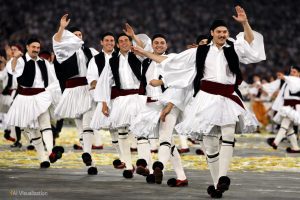
Greek and Cypriot dance music is not background sound. It is structure, instruction, and memory working at the same time. Across villages, islands, and generations, specific rhythms have guided how people move together, celebrate together, and mark life’s most important moments. This article explains how three core dance forms, Syrtos, Sousta, and Ballos, shape the musical language of Cyprus and Greece, why their rhythms matter, and how they continue to function not as performances, but as social glue. Music That Tells the Body What to Do In Greek and Cypriot tradition, dance music is practical before it is expressive. Its primary job is not to impress the listener, but to tell the dancer when to step, pause, turn, or leap. This is why rhythm matters more than melody. The structure of the beat dictates how bodies move together, whether in long communal lines or intimate pairs. Over time, certain rhythmic patterns became deeply familiar, allowing dancers to respond instinctively without instruction. Two broad movement styles dominate this musical world: Dragging, grounded movement, where dancers glide horizontally across the ground Leaping, spring-like movement, where energy rises and falls vertically These qualities are not abstract. They are felt immediately in the music. Syrtos: The Music of the Line and the Circle The Syrtos is the backbone of Greek and Cypriot dance music.…

Read more