Explore Cyprus with Our Interactive Map

Explore our top stories and discover ideas worth your time.

Karpasia Peninsula Climate

Karpasia Peninsula Climate

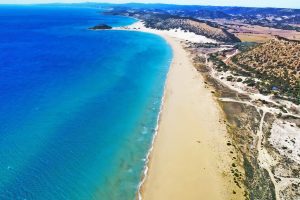
Karpasia Peninsula Sub-Humid Climate is marked by a slightly wetter profile in Cyprus's northern region, supporting lush scrub, wetlands, and seasonal agriculture. This climate, with higher rainfall than the island's interior, creates diverse habitats from coastal dunes to inland plains, fostering unique biodiversity and human activities. It shapes a landscape where moisture gradients influence everything from plant life to settlement patterns, highlighting the peninsula's role as a transitional zone in the eastern Mediterranean. wikipedia-org A Wetter Northern Haven on the Island The Karpasia Peninsula, also known as the "panhandle" of Cyprus, extends 80 kilometers into the Mediterranean from the island's northeast, encompassing a sub-humid climate that distinguishes it from the drier central Mesaoria Plains. Annual rainfall averages 450-550 millimeters, about 20-30% higher than inland areas, concentrated in winter months from November to March, with mild temperatures ranging from 15-20°C. Summers are warm, with highs of 30-35°C moderated by sea breezes, and lower evaporation rates due to coastal proximity. This slight increase in moisture supports lush maquis scrub dominated by evergreen shrubs like lentisk (Pistacia lentiscus) and wild olive (Olea europaea), wetlands that form ephemeral lagoons, and seasonal agriculture focused on rain-fed crops like wheat and barley. The climate's balance creates isolated niches, where freshwater sources and salt marshes coexist, making Karpasia a biodiversity hotspot with over 600 plant species and…

Read more

National Forest Park of Machairas

National Forest Park of Machairas

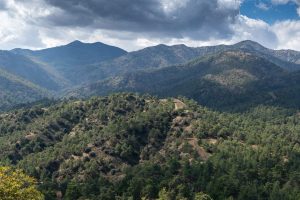
The National Forest Park of Machairas protects one of Cyprus's most important natural areas through 6,057 hectares of Mediterranean forest. It supports over 600 plant species and serves as the source of the island's two largest rivers. Adobe-Stock-com The park was officially declared a National Forest Park on December 22, 2004, through decree 61.368. The designation initially covered the Machairas forest at 43.93 square kilometers and the smaller Lythrodontas forest at 1.31 square kilometers. On June 1, 2005, decree 62.114 added the adjacent area called Vounia tou Anemou, which covers 1.126 square kilometers. The total protected area now spans 60.6 square kilometers across parts of Nicosia and Larnaca districts. Adobe-Stock-com The forest takes its name from the historic Machairas Monastery, which occupies a commanding position at the head of a wooded valley on one of the highest slopes of Kionia Peak. The monastery's name derives from the Greek word for sword or knife. By 1921, Machairas Forest covered 15.26 square miles and was recognized as one of the five main state forests in Cyprus, though it was smaller than the largest, Paphos Forest. visitcyprus-org The park received designation as a Natura 2000 site and Important Bird Area due to its ecological significance. Part of the forest has been declared a Special Protection Area to safeguard its biodiversity. The Department of…

Read more
Cyprus Night Bats

Cyprus Night Bats

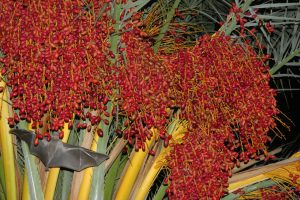
As the last light drains from a Cypriot sky and the air cools over the Troodos foothills, something stirs in the darkness of the old carob trees and ancient limestone caves. Before the stars have properly arranged themselves for the night, the bats are already out dozens, sometimes thousands of them slicing through the warm air in pursuit of mosquitoes, moths, and ripe figs. Cyprus is home to a remarkable diversity of bats, and their story is one of the island's most surprising, most dramatic, and most hopeful wildlife tales. www.inaturalist.org Wings in the Order of Things Bats belong to the order Chiroptera, a name that comes from the Greek words cheir (hand) and pteron (wing) literally, "hand-winged." With over 1,300 species worldwide, bats form the second largest order of mammals on Earth, surpassed only by rodents. Despite what many people assume, they are not related to mice or rats at all. Genetically speaking, bats are in fact closer to humans than they are to rodents. The order is split into two broad groups: the megabats large, fruit-eating species that navigate primarily by sight and the microbats, smaller insect-hunters that navigate through the darkness using echolocation, a biological sonar so precise it can detect a moth's wing-beat in total blackness. Cyprus is home to representatives of both groups, which makes…

Read more