Explore Cyprus with Our Interactive Map

Explore our top stories and discover ideas worth your time.

Roman Paphos Odeon

Roman Paphos Odeon

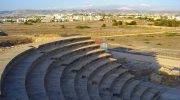
The Ancient Odeon of Paphos stands on the slopes of Fabrica Hill as one of Cyprus's most elegant survivors from Roman times. Built entirely from carefully carved limestone blocks in the 2nd century AD, this semicircular amphitheater today hosts both visitors and live performances in a setting that connects modern audiences with ancient traditions. wikimedia-org The Odeon began its life during the Hellenistic period when Paphos served as the capital of Ptolemaic Cyprus. The theater formed part of the Agora complex in the northern center of the ancient city. During the 2nd century AD, the Romans altered and expanded the structure to its present form. The builders integrated the theater into the natural slope of Fabrica Hill, cutting most of the amphitheater directly from solid rock and lining only the lower sections with separate limestone blocks. The structure originally contained 25 rows of seating. Archaeological evidence suggests the theater had a roof, which would have protected spectators from the Mediterranean sun and enhanced the acoustics. A devastating earthquake struck Cyprus in the 4th century AD, causing severe damage throughout Paphos. While many buildings collapsed entirely, the Odeon survived with 13 rows of its seating intact. The stage, measuring 11 meters in diameter, remained largely undamaged, along with parts of the proscenium and the original cobblestone floor. Discovery and Modern Restoration…

Read more
Left-Hand Driving System in Cyprus

Left-Hand Driving System in Cyprus

Cyprus stands out in Europe as one of only four countries where cars travel on the left side of the road. This unique characteristic catches many visitors by surprise, but it reflects a fascinating blend of historical influence and practical continuity that has shaped the island's transportation system for over a century. paphosmotorentals.cy The British assumed administrative control of Cyprus in 1878 through the Cyprus Convention with the Ottoman Empire. The island officially became a British crown colony in 1925 and remained under British rule until gaining independence in 1960. During this 82-year period, British authorities introduced left-hand traffic to match the system used throughout the British Empire. At that time, the British Empire was expanding rapidly across the globe. Countries under British control, including Australia, India, New Zealand, and numerous others, all adopted left-hand driving. When Cyprus joined this group, it made practical sense to maintain consistency with other British territories. The infrastructure built during the colonial period, from road layouts to signage systems, was all designed for left-hand traffic. When Cyprus gained independence in 1960, authorities faced a choice about whether to switch to right-hand driving like most European countries or maintain the existing system. They chose to keep left-hand traffic because the population had become accustomed to it over eight decades, and changing would have required massive…

Read more

Kyrenia Shipwreck Museum

Kyrenia Shipwreck Museum

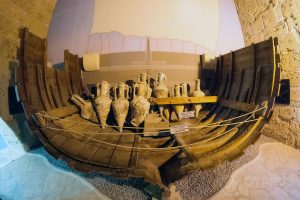
The Kyrenia Shipwreck Museum houses the oldest recovered Greek merchant ship in the world, located within Kyrenia Castle in the Turkish-occupied part of Cyprus. The vessel sank approximately one nautical mile off the coast around 300 BC during the era of Alexander the Great's successors. A local diving instructor named Andreas Cariolou discovered the wreck in November 1965 while collecting sponges at 33 meters depth during a storm. admiral-travel-com He lost the exact position and required over 200 dives before relocating it in 1967. The ship measures 15 meters in length and was constructed from Aleppo pine around 389 BC, sailing for about 80 years before its final voyage. visitncy-com The wreck represents a unique window into ancient Mediterranean trade, daily shipboard life, and maritime technology from over two millennia ago. The rescue that took two years Michael Katzev from the University of Pennsylvania Museum of Archaeology directed a scientific excavation from 1967 to 1969 after Cariolou notified authorities. Over 50 underwater archaeologists, students, and technicians employed stereophotography and advanced techniques to record the position of each object before bringing it to the surface. The team carefully photographed, labeled, dismantled, and lifted the wooden hull to avoid damage. kiprinform-com A protective layer of sand had built up around the ship soon after it reached the seabed, blocking oxygen and marine…

Read more