The Larnaca Synagogue represents the revival of Jewish religious life in Cyprus after centuries of minimal presence. Also known as the Great Synagogue of Cyprus or Cyprus Central Synagogue, the building was completed in 2005 and inaugurated on September 12, 2003.
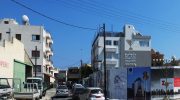
Located at Apollodorou 4 in Larnaca, this Orthodox Jewish congregation serves as the spiritual center for approximately 3,500 Jews currently living in Cyprus. The synagogue’s establishment marked a historic moment, as Cyprus had been the only European Union nation without an active synagogue.
The site serves multiple purposes beyond worship, housing a Jewish community center with educational facilities, kosher restaurants, and plans for a museum documenting Jewish history on the island.
Historical Background
The Jewish connection to Cyprus dates to the 3rd century BC during the Roman conquest of the island. Archaeological evidence indicates at least three ancient synagogues existed in Lapethos, Golgoi, and Constantia-Salamis. An inscribed column from the 4th century, now in the Cyprus Museum in Nicosia, records the renovation of a synagogue in the 3rd century, proving Jews had returned to the island after earlier expulsions.
In 117 AD, Jews on Cyprus participated in the Kitos War, a massive revolt against Roman Emperor Trajan that spread across the eastern Mediterranean. Led by a Jewish commander named Artemion, the uprising on Cyprus resulted in the destruction of Salamis and severe conflict with the Greek population. Roman historian Cassius Dio reported that 240,000 Greeks died during the violence. After crushing the rebellion, Emperor Hadrian issued an edict banning all Jews from Cyprus, enforced so strictly that any Jew whose ship wrecked on Cypriot shores faced immediate execution.
British Colonial Period and Failed Settlements
When Britain gained control of Cyprus in 1878, attempts were made to establish Jewish agricultural settlements on the island. Between 1883 and 1897, Romanian and Russian Jewish immigrants arrived hoping to farm, but these ventures met with little success. By 1901, the Jewish population numbered only 119 people, 63 men and 56 women. The community remained small through the early 20th century, playing a marginal role in island affairs.
The rise of Nazism in 1933 changed this pattern. Hundreds of European Jews fleeing persecution found refuge in Cyprus, which the Axis powers never attempted to conquer. In 1941, fearing a German invasion that never materialized, the British evacuated the island’s population, including its Jewish residents. Women and children were removed first, dispersing the small community that had begun to establish itself.
The Detention Camps and Their Legacy
Cyprus gained its most significant place in Jewish history after World War II. The 1939 White Paper had restricted Jewish immigration to Palestine to 75,000 over five years, with further entry requiring Arab consent. When the war ended, these quotas had expired, though Britain agreed to continue issuing 1,500 certificates monthly. This number fell far short of the desperate need as Holocaust survivors sought to reach Palestine.
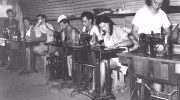
On August 7, 1946, the British government decided to detain Jews caught attempting illegal immigration in camps on Cyprus. Between August 1946 and February 1949, twelve detention camps were established, five summer camps at Caraolos near Famagusta housing detainees in tents, and seven winter camps at Dekalia with tin Nissen huts. In total, approximately 53,000 Jews passed through these camps, with more than 52,000 taken from 39 intercepted boats.
The detained population was predominantly young, with 80 percent between ages 12 and 35, and 8,000 in the 12 to 18 age range. Most were orphans. These survivors came as members of Zionist youth movements, maintaining strong ideological commitment despite harsh conditions. The camps were unbearably hot in summer and freezing in winter, with minimal furniture, no electricity, and severe overcrowding. Approximately 2,000 babies were born in the Jewish wing of the British military hospital in Nicosia. Tragically, 400 Jews died during detention and were buried in the Margoa cemetery.
The Path to Israeli Independence
From November 1946 to May 1948, Cyprus detainees were allowed into Palestine at 750 people monthly, half the legal immigration quota. Special quotas went to pregnant women, nursing mothers, and the elderly. Released Cyprus detainees represented 67 percent of all Palestine immigration during this period. When Israel declared independence on May 14, 1948, about 28,000 Jews remained in the camps. The British increased the release rate to 1,500 monthly, but deliberately held back approximately 11,000 men of military age to prevent them from fighting in the independence war.
The detainees appealed to the United Nations for release, staging a hunger strike on June 7, 1948. Finally in early July, two large ships, Atzma’ut and Kibbutz Galuyot, carried more than 4,100 refugees from Cyprus to Israel. The British maintained restrictions on men aged 18 to 45 throughout most of the conflict. Only in January 1949 did the British begin sending these final detainees to Israel, with the last departing on February 11, 1949.
The Modern Synagogue and Community Center
The Larnaca Synagogue opened in 2005 as the first permanent Jewish place of worship in Cyprus for centuries. Designed in modernist style, the building is affiliated with Orthodox Judaism but welcomes Jews from all denominations and visitors of all backgrounds. Chief Rabbi of Israel Yona Metzger attended the inauguration, stating this was a historic event for Cyprus and praising the country’s openness to all religions.
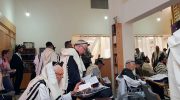
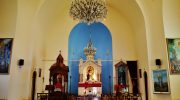
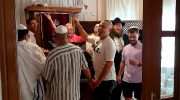
The complex includes a prayer sanctuary with services conducted in a warm atmosphere emphasizing Chabad joy and song. Shacharit services occur Monday through Friday at 8:00 AM and Sunday at 9:00 AM, with Mincha followed by Maariv at sunset. Children are encouraged to participate, creating a family-friendly environment. The facility also contains a religious school, kosher grocery store, two restaurants offering kosher meals, and a hotel for visiting Jews.
The Planned Jewish Museum
A major project under development is the Jewish Museum of Cyprus in Larnaca, conceived by Rabbi Raskin and Sibyl Silver of the Cleveland-based Jewish Heritage Foundation. Expected to require 9 million euros raised entirely through private donations, the museum will showcase Jewish contributions to Cypriot culture and the courageous actions of Cypriots who helped refugees during the detention camp period.
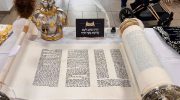
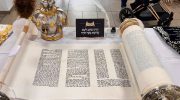
The centerpiece is a World War II era Quonset hut, one of the last remaining structures from the British camps. Rabbi Raskin discovered it being used as a tractor shed by a farmer and secured it for the museum. The metal structure will help visitors understand the harsh conditions detainees endured. The museum will also display rare 19th century Torah scrolls confiscated by Nazis and stored for decades at a Soviet military installation east of Moscow, on loan to tell the story of Jewish persecution and survival.
Contemporary Jewish Community Growth
The Jewish population has expanded significantly in recent years. By 2018, approximately 6,500 Jews lived in Cyprus. By April 2024, Israelis alone numbered 12,000 according to Israel’s KAN public news channel. Three waves of Israeli migration occurred, first during the COVID pandemic, second during Israel’s 2023 political unrest over judicial reform, and third following the October 7, 2023 attacks and ensuing Gaza war. Some 800 Israeli families live in Limassol and 400 in Larnaca.
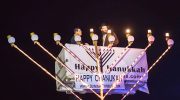
Israel and Cyprus maintain full diplomatic ties with close cooperation in military, agricultural, technological, and tourism sectors. The discovery of significant natural gas fields in waters between the two countries has strengthened commercial and diplomatic relationships. Cyprus has become a popular destination for Israeli tourists, with the 45 minute flight making Larnaca’s synagogue the world’s closest functioning synagogue to Israel.
Visiting the Synagogue and Community
The Larnaca Synagogue welcomes visitors regardless of religious affiliation or knowledge of Hebrew. The building is located a few blocks from Larnaca’s Byzantine-era Church of Saint Lazarus, making it accessible to tourists exploring the city’s religious heritage sites. Each city with a Jewish center has a kosher shop offering ready meals, takeaway options, and eat-in facilities for visitors keeping kosher dietary laws.
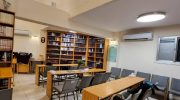
The synagogue and community center represent more than religious infrastructure. They symbolize the resilience of Jewish life, the restoration of a community nearly erased by history, and Cyprus’s role as a crossroads where ancient civilizations, modern conflicts, and humanitarian values intersect. For the descendants of those detained in British camps, the synagogue stands as evidence that the journey to freedom, though delayed and painful, ultimately succeeded.