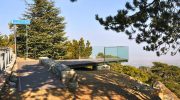
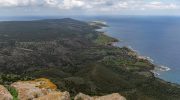
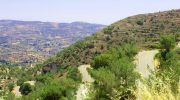
Cyprus forests cover approximately 42% of the island’s total area, with 18% classified as high forest and the remaining 20% as other wooded land. These green expanses stretch across mountain ranges, particularly the Troodos Mountains that dominate the western side of the island. Pine and cedar forests create distinctive ecosystems supporting unique endemic species found nowhere else on Earth.
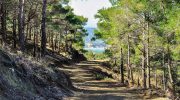
The island was almost entirely forested in ancient times, earning its reputation as the green island of the Mediterranean. Historical records describe Cyprus as a major timber exporter and shipbuilding center. Today, forests remain vital to Cyprus’s natural heritage, water resource protection, and village economies through timber and non-wood products.
Ancient Forest Legacy Shapes Modern Landscape
Ancient civilizations harvested Cyprus forests extensively for shipbuilding and construction. The timber quality made Cyprus a strategic resource for Mediterranean powers. By the 19th century, overgrazing by the largest goat population of any Mediterranean island degraded mature woodlands into garigue and maquis shrubland.
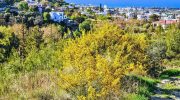
Deciduous oak forests disappeared as communities cleared land for crop terracing. Today, cultivation occupies 45% of the island, primarily across the Mesaoria plain and coastal zones. What remains concentrates in protected mountain areas where terrain prevented agricultural development.
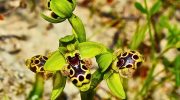
The forests host 1,750 native plant species, with 128 endemic varieties. Endemic species concentrate in the Troodos Mountains (87 species), Kyrenia Mountains (57 species), and Akamas peninsula (35 species). This biological diversity reflects millions of years of isolated evolution on an island positioned between three continents.
Calabrian Pine Dominates Lower Elevations
Turkish pine, also called Calabrian pine (Pinus brutia), represents the most extensive forest type in Cyprus. These hardy trees cover both mountain ranges from sea level to approximately 1,400 meters elevation. Their deep root systems enable remarkable drought resistance and wind tolerance in the Mediterranean climate.
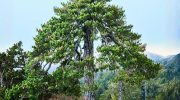
The trees thrive in Cyprus’s extreme conditions with their ability to withstand high temperature ranges and limited rainfall. Deep roots anchor them on exceptionally steep slopes where the underlying rock appears friable and shaly. The extensive root networks stabilize soil and prevent erosion across mountainous terrain.
Calabrian pine grows as a light-demanding species, naturally developing discontinuous canopy rather than dense coverage. Existing forests show preponderance toward mature and overmature trees. Where these lack amenity value, foresters fell and reseed them. Terraces created with heavy machinery assist regeneration after forest fires.
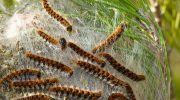
The most damaging pest affecting these pines is the Pine Processionary Moth (Thaumetopoea wilkinsoni Tams). The larvae consume needle shoots, weakening trees and reducing growth. Foresters use pheromone traps attempting to control populations before significant damage occurs.
Cyprus Cedar Fights for Survival
The Cyprus cedar (Cedrus brevifolia) exists only in a small section of Paphos Forest, primarily in Cedar Valley. This endemic species grows at elevations between 800 and 1,400 meters in subhumid to humid bioclimate zones. The natural distribution covers approximately 290 hectares total, with only 106 hectares in pure stands.
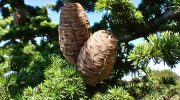
The species splits across six separate geographical areas within the Koilada Kedron-Kampos Natura 2000 network site. This fragmentation increases vulnerability to catastrophic events. The cedars face multiple threats including periodic drought dieback, insect blights, and competition from Calabrian pine.
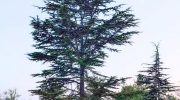
Climate change poses severe challenges for Cyprus cedar. The species cannot migrate to higher altitudes as adaptation strategy because it already grows at the tree line’s top. Unlike some pines, cedars cannot regenerate after fire, making single large fires potentially devastating to populations.
The LIFE-KEDROS conservation project conducted silvicultural treatments reducing competition between young and mature cedars and other forest species. Teams restored 12 hectares of degraded habitat and planted 8 hectares of new cedar habitat. A seed bank stores approximately 239,250 seeds for future reforestation efforts.
Golden Oak Adds Endemic Character
The golden oak (Quercus alnifolia) serves as Cyprus’s national tree. This evergreen oak grows exclusively on the igneous geological substrate of the Troodos Massif between 400 and 1,800 meters elevation. It appears either in dense maquis by itself or associated with Turkish pine.
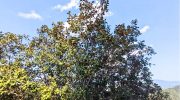
Cypriot law protects the golden oak, while European Union law protects its entire habitat as part of the Quercus alnifolia biota. The species dominates understory vegetation in many pine forests at higher elevations. Endemic shrubs including Rosa chionistrae and Berberis cretica grow alongside golden oak.
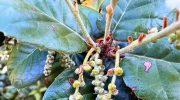
The golden oak’s leaves feature distinctive small thorns resembling spines. This adaptation helps reduce water loss in the Mediterranean climate. The species produces acorns supporting wildlife populations including the endangered Cyprus mouflon.
Juniper and Cypress Complete Forest Diversity
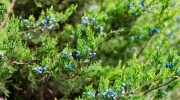
Foetid juniper (Juniperus foetidissima) grows at the Troodos Mountains’ topmost elevations. Known for the strong odor of crushed leaves, these trees appear as isolated individuals or pine forest understory from around 1,200 meters. Between 1,500 meters and Chionistra peak at 1,952 meters, juniper forms small stands on rocky slopes.
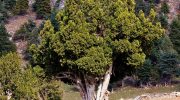
Mediterranean cypress (Cupressus sempervirens) occurs mainly in the Kyrenia Mountains with remarkable stretches along the Pentadaktylos range. These forests develop on mountainous areas in the Thermo and Meso-Mediterranean zones, primarily on limestones and marls. Pure cypress forests occupy steep slopes and mountain peaks.
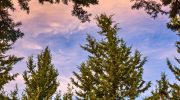
Phoenician juniper (Juniperus phoenicea) creates high formations (4-6 meters) primarily in Karpasia peninsula, notably at Cape Apostolos Andreas. These rare formations once covered larger areas including Kavo Greco. Fragments survive in Akamas and Kormakitis peninsulas.
Protected Areas Safeguard Biodiversity
Cyprus operates 10 National Forest Parks covering 15,627 hectares. The largest is Troodos National Forest Park at 9,062 hectares, protecting woodland surrounding Mount Olympos. Paphos Forest protected area covers vital Cyprus mouflon habitat and functions as a Special Protection Area for birds.
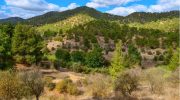
Seven nature reserves provide additional protection including Chionistra, Madari (11.37 square kilometers), and Tripylos Mavroi Kremmoi (33.31 square kilometers). The Troodos UNESCO Global Geopark encompasses 1,149.8 square kilometers including several smaller protected areas.
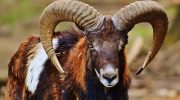
These protected zones concentrate conservation efforts on endemic species and priority habitats. Management plans address specific needs of each area. Monitoring systems track habitat and species health. The Paphos Forest hosts approximately 3,000 Cyprus mouflon, the island’s largest wild land mammal.