Enkomi’s bronze figurines show how Late Bronze Age Cyprus fused religion with copper production, turning its key resource into divine protection and political legitimacy. The Horned God and the Ingot God were not decorative art but intentional symbols, linking sanctuaries, workshops, and administrative control inside one civic system. This article explains Enkomi’s trade position as Alashiya, what each figure was designed to communicate, and why their burial and survival still shape how we understand “sacred industry” on Cyprus.
- A City Between Mine and Sea
- Gods Made to Match the City
- Horned God: Authority by Presence
- Ingot God: Wealth Under His Feet
- Crafting Divinity Through Metallurgy
- Belief at the Crossroads of Cultures
- Why the Gods Were Placed Underground
- From Excavation to Interpretation
- Why the Enkomi Figurines’ Divinity Endures
A City Between Mine and Sea
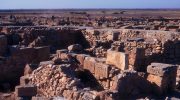
Enkomi rose on a rocky plateau near a sheltered inlet that once opened to the sea. This position allowed it to function as both a port and a processing centre, linking the copper-rich Troodos Mountains to international trade routes that reached Egypt, the Levant, and the Aegean. Ancient texts refer to the kingdom of Alashiya as a copper supplier powerful enough to address pharaohs as equals. That status came directly from Enkomi’s control of metal production.
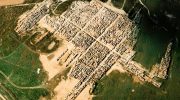
The city expanded dramatically during the Late Bronze Age, especially in the 14th and 13th centuries BCE. Its layout reveals planning rather than improvisation. Straight streets, large ashlar buildings, and massive fortifications point to centralised authority and long-term investment. This was not a marginal settlement. It was an industrial capital whose wealth depended on metal and whose religion reflected that dependence.
Gods Made to Match the City
The bronze figurines found at Enkomi belong to the 12th century BCE, a moment of crisis and transformation across the eastern Mediterranean. Cities collapsed, trade networks fractured, and populations shifted. Enkomi itself suffered damage yet continued to function, and it was during this period of uncertainty that its most distinctive religious images were created or reworked.
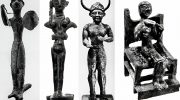
What makes these figures remarkable is not only their technical refinement but the clarity of their message. They do not depict distant or abstract deities removed from daily life. Instead, they present divine figures shaped specifically for a community whose survival rested on copper extraction, skilled labour, and long-distance exchange.
Horned God: Authority by Presence
The Horned God is among the most striking bronze statues of the ancient Mediterranean. Standing roughly half a meter tall, the figure depicts a youthful, athletic male wearing a short kilt and a helmet crowned with curved bull’s horns. His stance is balanced and composed, suggesting alertness rather than aggression.
This restraint is significant. In much Near Eastern art, gods appear in overtly dynamic or violent poses meant to demonstrate dominance. At Enkomi, the Horned God communicates authority through presence rather than action. His body reflects Aegean artistic influence, while the horns draw on older Cypriot and Near Eastern symbols associated with strength, fertility, and protection.

The statue was discovered inside a monumental ashlar building, accompanied by animal remains linked to ritual activity. Its placement indicates deliberate integration into a space where governance, worship, and collective memory intersect. Many scholars see the figure as a local deity later associated with Apollo, illustrating how new religious ideas were absorbed and reshaped rather than imposed.
Ingot God: Wealth Under His Feet
If the Horned God embodies divine presence, the Ingot God communicates purpose. This smaller bronze figure represents a bearded warrior equipped with a helmet and weapons, yet its defining feature lies beneath his feet. The god stands upon a miniature copper ingot shaped like the oxhide ingots used in Bronze Age trade.
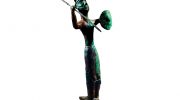
This visual choice leaves little room for interpretation. The deity is literally grounded in copper, the material that sustained Enkomi’s economy and influence. His sanctuary was located close to metallurgical workshops, reinforcing the idea that religious protection and industrial production were inseparable aspects of civic life.
Scientific analysis reveals that the figure did not originally stand in this upright position. It began as a conventional Near Eastern smiting god before being deliberately altered to rest on the ingot. This modification reflects a conscious shift in meaning. The god was transformed from a general symbol of martial power into a protector specifically tied to Cyprus’s copper wealth and the stability it provided.
Crafting Divinity Through Metallurgy
Such images were possible only because Enkomi possessed exceptional metallurgical expertise. Excavations across the site uncovered furnaces, crucibles, tuyères, slag deposits, and casting debris, indicating large-scale and continuous metal production. Bronze objects were not imported fully formed. They were created, refined, and reimagined locally.
The figurines were cast using the lost-wax technique, a complex process requiring both precision and experience. Chemical studies of Enkomi’s metalwork reveal careful alloying, strategic recycling of older copper, and a nuanced understanding of how composition affected strength and finish. In a city where copper defined diplomacy, wealth, and survival, technical skill carried cultural and symbolic authority.
Belief at the Crossroads of Cultures
Enkomi occupied a geographical and cultural crossroads, and its religious imagery reflects that position. The Horned God’s physique echoes Aegean ideals, while the Ingot God’s armour and weaponry draw on Levantine traditions. Other finds include seated deities, smiting figures, and imported ceramics decorated with symbolic scenes.
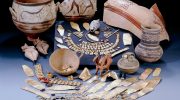
Rather than competing, these influences formed a coherent religious system. Deities were adapted, renamed, and reshaped to address local concerns. This flexibility allowed Enkomi’s inhabitants to incorporate new ideas while maintaining continuity with established beliefs. Religion functioned pragmatically, offering protection, fertility, and stability during periods of widespread disruption.
Why the Gods Were Placed Underground
Both major figurines were discovered in pits rather than in open display. Earlier interpretations viewed this as hurried concealment during moments of danger. More recent perspectives suggest ritual deposition, a deliberate act intended to renew protection or spiritually anchor important structures.
The Horned God’s horns remained visible above floor level, indicating that the figure was not hidden but symbolically embedded within the space. This practice aligns with broader Bronze Age traditions in which powerful objects were placed beneath buildings to safeguard communities during times of transition.
From Excavation to Interpretation
The modern understanding of Enkomi emerged gradually. Early excavations in the late nineteenth century focused primarily on tombs and portable wealth. It was only through systematic work in the mid-twentieth century that the city’s full urban layout and religious complexity became clear.
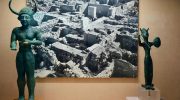
Today, the key bronze figurines are preserved in the Cyprus Museum, where they continue to shape interpretations of Late Bronze Age society. Seen together, they reveal a unified message. These were not decorative objects created in isolation. They were intentional expressions of identity, belief, and economic reality.
Why the Enkomi Figurines’ Divinity Endures
The Horned God and the Ingot God endure because they were cast in the very material that defined their world. Copper made Enkomi prosperous, vulnerable, and connected to distant powers. By transforming that metal into divine form, the city articulated a worldview in which labour, wealth, and protection were inseparable.
Rather than abandoning tradition during uncertain times, Enkomi reshaped it. Gods were adapted to reflect new realities, and belief remained grounded in the resources that sustained life. In this way, the Enkomi bronze figurines are not simply remnants of the past. They are deliberate answers to a fundamental question faced by Bronze Age societies: what deserves protection when everything else is at risk?