Across Cyprus, the village square is the island’s most durable social design: a shared open space where movement, news, rest, and routine naturally meet. Shaped by walkable village layouts, scarce flat ground in mountain settlements, and practical features like fountains and cafés, the square became a daily system rather than a decorative centre.
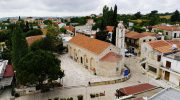
This article explains how Cypriot squares formed, what details make them work, and how they still balance continuity with modern pressure.
The Village’s Shared Living Room
At first glance, a Cypriot village square may appear simple: a paved open area, a few cafés, perhaps a church or mosque nearby. But simplicity here is deliberate. The square was never designed as a monument. It grew organically as a response to daily needs.
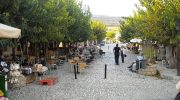
Before modern roads and private vehicles, villages were scaled for walking. Narrow streets funnelled movement toward a central opening where people naturally gathered. The square became the place where paths met, news was exchanged, and decisions were made without formality. It was not planned as a focal point. It became one through use.
How Paths Create a Centre
Cyprus’s landscape plays a quiet but decisive role in how its squares function. Mountain villages in the Troodos range sit on slopes and ridges, where flat land is scarce. In these settlements, the square often occupies the only level ground available, giving it immediate importance.
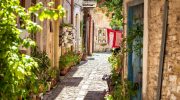
In coastal plains and lowland towns, space was less restricted, but the square still emerged as a social anchor.
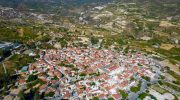
Whether in elevated wine villages or flatter administrative centres, the square consistently absorbed communal life, adapting to local conditions rather than following a rigid design model.
Built Slowly, Layer by Layer
Village squares in Cyprus are not the product of a single historical moment. They are layered spaces.

Early settlements gathered around shared open areas without a formal layout. Over time, religious buildings, fountains, and cafés were added as needs changed. Frankish, Venetian, Ottoman, and later British periods all left traces, not as complete redesigns, but as additions that reshaped how the square was used.
This layering explains why many squares feel cohesive without being symmetrical. They were shaped by repetition, not by blueprint.
Stone, Shade, and Human Scale
The visual character of Cypriot village squares is rooted in restraint rather than display. Local limestone dominates most settings, its pale surface reflecting sunlight and softening the intensity of the Mediterranean heat. In older villages, darker stone and rubble construction appear in foundations and boundary walls, grounding the square firmly in its surroundings.
Equally important is scale. Buildings enclosing the square rarely dominate it. Doorways, arcades, and shaded thresholds remain proportioned to the human body, encouraging movement at walking pace and conversation at arm’s length. The square feels neither imposed nor monumental. It feels inhabited.
The Fountain as a Social Engine
Long before running water reached individual homes, the communal fountain shaped daily movement through the square. Positioned centrally or just beside it, the fountain supplied water for households, animals, and seasonal work. Yet its social role extended far beyond practicality.
Water collection followed predictable rhythms, often bringing women together in the early hours of the day. These encounters allowed news to circulate quietly, relationships to be maintained, and the life of the village to remain visible. Even after fountains lost their functional necessity, they retained their place as symbolic anchors of shared routine and collective memory.
Kafeneio Time and Slow Talk
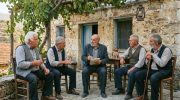
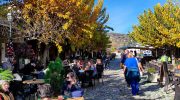
As the fountain’s role diminished, the kafeneio emerged as the square’s most consistent presence. Almost every village square contains at least one traditional coffeehouse, often positioned beneath vines, awnings, or mature trees that soften light and invite stillness.
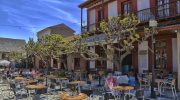
Time behaves differently here. Coffee is brewed slowly, served without embellishment, and consumed without urgency. Conversation drifts between subjects. Silence settles comfortably. Games of backgammon stretch across hours. Chairs spill outward into the square, blurring the line between private and public space. The square is not observed from a distance. It is lived from within.
Light, Heat, and Daily Cycles
The character of a village square changes as the day unfolds.
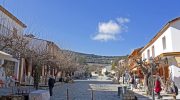
Morning brings measured activity: deliveries arriving, cafés opening, brief exchanges marking the start of work. By midday, heat reshapes movement, drawing people toward shade and quiet. The square empties without disappearing, holding space rather than demanding attention.
Evening reverses this withdrawal. Families return, chairs reappear, voices rise, and the square resumes its role as a shared living room. This rhythm is neither enforced nor scheduled. It endures because it has always been understood.
Tradition Meets Modern Pressure
Today, village squares stand between continuity and adaptation. Tourism and restoration efforts have revived many rural centres, repairing stonework, reopening cafés, and drawing renewed attention to village life. In some places, this attention has sustained spaces that might otherwise have faded.
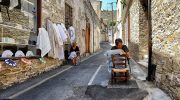
Yet tension remains. When squares are treated as backdrops rather than lived environments, their meaning thins. The challenge lies in allowing visitors to witness village life without replacing it. Where that balance is respected, the square remains dynamic rather than staged.
Importance of the Cypriot village square
The Cypriot village square persists because it was never designed for a single purpose. It accommodates ritual and routine, conversation and quiet, celebration and pause. It absorbs change without surrendering its role as a shared centre.
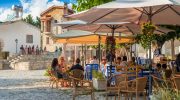
In a world increasingly shaped by private space and speed, these squares offer something increasingly rare: a public setting where belonging is visible and time is collectively held. To sit in a Cypriot village square is not to observe history from a distance. It is to participate in it, quietly, one coffee at a time.