Enkomi was a Late Bronze Age city where copper production shaped not only wealth but belief, linking metallurgy to divine protection and political authority. Two bronze figures, the Horned God and the Ingot God, show how Cyprus turned its key resource into sacred symbolism, placing industry, ritual, and administration inside a single system. This article explains Enkomi’s trade position, what the statues were designed to communicate, and how the city’s decline preserved a rare record of “sacred industry” on the island.
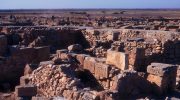
Enkomi, Built Between Mine and Sea
Located near the eastern coast of Cyprus, close to modern Famagusta, Enkomi occupied a position that shaped its destiny. It stood between the copper-rich Troodos foothills and the maritime routes linking Cyprus to Egypt, the Levant, and the Aegean. During the Late Bronze Age, the Pedhieos River functioned as a navigable channel, allowing ships to reach the city inland and making Enkomi a natural hub for trade.
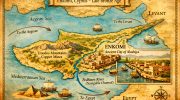
By the 14th and 13th centuries BCE, Enkomi had grown into a powerful urban centre, widely identified with the kingdom of Alashiya, a name that appears in diplomatic correspondence with the pharaohs of Egypt. Copper flowed outwards from Cyprus, while wealth, influence, and ideas flowed in.
This was not a simple trading post. It was an organised city capable of managing large-scale production, storage, and export, supported by a ruling elite that understood the importance of legitimacy as much as logistics.
Alashiya and the Copper Diplomacy
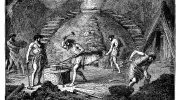
Copper was the backbone of Enkomi’s prosperity, but it was also unpredictable. Smelting required skill, resources, and cooperation, and failure could threaten the stability of the entire city. The solution was ideological as much as technical.
At Enkomi, metallurgy was placed under divine authority.
This belief is most clearly expressed through two bronze statues, each linking copper production directly to the sacred realm.
The Horned God: Power Without Violence
The Horned God is one of the most iconic prehistoric sculptures from Cyprus. Cast in solid bronze and standing over half a meter tall, the figure depicts a youthful male deity wearing a horned helmet, a universal ancient symbol of divinity.
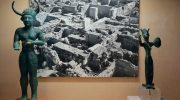
His posture is calm rather than aggressive. He is not shown striking or conquering, but standing with controlled confidence. The figure was discovered buried beneath the floor of a monumental ashlar building, surrounded by ritual debris including animal skulls and antlers.
Rather than a hurried act of concealment, many scholars believe the statue was deliberately placed in the ground as a form of ritual protection, possibly after an earthquake damaged the building. In this interpretation, burying the god preserved his presence rather than removing it.
The Horned God embodies authority, stability, and continuity. He represents a form of power that watches over the city rather than dominating it.
The Ingot God: Copper Made Divine
If the Horned God suggests sacred authority, the Ingot God makes the message unmistakable. This smaller bronze figure depicts a fully armed warrior standing directly on a base shaped like an oxhide copper ingot, the standard form used for transporting copper across the Mediterranean. The symbolism is deliberate and unambiguous. The god does not merely protect copper. He stands upon it.
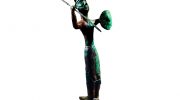
Scientific analysis indicates that the figure was altered in antiquity. Originally resembling a Near Eastern smiting deity, its posture and base were modified to incorporate the ingot form. Through this transformation, the figure’s meaning shifted. The god became inseparable from copper itself, no longer a distant protector but an embodiment of the resource that sustained the city.
The sanctuary in which the Ingot God was found reinforces this interpretation. Archaeological evidence points to repeated sacrifice, including slaughtering installations and large quantities of cattle remains. Bulls, long associated with strength, fertility, and power, reinforced the link between animal vitality, metal production, and divine favour. Copper was not treated as a neutral material. It was animated by ritual.
A Sacred Partnership of Forces
Enkomi’s religious landscape extended beyond male deities alone. A smaller bronze figurine, often referred to as the Bomford Goddess, also stands upon an oxhide ingot and represents a complementary female presence within the same symbolic system.
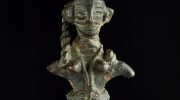
Although discovered outside formal excavations, her stylistic features and iconography strongly suggest a Cypriot origin. Scholars associate her with fertility, abundance, and productive continuity. Within the context of Enkomi’s belief system, she appears to complete a sacred cycle in which extraction, transformation, and prosperity were jointly overseen.
Copper was not simply mined and melted. It was ritually sustained through balance, symbolism, and repeated acts of devotion.
Where Work and Worship Met
One of Enkomi’s most revealing characteristics is the proximity of metallurgical workshops to sanctuaries. Industrial activity and ritual space were not separated. They existed side by side, reinforcing one another through daily practice.
This arrangement served a clear social function. By embedding copper production within sacred settings, the city’s elite framed economic control as divinely sanctioned. Authority did not rely solely on force or administration. It was reinforced through belief.
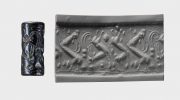
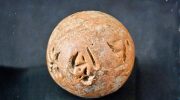
Cylinder seals discovered at the site, often decorated with ingots, animals, and ritual imagery, point to an administrative system where economic management and religious symbolism were deeply intertwined. Power flowed through both systems simultaneously.
Decline, Abandonment, and Memory
Enkomi’s dominance gradually faded. Environmental changes, including the silting of its river harbour, reduced access to maritime trade. Earthquakes repeatedly damaged the city’s structures, disrupting both industry and daily life. By the 11th century BCE, population movement toward the coast accelerated, contributing to the rise of Salamis.

The city was not destroyed in a single moment. It was slowly emptied. Workshops fell silent. Sanctuaries closed. The bronze gods remained buried, preserving their meaning long after the city itself ceased to function.
Encountering Enkomi Today
Although the archaeological remains of Enkomi lie in northern Cyprus and receive limited visitation, its most important artefacts are accessible elsewhere. The Horned God and the Ingot God are displayed in the Cyprus Museum in Nicosia, where they continue to communicate the unusual fusion of religion, industry, and authority that defined Late Bronze Age Cyprus.
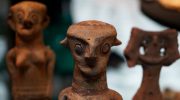
Seen in person, their symbolism becomes immediate. These are not abstract deities. They are carefully constructed expressions of how a society understood risk, wealth, and survival.
What Enkomi Explains About Power
Enkomi challenges modern assumptions about ancient economies. It reveals a world in which belief and production were not separate domains, but parts of a single system designed to manage uncertainty and complexity.
By sanctifying metallurgy, the people of Enkomi stabilised their society, justified authority, and transformed copper into something far more powerful than a trade commodity. The bronze gods are not relics of superstition. They are evidence of strategic thinking expressed through belief.
And in that sense, Enkomi feels unexpectedly modern.