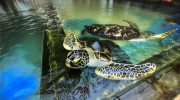
The green sea turtle represents one of the Mediterranean’s rarest nesting species. In this entire sea, only 300 to 400 female green turtles nest each year, with the vast majority choosing beaches in Cyprus and Turkey. This makes Cyprus critically important for the species’ survival in the region. The green turtle earned its name from the green fat stored beneath its shell, a result of its diet that consists almost entirely of seagrass and algae once the turtle reaches adulthood.
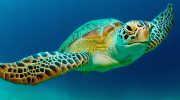
Green turtles belong to the family Cheloniidae and hold the distinction of being the largest hard-shelled sea turtle species. Adults can reach one meter in length and weigh between 130 and 160 kilograms. Their distinctive heart-shaped shell ranges from olive to black in color, while the underside stays pale yellow. Unlike their carnivorous loggerhead cousins, adult green turtles maintain an almost exclusively herbivorous diet, grazing on seagrass meadows and coastal algae.
From Crisis to Conservation Action
Historical records and testimony from older fishermen confirm that green turtles were once far more abundant around Cyprus than they are today. Exploitation of Mediterranean sea turtles from ancient times through the mid-20th century devastated populations. An estimated 100,000 turtles were shipped from the Eastern Mediterranean to Europe to meet demand for turtle soup and other products. This commercial harvest, combined with coastal development and habitat loss, pushed populations to critically low levels.
The first systematic surveys of turtle nesting beaches in Cyprus took place in 1976 and 1977. These surveys revealed that green turtles had retreated almost exclusively to the desolate, surf-swept beaches of the west coast north of Paphos, mainly in the Lara area. Beaches that once hosted nesting turtles at Ayia Napa and several Paphos locations had been abandoned due to intensive tourism development and sand extraction.
How Conservation Programs Work
The Lara Bay Turtle Conservation Station, operated by the Department of Fisheries and Marine Research, serves as the operational hub for green turtle conservation in the Republic of Cyprus. Staff and volunteers monitor beaches throughout the nesting season, which runs from late May through August for green turtles. Female turtles come ashore almost exclusively at night to excavate nests and deposit eggs.
Each female typically nests four to five times per season at roughly two-week intervals, then returns to nest again approximately every three years. The estimated breeding population in the Lara area numbers around 100 green turtles. Each clutch contains approximately 100 eggs, which incubate in the sand for seven to eight weeks before hatching.
In northern Cyprus, the Society for the Protection of Turtles has operated conservation programs since 1991 in collaboration with the University of Exeter’s Marine Turtle Research Group. This Marine Turtle Conservation Project monitors beaches including Alagadi near Esentepe and Golden Beach in the Karpaz Peninsula. Numbers of nesting green and loggerhead turtles on monitored beaches have increased consistently over the past decade, indicating successful conservation efforts.
Notable Conservation Achievements
The Cyprus Turtle Conservation Project has produced several important findings. Research confirmed that the nesting season extends from mid-June to mid-August, with peak activity in July. Temperature studies revealed the critical role of sand temperature in determining hatchling sex ratios. Warmer sand produces more females, while cooler conditions yield males. This understanding has proven essential given climate change concerns about skewed sex ratios.

Early conservation efforts experimented with incubating eggs in polystyrene boxes at the hatchery. However, research showed this method produced predominantly male hatchlings due to temperature effects. The program shifted away from artificial incubation toward protecting nests in their natural beach locations whenever possible.
The project also investigated head-starting programs, where hatchlings are raised in captivity to larger sizes before release. Around 100 turtles ranging from one to six years old were kept in sea cages in Paphos Harbor and special tanks in Nicosia to study their nutrition and hygiene requirements. The concept remains somewhat controversial, though releasing larger juveniles likely reduces mortality during vulnerable early life stages.
Since 1978, the Lara station has released thousands of hatchlings each year. The 1978 season saw more than 1,500 releases, with annual numbers increasing to approximately 3,500 in subsequent years. All released turtles receive tags for identification if they return to Cyprus beaches as adults decades later.
The Department of Fisheries and Marine Research has conducted training courses in hatchery techniques and beach management for Mediterranean scientists at the Lara Station annually since 1989. This knowledge transfer has helped improve conservation practices across the region.
Current Threats and Challenges
Despite conservation successes, green turtles face ongoing threats. Coastal development continues to degrade and destroy nesting habitat. Recent years have seen expansion of hotels, restaurants, and housing developments near important nesting beaches, particularly in the Iskele region of northern Cyprus. A lit walkway and major development projects were completed behind kilometers of nesting beach without environmental impact assessment for turtles.
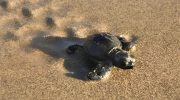
Artificial lighting creates serious problems for hatchlings, which instinctively crawl toward the brightest point on the horizon. Under natural conditions, this means moving toward moonlight or starlight reflected on the sea. Artificial lights from buildings and streets disorient hatchlings, causing them to head inland where they die from dehydration, predation, or exhaustion.
Visiting Conservation Sites
Lara Bay offers the most accessible opportunity to learn about green turtle conservation in the Republic of Cyprus. The site lies about seven kilometers from the Akamas Peninsula entrance at Ayios Georghios Peyias. The access road is unpaved but generally navigable in standard vehicles at reduced speeds. Parking is available near the beach, with a short walk to reach the conservation station and shore.
Swimming is permitted, though visitors cannot bring umbrellas or beach structures that might damage underground nests. Sun protection cream is essential. No restaurants or facilities exist in the area, so visitors must bring water and food. The conservation station operates throughout the nesting and hatching season with staff available to explain ongoing work.
In northern Cyprus, Alagadi Beach near Esentepe offers guided turtle-watching experiences. Advanced booking through the Society for the Protection of Turtles is essential, as participant numbers are strictly limited to minimize disturbance. Small groups can observe nesting females or watch hatchlings released under supervision.
Best visiting times run from June through September. Nesting peaks in June and July, while hatching occurs mainly in August and early September. All observation happens at night when turtles are naturally active. Visitors must remain quiet and avoid using lights or flash photography, which disturb the turtles and disorient hatchlings.
Why Green Turtle Conservation Matters
Green turtle conservation programs in Cyprus represent a critical component of Mediterranean biodiversity protection. With only a few hundred females nesting annually across the entire sea, every protected beach and every successful nest contributes meaningfully to species survival. The programs demonstrate that dedicated conservation efforts can reverse population declines and rebuild threatened species. Cyprus’s commitment to protecting these ancient mariners sets an example for coastal nations balancing development with environmental stewardship. The work connects modern Cypriots to natural cycles that have continued for millions of years, maintaining living links to the island’s ecological heritage. Through continued protection, research, and public engagement, Cyprus helps ensure that future generations will still witness green turtles returning to moonlit beaches to continue their timeless nesting ritual.