Explore Cyprus with Our Interactive Map

Explore our top stories and discover ideas worth your time.

Nissi Beach

Nissi Beach

The Nissi beach stretches 500 meters along a crescent-shaped bay on the eastern coast of Cyprus, approximately three kilometers from Ayia Napa town center in the Famagusta district. The bay's distinctive feature is the small island, or "nissi" in Greek, positioned about 50 meters offshore. The water depth remains shallow throughout the bay, typically staying below waist level even 100 meters from shore, making the entire area accessible for wading and safe for families with children. The beach actually consists of two connected sections. The main stretch near the islet attracts larger crowds and hosts most water sports activities and beach bars. A second, smaller, quieter section extends to the west, providing more relaxed conditions for visitors seeking less activity. Both areas share the same water quality and sand characteristics that earned Nissi Beach its Blue Flag designation, an international eco-label awarded for excellent water cleanliness, environmental management, safety standards, and proper facilities. Historical Background Archaeological excavations conducted along the western borders of the bay in 2005 revealed firelighting equipment dating back 12,000 years. This discovery suggests the area may have been among the first locations settled by humans arriving on Cyprus. The artifacts included chipped stone tools and evidence of fire use. That shows early inhabitants recognized the bay's advantages, including protected waters, access to marine resources, and suitable…

Read more
Cyprus Mouflon Wildlife and Habitat

Cyprus Mouflon Wildlife and Habitat

The Cyprus mouflon represents the only wild sheep endemic to Cyprus and the largest wild land mammal on the island. This subspecies stands about one meter tall at the shoulder and exhibits the classic features of mouflon: reddish to dark brown coats with distinctive black dorsal stripes and lighter saddle patches. The name "mouflon" comes from the Corsican words "mufro" for males and "mufra" for females. In Cyprus, locals call this animal "agrino," derived from the Greek word "Αγρινό." Adult males weigh up to 50 kilograms, while females typically reach around 35 kilograms. Males develop spectacular curved horns that grow in nearly complete circles, reaching lengths up to 85 centimeters. Most females do not develop horns, though some carry small versions. The Cyprus mouflon demonstrates island dwarfism, with shoulder heights averaging 15 centimeters less than their closest relatives, the Armenian mouflon. Ancient Arrivals and Near Extinction Archaeological evidence places sheep bones at the Neolithic village of Khirokitia, dating the mouflon's presence on Cyprus to approximately 10,000 years ago. Scientists believe early settlers brought wild sheep from Anatolia or the Levant during the early stages of sheep domestication. These animals later became feral, adapting to the island's mountain environments. Genetic studies show strong phylogenetic relationships between Cyprus and Anatolian mouflons, with origins likely traced to northwest Iran. The mouflon thrived for…

Read more
Famagusta Martinengo Bastion

Famagusta Martinengo Bastion

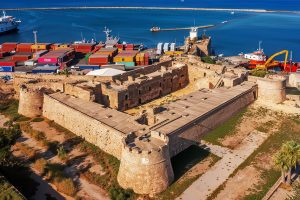
In the northwest corner of Famagusta's historic walled city stands one of the Mediterranean's most impressive examples of Renaissance military architecture. The Martinengo Bastion, also known as Tophane, represents a turning point in defensive technology and remains a testament to 16th-century engineering brilliance. When the Republic of Venice took control of Cyprus in 1489, military engineers quickly recognized a serious problem. The existing fortifications throughout the island were outdated and vulnerable to modern artillery. Medieval walls, built tall and thin to defend against siege towers and scaling ladders, could not withstand the devastating impact of cannon fire. Famagusta presented a particular challenge. As Cyprus's main port and commercial hub, the city required strong defenses. Yet its northwest corner remained especially weak, creating a dangerous gap in the defensive perimeter. The Venetians understood that this vulnerability could prove fatal if the Ottoman Empire decided to expand its territory into Cyprus. Giovanni Girolamo Sanmicheli Takes Command In 1550, the Venetians brought in Giovanni Girolamo Sanmicheli, nephew of the renowned fortification architect Michele Sanmicheli of Verona, to redesign Famagusta's defenses. The younger Sanmicheli arrived with experience in the latest military engineering techniques and an understanding of how warfare had evolved. Construction took approximately nine years. Sanmicheli died in Famagusta in 1559 before seeing his masterwork completed, but his vision resulted in a bastion…

Read more