Explore Cyprus with Our Interactive Map

Explore our top stories and discover ideas worth your time.

Saranda Kolones Fortress

Saranda Kolones Fortress

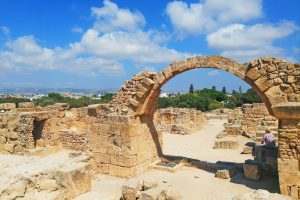
Inside the Paphos Archaeological Park, just north of the old harbor, a pile of broken stones and toppled columns marks where one of Cyprus's most important medieval fortresses once stood. Saranta Kolones, which translates to Forty Columns, served as the main defensive stronghold protecting Paphos during a turbulent period when Arab raids threatened the island. Today, visitors walk among its ruins and discover a fortress that endured multiple rebuilds, witnessed crucial historical events, and met a violent end in one of the worst earthquakes ever to strike Cyprus. tripadvisor-com Historical Background The fortress was built at the end of the 7th century AD under Byzantine rule. Historical records indicate that Theodore, the brother of Emperor Heraclius I, supervised its construction. At that time, the Arab Caliphate had emerged as a powerful force in the Middle East, and Cyprus found itself in the path of expansion. Arab forces launched raids on the island, making coastal cities particularly vulnerable. Paphos, with its strategic harbor and position on shipping routes, needed strong defenses. hotel-com The Byzantine builders created a formidable structure. The fortress featured walls three meters thick, substantial enough to resist siege weapons of that era. Four massive corner towers anchored the defenses, with four additional intermediate towers positioned along the connecting walls. A moat surrounded the entire complex, and access was…

Read more

Bosea Cypria

Bosea Cypria

High on a sun-bleached limestone cliff in the Akamas or along a rocky gulley near Paphos, you might spot a graceful evergreen shrub with deep-green leaves cascading like a living curtain. In late summer its branches glow with clusters of bright red berries that shine like tiny rubies against the rock. This is Bosea cypria, a quiet but extraordinary survivor that has clung to the island’s rugged edges for millions of years. www.inaturalist.org An Ancient Shrub from the Amaranth Family Bosea cypria belongs to the Amaranthaceae family – the same group that gives us spinach, beetroot and colourful garden amaranths. Unlike most of its relatives, which are soft-stemmed herbs, this species is a woody evergreen shrub, one of only three living members of the genus Bosea worldwide. In Cyprus it grows 1–2 metres tall, highly branched, often pendulous, seeming to drape dramatically from cliffs, old stone walls or even tree trunks. A Living Fossil from the Ancient Tethys Sea This plant is a true botanical relic. Its ancestors once grew along the shores of the vast Tethys Sea during the Tertiary period, long before the Mediterranean took its present form. As continents drifted and the sea shrank, most Bosea species disappeared; today only three remain — one in Cyprus, one in the Canary Islands and one in the north-west Himalayas.…

Read more
A Fiery Crown in the Cypriot Summer

A Fiery Crown in the Cypriot Summer

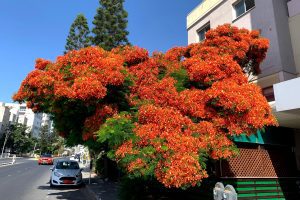
Picture a quiet street in Ayia Napa or Limassol in early June, when the heat has already settled in. Suddenly the whole canopy ignites in a blaze of scarlet and orange, as if someone has draped living flames across the branches. This is the royal poinciana of Cyprus – a tree so spectacular that locals and visitors alike stop to stare every summer. The Royal Flame in the Legume Family Delonix regia belongs to the vast Fabaceae (legume) family, specifically the Caesalpinioideae subfamily – the same group that includes carob, senna and many beautiful tropical trees. The genus Delonix is small, with just a handful of species, nearly all native to Madagascar and nearby islands. Locally it is known as Φλαμπουγιάν (Flambouyian) or Βασιλική Ποιντσιάνα (Vasiliki Pointsiána), names that echo its French nickname “flamboyant” (showy or flaming) and its older scientific synonym Poinciana regia. The genus name itself comes from ancient Greek: delos (visible or conspicuous) + onyx (claw), perfectly describing the long, claw-like petals that make each flower look like a tiny exotic bird. From Madagascar to Cypriot Shores Native to the dry deciduous forests of Madagascar, the royal poinciana was unknown to science in the wild until the 1930s, though it had already been carried around the tropics by traders and gardeners for centuries. It reached the Mediterranean…

Read more