Explore Cyprus with Our Interactive Map

Explore our top stories and discover ideas worth your time.

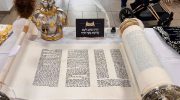
Larnaca Synagogue Cyprus

Larnaca Synagogue Cyprus

The Larnaca Synagogue represents the revival of Jewish religious life in Cyprus after centuries of minimal presence. Also known as the Great Synagogue of Cyprus or Cyprus Central Synagogue, the building was completed in 2005 and inaugurated on September 12, 2003. commons.wikimedia-org Located at Apollodorou 4 in Larnaca, this Orthodox Jewish congregation serves as the spiritual center for approximately 3,500 Jews currently living in Cyprus. The synagogue's establishment marked a historic moment, as Cyprus had been the only European Union nation without an active synagogue. The site serves multiple purposes beyond worship, housing a Jewish community center with educational facilities, kosher restaurants, and plans for a museum documenting Jewish history on the island. Historical Background The Jewish connection to Cyprus dates to the 3rd century BC during the Roman conquest of the island. Archaeological evidence indicates at least three ancient synagogues existed in Lapethos, Golgoi, and Constantia-Salamis. An inscribed column from the 4th century, now in the Cyprus Museum in Nicosia, records the renovation of a synagogue in the 3rd century, proving Jews had returned to the island after earlier expulsions. google-com In 117 AD, Jews on Cyprus participated in the Kitos War, a massive revolt against Roman Emperor Trajan that spread across the eastern Mediterranean. Led by a Jewish commander named Artemion, the uprising on Cyprus resulted in the…

Read more

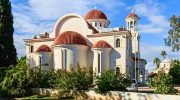
Phaneromeni Necropolis Larnaca

Phaneromeni Necropolis Larnaca

Beneath the streets and churches of modern Larnaca lies a network of ancient tombs that gave the city its name. The Phaneromeni necropolis represents a vast burial ground used for over 1,500 years, from the Late Bronze Age through the Phoenician and Hellenistic periods, preserving layers of history beneath one of Cyprus's oldest continuously inhabited cities. in-cyprus.philenews.com The name Larnaca comes from the ancient Greek word larnax, meaning sarcophagus or stone coffin. This etymology directly reflects the thousands of tombs and burial chests discovered throughout the city. An American consul in the late 19th century claimed to have explored more than 3,000 tombs in the Larnaca area, and archaeological work continues to uncover more burial sites with each new construction project. A Tomb That Became a Church The Catacomb of Phaneromeni Church sits next to the old Panagia Phaneromeni Church, about 7 meters from the east wall of the church building. This rock-cut tomb consists of two chambers connected by a corridor, carved entirely from natural rock. The structure suggests it originally served as a pagan burial site during Phoenician times, possibly as early as 1200 BCE based on the architecture. commons.wikimedia.org The catacomb was discovered in 1870 and was officially dated to the 8th century CE based on its use as a Christian burial site and place of worship.…

Read more
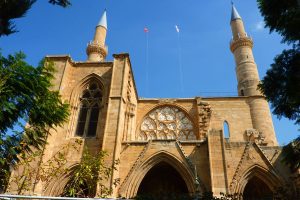
St. Sophia Cathedral Gothic Landmark Cyprus

St. Sophia Cathedral Gothic Landmark Cyprus

In the center of North Nicosia stands the largest Gothic building in Cyprus. Originally a cathedral, it was later turned into a mosque but still keeps its French Gothic style. Over 800 years, the building has seen coronations, earthquakes, sieges, and the rise and fall of kingdoms, making it one of the most important historic sites on the island. wikipedia-com St. Sophia Cathedral, now called Selimiye Mosque, was built in the 13th century. It was converted into a mosque in 1570 after the Ottoman conquest of Cyprus. The building measures 66 by 21 meters inside and can hold about 2,500 worshippers. It was the coronation church for the Lusignan kings of Cyprus and later for the titular kings of Jerusalem and Armenia. Historical Background Construction of St. Sophia Cathedral began in 1209 under the Lusignan dynasty, a French royal family that ruled Cyprus after the Crusades. Its design was strongly inspired by Notre-Dame de Paris and other French cathedrals. French masons came to Cyprus to lead the work, while local craftsmen helped. The building took more than 150 years to finish, with the final parts completed around 1326. For over 200 years, St. Sophia was the coronation church for the Lusignan kings. Kings of Cyprus were crowned here as rulers of Jerusalem, even though Jerusalem was no longer under their…

Read more