Explore Cyprus with Our Interactive Map

Explore our top stories and discover ideas worth your time.

St. Hilarion Castle

St. Hilarion Castle

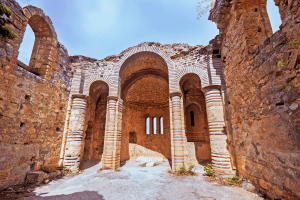
St. Hilarion Castle stands 732 meters above sea level in the Kyrenia mountain range of Cyprus. This medieval fortress features stone walls and towers that appear to grow directly from the rocky peaks. Located just off the main Kyrenia to Nicosia highway, the castle commands the mountain pass between the coast and the central plain. atlasobscura-com The castle is the best preserved of three Byzantine strongholds built along the Kyrenia mountain range, the others being Kantara to the east and Buffavento further west. The fortress consists of three main sections built at different elevations on the mountainside. The lower ward contained stables and living quarters for soldiers. The middle ward housed royal apartments, kitchens, a church, and a large cistern for water storage. The upper ward, surrounded by 1.4-meter-thick Byzantine walls made of rough masonry, served as the royal residence and includes Prince John's Tower perched on a rocky cliff. Historical Background The castle takes its name from an obscure Christian hermit who fled to Cyprus after the Arab conquest of the Holy Land in the 7th century. This saint, known for living in a cave on the mountain, is not the same as the more famous St. Hilarion, who was active in Palestine and died near Paphos in 371 AD. Local tradition holds that the hermit spent his final…

Read more
Living Fossils in Cypriot Gardens

Living Fossils in Cypriot Gardens

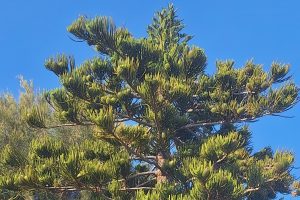
Stand in a quiet park in Limassol or Nicosia on a sunny day, and you might spot tall, pyramid-shaped trees that look like they stepped out of a prehistoric forest. These are the Araucaria trees ancient conifers from far-away lands that bring a touch of exotic elegance to our island's urban green spaces. Konstantin-Solovev Ancient Guardians of the Pine Family Araucaria trees belong to the Araucariaceae family, a group of evergreen conifers that once dominated vast forests across the southern hemisphere. In Cyprus, the most common is Araucaria heterophylla, often joined by its cousin Araucaria columnaris. Locally known as Αρωκάρια (Arokária), a name derived from the genus's scientific title, which honors the Arauco people of Chile where related species grow wild. Survivors from a Lost World These trees trace their lineage back over 200 million years to the time of the dinosaurs, when supercontinents like Gondwana were still united. Native to places like Norfolk Island in the Pacific for A. heterophylla, they arrived in Cyprus during the British colonial era around the early 20th century, planted as striking ornamentals in gardens and along avenues. Like many introduced species, they were chosen for their ability to thrive in our Mediterranean climate, echoing the island's long history of welcoming plants from distant shores. Symmetrical Towers of Green Araucaria heterophylla grows into a…

Read more
Agios Nikolaos tis Stegis

Agios Nikolaos tis Stegis

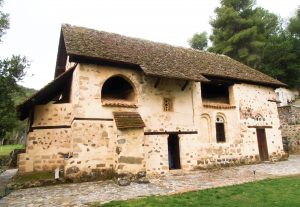
Agios Nikolaos tis Stegis, near Kakopetria in the Solea Valley, is one of Cyprus’s most important painted churches, preserving multiple phases of Byzantine frescoes inside a modest mountain building. Its steep timber roof, added for protection, helped these wall paintings survive centuries of harsh weather and shifting rule. This article explains how the church evolved, what the fresco layers show, and why the site remains a rare visual record of Byzantine life in Cyprus. Agios Nikolaos tis Stegis stands on the western bank of the Karkotis River, near the village of Kakopetria, at an elevation of roughly 700 meters. dreamstime-com This mountain setting explains one of the church’s most defining features. Unlike urban Byzantine churches, which display their domes openly, this church is wrapped beneath a steep, timber roof covered in flat tiles. The roof was added in the medieval period to protect the masonry and paintings from heavy rain and winter snow. The solution was practical, not symbolic, yet it transformed the church’s identity. The word Stegis means “of the roof,” and the shelter became so closely associated with the building that it distinguished this Saint Nicholas from countless others across the Orthodox world. What began as a climatic adaptation ultimately became a defining architectural signature unique to the Troodos region. From Monastery to Mountain Archive The church was…

Read more