Explore Cyprus with Our Interactive Map

Explore our top stories and discover ideas worth your time.

Konnoi to Cyclops Cave Trail

Konnoi to Cyclops Cave Trail

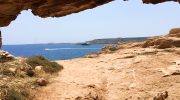
The Konnoi to Cyclops Cave trail offers a unique path through the Cape Greco National Forest Park. This route winds along the eastern coastline of Cyprus where the Mediterranean Sea meets rugged limestone cliffs. Hikers encounter a landscape shaped by volcanic activity and salt spray over millions of years. The path remains popular for those who seek natural beauty far from the crowded resort beaches. This trek provides a direct link between the famous Konnos Bay and the legendary limestone cavern known as Cyclops Cave. Each step reveals a different aspect of the island’s ancient geological history. It serves as a vital corridor for local flora and fauna. Trail Overview Location: Cape Greco National Forest Park, Ayia Napa, Cyprus Distance: 1.5 miles (2.4 km) Route Type: Point-to-Point (or Out & Back) Difficulty: Easy Elevation Gain: 130 feet (40 meters) Duration: 45 – 60 minutes Best Time to Visit: September–May or at Sunrise Terrain: Rocky, Coastal, uneven limestone The Geological Foundation of Cape Greco The region of Cape Greco consists mainly of sedimentary rock and fossilized coral reefs. This specific trail sits on a plateau that rose from the sea during the Pleistocene epoch. As you walk the path you notice the sharp edges of the calcarenite stone. This material forms the base of the entire peninsula. Wind and waves erode…

Read more
Agia Paraskevi Necropolis

Agia Paraskevi Necropolis

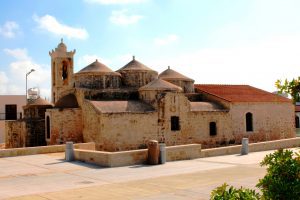
The Agia Paraskevi necropolis is an extensive Bronze Age burial ground located approximately half a mile north of the Church of Agia Paraskevi in the Nicosia district. The site occupies the edge of a plateau southwest of Cyprus's modern capital. It takes its name from the nearby Byzantine church. This cemetery was used continuously throughout the Early and Middle Bronze Age periods, roughly from 2400 BCE to 1100 BCE. The site contains hundreds of rock-cut chamber tombs where ancient communities buried their dead along with pottery, tools, jewelry, and other grave goods. These artifacts provide detailed information about how Cypriots lived, traded, and organized their societies during prehistoric times. The necropolis is particularly important because it represents the burial ground for ancient Ledra, one of the early kingdoms mentioned in Assyrian records. While the settlement itself lies buried beneath modern Nicosia, the cemetery on the plateau has survived and offers the most complete picture of life in central Cyprus during the Bronze Age. Historical Background The Agia Paraskevi necropolis came to archaeological attention in the late 19th century. In 1883 and 1884, German archaeologist Dr. Max Ohnefalsch-Richter conducted extensive excavations at the site. His work uncovered numerous tombs and established the cemetery's importance for understanding Cypriot prehistory. Ohnefalsch-Richter arrived in Cyprus in 1878 as a journalist but quickly shifted his…

Read more
St. Hilarion Castle

St. Hilarion Castle

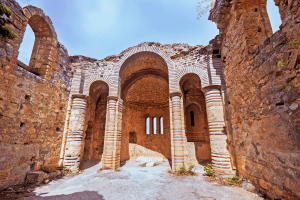
St. Hilarion Castle stands 732 meters above sea level in the Kyrenia mountain range of Cyprus. This medieval fortress features stone walls and towers that appear to grow directly from the rocky peaks. Located just off the main Kyrenia to Nicosia highway, the castle commands the mountain pass between the coast and the central plain. The castle is the best preserved of three Byzantine strongholds built along the Kyrenia mountain range, the others being Kantara to the east and Buffavento further west. The fortress consists of three main sections built at different elevations on the mountainside. The lower ward contained stables and living quarters for soldiers. The middle ward housed royal apartments, kitchens, a church, and a large cistern for water storage. The upper ward, surrounded by 1.4-meter-thick Byzantine walls made of rough masonry, served as the royal residence and includes Prince John's Tower perched on a rocky cliff. Historical Background The castle takes its name from an obscure Christian hermit who fled to Cyprus after the Arab conquest of the Holy Land in the 7th century. This saint, known for living in a cave on the mountain, is not the same as the more famous St. Hilarion, who was active in Palestine and died near Paphos in 371 AD. Local tradition holds that the hermit spent his final years…

Read more